the maximum towing capacity of your towing vehicle should not be exceeded. The towing capacity of your vehicle
can be found in the tow vehicle's Owner's Manual.
Use of a hitch with a load rating less than the load rating of the trailer can result in loss of control and may lead to
a serious accident. Ensure that your hitch and tow vehicle are rated for the Gross Vehicle Weight Rating (GVWR)
and tongue weight of your trailer.
•Overloading and/or improper weight distribution
The total weight of the load you put in or on the trailer, plus the empty weight of the trailer itself, must not exceed
the trailer's Gross Vehicle Weight Rating (GVWR.) If you do not know the empty weight of the trailer plus the car-
go weight, you must weigh the loaded trailer at a commercial scale. In addition, you must distribute the load in the
trailer such that the load on any axle does not exceed the Gross Axle Weight Rating (GAWR.) The GVWR and
GAWR are located on the OEM certification and VIN label attached to the front frame of the trailer.
Never exceed the trailer Gross Vehicle Weight Rating or the Gross Axle Weight Rating. Do not load a trailer so
that the weight on any tire exceeds its rating.
Improper front/rear load distribution can lead to trailer sway and poor handling conditions. Undesirable trailer
sway results from tongue weights that are too low, while tow vehicle instability results from tongue weights that
are too high.
Uneven left/right load distribution can cause tire, wheel, axle or structural failure. To the extent possible, be sure
your trailer is evenly loaded left/right. Towing stability also depends on keeping the center of gravity as low as
possible.
Make certain the tongue weight is within the allowable range. Keep the center of gravity as low as possible.
•Unsecured loads
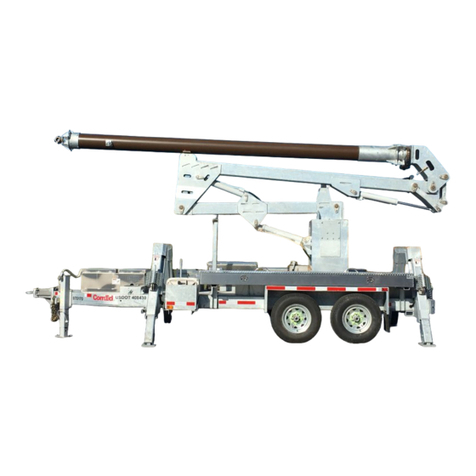
Your trailer may be designed for specific cargo, such as reels, or poles. If your trailer is designed for specific car-
go, do not carry any other cargo such as people, hazardous substances or containers of flammable materials.
It is important to avoid shifting cargo. The trailer ride can be bumpy and rough. Securing cargo so that it does not
shift or bounce out of the trailer is imperative. Tie down all loads with proper sized fasteners. Always secure doors
or lids if present on your trailer by securing it's latch.
•Improper braking and steering under sway conditions
When towing a trailer, you will have decreased acceleration, increased stopping distance, and increased turning
radius. The trailer will change the handling characteristics of your towing vehicle, making it more sensitive to
steering inputs and more likely to be have its stability affected in windy conditions or when passed by large vehi-
cles. You will also need to adjust driving accordingly, i.e. taking a longer distance to pass and allowing for in-
creased braking distances, etc.
Common sense measures may be necessary, such as; being alert for slippery conditions, anticipate trailer sway
and be ready to reduce speed, use small, trim-like steering adjustments to re-gain control, check rear view mirrors
frequently to evaluate trailer towing and traffic conditions, use a lower gear when driving downhill or on long
grades, be aware of your trailer height at all times, especially when approaching bridges and roofed areas.
•Improper or incorrect coupling of the trailer to the hitch
It is critical that the trailer be securely coupled to the hitch, and that the safety chains and emergency break-away
cable (electric brakes) and air hoses (air brakes) are correctly attached. Uncoupling of the trailer during transit can
lead to a serious accident or a fatality.
This information is the property of Sauber Mfg. Co. and is intended for customer use only.
Operation & Maintenance Manual
Model 1580-TBA Tilt-Bed Trailer
10/2014
Page 2