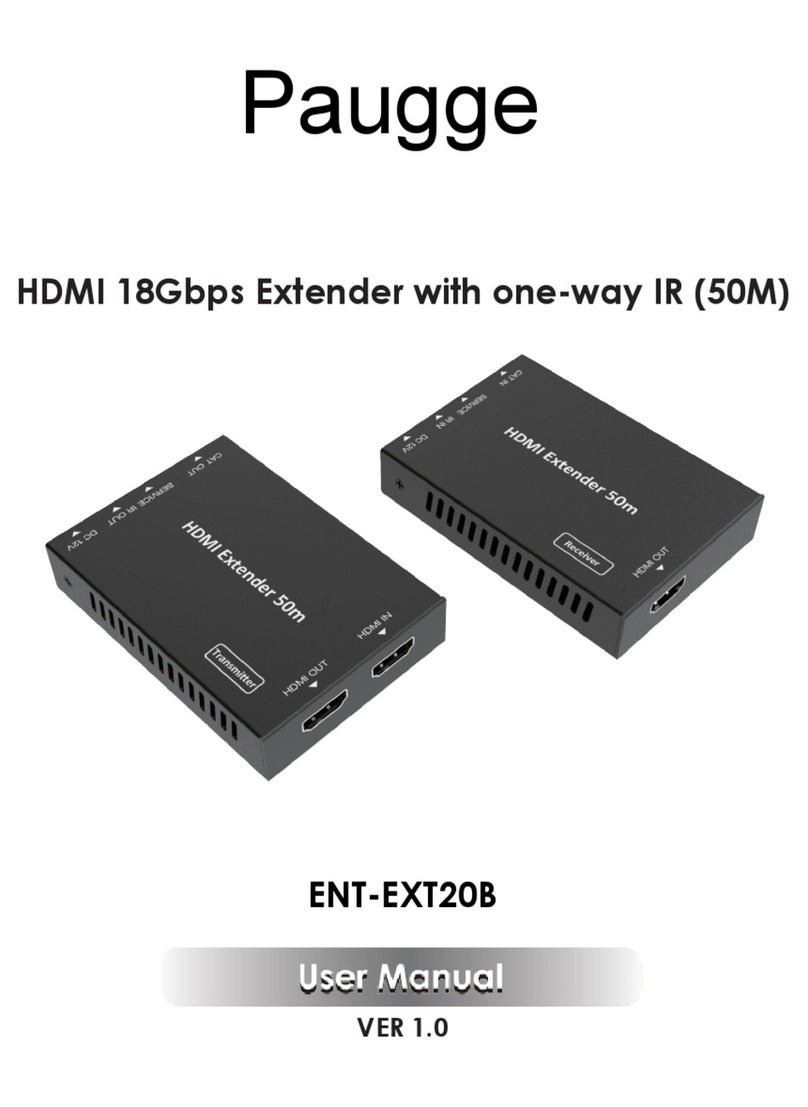
“hue” LED lights via the “hue” bridge. The P44-DSB-E is connected to the
Digital Strom server via an Ethernet network link.
Safety instructions
Only trained experts are authorised to install and commission the
device. Country-specific regulations must be adhered to.
The device may only be operated in dry, closed rooms and must not be
used directly or indirectly for health or life-saving purposes or for pur-
poses where a device failure could lead to danger for people, animals
or material property.
The device is to be mounted such that it is protected from access by
unauthorized persons as well as from dust and debris entering the
venitilation slots.
The device produces heat. The device must be installed in a way such
that there is sufficient air circulation to dissipate the heat to the
environment and keep the device from overheating.
Installation
1. Mount the device at a suitable location. The device contains an
Enocean radio interface which does not work at all or does not work
properly when the device is mounted within metallic enclosures (such
as fuse box).
2. Connect the device to the same local network where the Digital Strom
server is also connected to. The device receives the IP configuration
via DHCP. To install firmware updates, the local network must also
provide access to the internet - for normal operation of the device
however internet access is not required.
3. Connect power (5V DC) to the USB micro power connector (5V USB
power supply included).
4. The red “POWER” LED (at short edge of the device) should be on
whenever power is applied.
5. The green “BUSY” Activity-LED will flicker during startup of the device,
but then stays off as soon as the device is fully ready for operation, only
with occasional short flashes indicating activity (such as receiving a
signal from a sensor or button).
Connection to the Digital Strom System
The connection to the Digital Strom-System is automatic. The Digital Strom
server (Version 1.9 or newer) and the P44-DSB-E only need to be connected
to the same local IP network.
Preferably, use a regular Ethernet switch to connect dSS and P44-
DSB-E and not directly the ports of routers of the internet service
provider, as unfortunately, those often block part of the network traffic
(IP multicast) causing dSS connection to fail.
Using the web interface, a network expert may set static IP/gateway/DNS
configuration when required.
Web Interface
The device itself does not have user
interface elements; all configuration is done
via the built-in web interface.
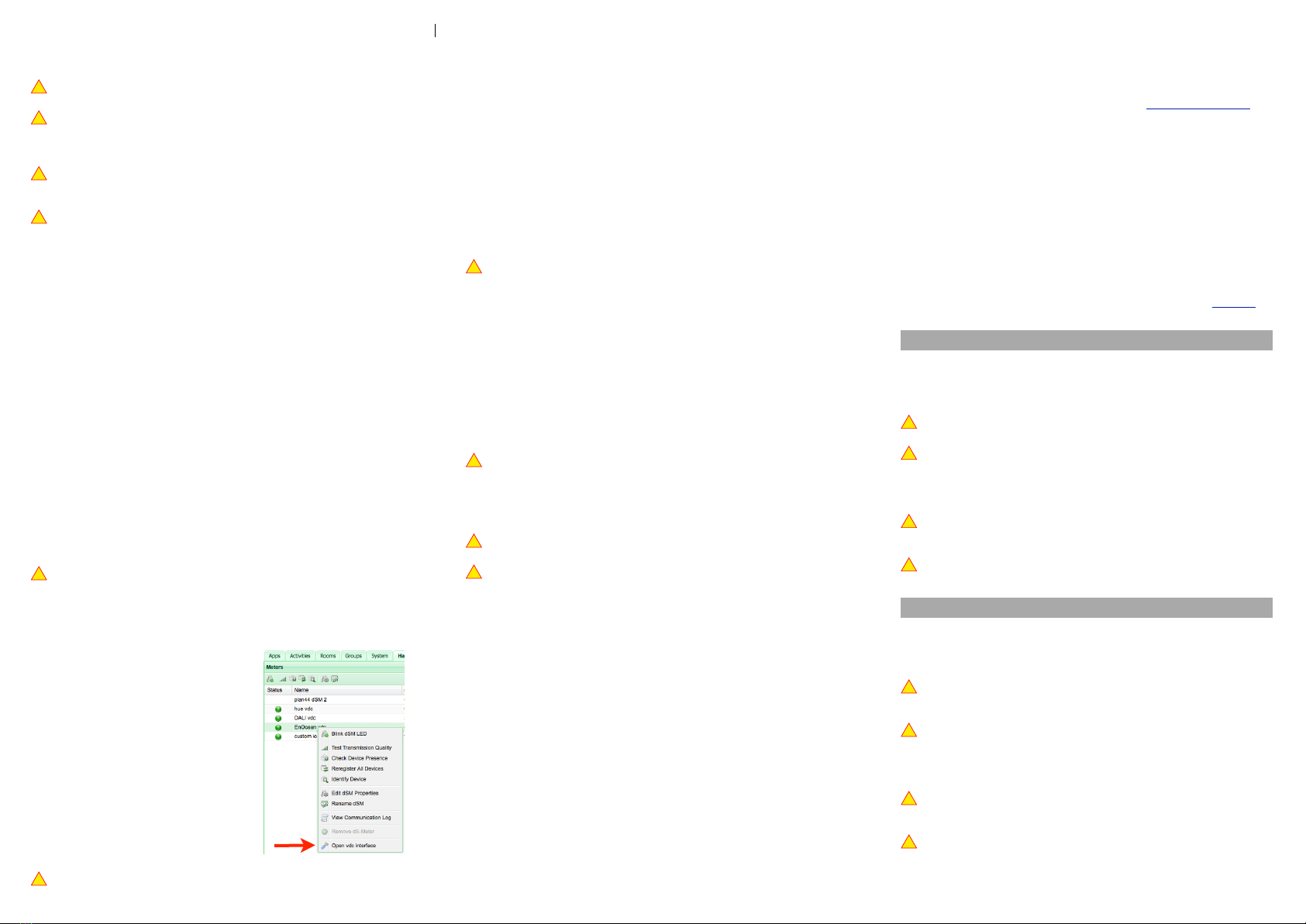
As soon as the device has been recognized
by the Digital Strom system, the Digital
Strom web configurator (“Advanced View”,
“Hardware” tab, List of “Meters”) will show
an entry per device class (EnOcean, hue).
Via the context menu the web interface of
the P44-DSB-E can be opened in a new
browser window/tab.
In addition, the P44-DSB-E web interface
can be reached directly from the “Bonjour”
bookbark menu in Bonjour enabled web
browsers (Safari).
The web interface is proteced from
unauthorized access by a login. The user name is “vdcadmin”, and the
default password is also “vdcadmin”. It is strongly recommended to
change the password (on the “System” tab in the P44-DSB-E web
interface).
Updating the Firmware
To make sure the device has up-to-date firmware, it is recommended to
perform a firmware upgrade as a first step:
1. Device needs to be powered and ready for use, and needs to have
access to the internet via local network with DHCP.
2. Open the web interface of the P44-DSB-E.
3. In the “System” tab, press the “Check for firmware update” button.
4. If a new firmware version is available, it will be displayed an can be
installed by pressing the “Update now” button.
5. Installation takes 1-3min, depending on the speed of the internet
connection. During the entire update process, the green “BUSY” LED is
steadily on. After firmware update is complete, the device will restart
automatically.
Do not disconnect power during firmware update! Otherwise, the
system software might get damaged and the device needs to be
replaced. Interrupts in the internet connection however are not critical
but may just abort the update process and require that the update must
be started again.
Adding or removing EnOcean Buttons
1. Open the web interface, “Devices” tab
2. Press the “Device learn in/out..” button.
3. Withing 20 seconds, bring an EnOcean rocker switch near the P44-
DSB-E (less tha 30cm, best is just touching the devices)
4. Operate the EnOcean button
5. A message appears indicating when the button was added or (when
already connected before) removed from the system.
Using the “Learn buttons w/o proximity check..” button it is possible to
add buttons from distance. You need to make sure that no other
EnOcean button is operated accidentally within the radio range of
the system, as these would be falsely added or removed. Therefore
using this feature in environments with many EnOcean devices this
expressedly not recommended.
EnOcean rocker switches appear in the Digital Strom konfigurator as
two (with 4 rockers: four) independent up/down Digital Strom buttons.
EnOcean switches with a single rocker are technically 2-rocker
switches as well (only the changeable plastic cap is different), so these
also appear as 2 Digital Strom buttons in the system.
Adding or removing other EnOcean components or hue
bridge
1. Use the component’s documentation to find out how learn-in is
triggered for the device. Some devices have a special “learn” button,
others have a marked spot where a magnet needs to be held close to
activate learn-in. For the hue bridge, the center button triggers the learn
in and out.
1. Open the web interface, “Devices” tab
2. Press the “Device learn in/out..” button.
3. Within 20 seconds, trigger the learn activity at the component.
4. A message appears indicating when the component was added or
(when already connected before) removed from the system.
If no message appears, the component may not (yet) be supported by the
P44-DSB-E, or the radio distance to the component is too high or obstructed
by shielding walls (concrete, metal) etc.
A list of all supported components can be found on the plan44.ch website.
Guarantee
plan44.ch guarantees fault-free operation of this device according to the
specification for 24 months after delivery by plan44.ch. Opening the device,
other interference with the device, or incorrect installation/configuration will
invalidate the guarantee.
Technical data
Name: P44-DSB-E
GTIN: 7640161170025
Manufacturer: plan44.ch, CH-8048 Zürich, plan44.ch/automation
Dimensions: 94mm * 63mm * 33mm
Weight: ca. 86g
Operating temp.: 0..+50 °C, indoor use in dry/closed rooms only
Raspberry Pi Model B+
Network: 10/100 MBit/s Ethernet (RJ45 8P8C)
Power supply: external power supply via USB micro, 5V/1A
Power consumption: typ. 635mA @ 5V (3.2W)
Regulations: RoHS 2011/65/EU, EMC 2004/108/EG
EnOcean Pi (TCM 310)
Antenna: internal “whip” wire antenna
Frequency: 868.300 Mhz (ASK)
Radio standard: EnOcean 868MHz: ISO/IEC 14543-3-10
Radio signal: typ. 3dBm @ 868MHz
Regulations: R&TTE EN 300220 (TCM 310), RoHS 2011/65/EU
Subject to technical modifications. Up-to-date information available at plan44.ch
plan44.ch Digital Strom bridge pour EnOcean
Instructions de sécurité
Seuls des spécialistes formés sont autorisés à installer cet appareil et à
le mettre en service. Respecter les directives nationales en vigueur.
L‘appareil ne doit être utilisé que dans des locaux secs et fermés et non
à des fins (directement ou indirectement) à risque pour la santé ou
pouvant entraîner la mort, ni à des fins pour lesquelles une panne de
l‘appareil peut présenter un danger pour les personnes, les animaux ou
les biens matériels.
L'appareil doit être installé de manière qu'il soit protégé contre les
accès par des personnes non autorisées de même que de la poussière
et de débris d'entrer dans les fentes de venitilation.
L'appareil produit de la chaleur. L'appareil doit être installé de manière
à permettre une circulation d'air suffisante pour dissiper la chaleur a
l'environnement pour eviter la surchauffe de l'appareil.
plan44.ch Digital Strom bridge per EnOcean
Avviso di sicurezza
Il dispositivo deve essere installato e messo in funzione solo da
personale tecnico specializzato e appositamente formato. Osservare le
direttive specifiche vigenti a livello nazionale.
il dispositivo deve essere attivato solo in ambienti chiusi e asciutti e non
deve essere utilizzato né direttamente né indirettamente per la
protezione della vita o della salute o per qualsiasi altra finalità per cui
un guasto del dispositivo stesso possa determinare un pericolo per
persone, animali o beni materiali.
Il dispositivo deve essere installato protetto dall'accesso di persone non
autorizzate e contro corpi estranei che possono entrare attraverso le
aperture di ventilazione.
Il dispositivo produce calore. Il dispositivo deve essere installato in
modo tale che vi sia sufficiente circolazione d'aria per dissipare il calore
all'ambiente per evitare il surriscaldamento del dispositivo.
P44-DSB-E-manual, 2023-11-11 © 2015-2023 plan44.ch