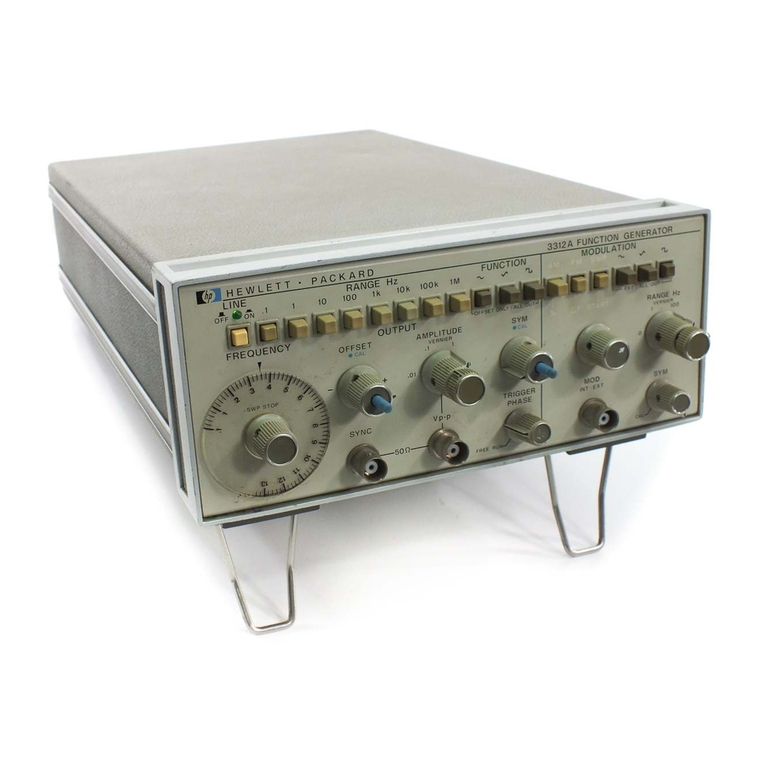
POTOMAC INSTRUMENTS INC. AG-51 User manual

www.SteamPoweredRadio.Com
WARRANTY
FOR EQUIPMENT
AND
ACCESSORIES
Potomac Instruments Inc. warrants each new equipment
to
be free
of
defects in material
and workmanship,
for
a period
of
one (
1)
year after date
of
original shipment, except
for
fuses, transistors, diodes, and integrated circuits,
which
are warranted
for
a period
of
ninety
(90) days.
Any
instrument
which
is
found
within
one year
not
to
meet
the
fore-
going standards
after
examination
by
our
factory,
will
be
repaired
or
at
the
option
of
Potomac Instruments replaced
without
charge. This warranty does
not
apply
to
equip-
ment
which
has
been altered,
improperly
handled,
or
damaged in any way.
CHANGES IN SPECIFICATIONS
The
right
is
reserved
to
change
the
published specifications
of
equipment
at
any time, and
to
furnish merchandise in accordance
with
current
specifications,
without
incurring any
liability
to
modify
equipmentpreviously sold.
RETURNING
EQUIPMENT
TO
THE
FACTORY
Factory service is available
for
repair and adjustment
of
this
instrument; however, a
des-
cription
of
the
troub
le, plus
the
model and serial number(s)
of
the
unit
should be
for-
warded first, whereupon instructions
for
correcting
the
troub
le
or
authorization
for
returning the equipment
will
be given. This applies
to
all units, whether under warranty
or
not.
Shipment
in
an
improper
container may result
in
damaged equipment thereby
voiding warranty.

www.SteamPoweredRadio.Com
TAB
LE
OF
CONTENTS
Paragraph Title
Page
SECTION
1 GENERAL
DESCRIPTION
l.l
Function
1-1
1.2 Electrical Characteristi
cs
1-1
1.3 Specifications
1-
1
SECTION
2
OPERATING
INSTRUCTIONS
2.1
lnstallation
2-1
2.2 Controls and Indicators 2
-1
2.3 Connectors 2-4
2.4
Fuse Location 2-4
2.5 Operating Procedures 2-4
2.5.l
Tum
-
On
Procedure 2-4
2.5.2
Output
Mode Selection 2-5
2.6
Application
Not
es 2-5
2.6.l
Distortion Measurements 2-5
2.6.2
Output
Circuit and Termination 2-5
2.6.3 StereoTests 2
-6
2.
6.4
Equipment Performance Measurements 2-6
2.6.5 Grounding 2-6
SECTION
3
TH
EORY
OF
OPERATION
3.1 Overall Description
3-1
3.2
Detailed Theory
of
Operation
3-1
3.2.1 Variable Frequency
Wien
Bridge Oscillator
3-1
3.2.2 Fixed Frequency Wien Bridge Oscillators 3-3
3.2.3 Power Amplifier 3-3
3.2.4
Output
Monitor 3-3
3.2.5
Output
Attenuator Switching 3-3
3.2.6
Output
Mode Switching 3-3
3.2.7 Test/Operate Switching 3-4
3.2.8 Regulated Power Supply 3-4
SECTION
4
MAINTENANCE
4.1 General
4-1
4.2 Periodic Maintenance
4-1
4.3 Alignment Procedure/Performance Test
4-1
4.3.1 Power Supply
4-1
4.
3.2
Oscillator Pre-Amplifier,
A6
4-1
4.3.3
Control
Amplifier
Board,
A7 4-2
4.3.4
Output
Monitor, Buffer Amplifier,
AS
4-3
4.3.5 IM/WF Signal Generator,
A4
4-3
4.3.6
AG-5J Overall Performance Test 4-4
4.4
Troubleshooting,General 4-5
4.5 Circuit Module Troubleshooting 4-6
4.5.1 General 4-6
4.5.2
Power Supply
Al
4-6
4.5.3 Power Amplifier/Inverter A2, A3 4-6
4.5.4 IM/WF Generator,
A4
4-6
4.5.5 Buffer Monitor,
AS
4-9
4.5.6
Oscillator Preamp, A6 and Control Amp, A7 4-9

www.SteamPoweredRadio.Com
LIST
OF
TABLES
Table Title
Page
4.1 AG-51 Performance Test
4.4
4.2
Voltage Readings,Power
Amp
/Invert
er
A2
and
A3 4.9
4.3 Voltage Readings, IM/
WF
Generator,
A4
4-10
4.4
Voltage Readings,
Output
Mo
nitor
/
Attenuat
or
Buffer,
AS
4-10
4.5
Voltage Readings, Wien Brid
ge
Oscillator
Pr
e Amp, A6 4-10
4.6
Voltage Readings,
Control
Amp, A7
4-11
4.7
Voltage Readings, Po
wer
Supply AJ
4-11
4.8
Parts
Li
st, AG-51 Chassis 4-29
4.9
Parts List, Power Supply PCB Assembly,
Al
4-30
4.10
Parts List, Po
wer
Amp
/
invert
er
PCB Assembly, A2, A3
4-
31
4.11
Part
s List, fM/WF Signal G
enerator
PCB Assembly,
A4
4-32
4.12
Parts List,
Ou
tp
ut M
on
itor
/B
uffer Amp PCB Assembly,
AS
4.33
4.13
Parts List, Oscillator Pre-Amp PCB Assembly, A6
4.34
4.14
Parts List, Control
Amp
PCB Assembly 4-35/4-36
LIST
OF
ILLUSTRATIONS
Figure
Title
Page
2.1 AG-5 l Controls
and
Indicators 2-2
3.1
AG
-51
Block Diagram 3-2
4.1
Troubleshooting Chart,
Outpu
t Leve
l/
Distorti
on
4-7
4.2
Generator
Frequency
Troubleshooting Chart 4-8
4.3
Circuit Module and
Test
Point Location, AG
-S
I 4-12
4.4
Switch
Configurations 4-13
4.5
Component
Location, Power Supply,
Al
4-14
4.6
Schematic Diagram, PowerSupply,
Al
4-15
4.7
Component
Location, Power Amp/Inverter,
A2,
A3 4-16
4.8
Schematic Diagram, Power
Amp/
lnverter, A
2,
A3 4-17
4.9
Component
Lo
cation,
IM/WF Siganl Generator,
A4
4-18
4.10
Schematic Diagram,
IM
/WF Signal G
ener
ator
,
A4
4-19
4.
I I
Component
Location,
Oulput
Monito
r/
Buffer
, AS 4-20
4.12
Schematic Diagram,
Output
Monito
r/
Buffer, A5 4-21
4.13
Component
Location, Oscillator
Pr
e-Amp, A6
4-22
4.14
Schematic Diagram, OscillatorPre-amp, A6 4-
23
4.15
Component Locati
on,
Control
Amp
, A7 4-24
4
.1
6
Schematic Diagram,
Control
Amp, A7
4-25
/
4-26
4.17
Wiring Diagram, AG-51 4-27/4-28
11

www.SteamPoweredRadio.Com
1.1 FUNCTION
SECTION 1
GENERAL DESCRIPTION
Th
e Model AG-5 l Audio
Generator
furnishes audio signa
ls
from
+20
dBm
to
-
79.9
dBm* over
the
frequency range
of
20
Hz
to
200
kHz
to
a
600-ohm
load. At a
150
-
ohm
load,
the audio signal levels
are
O
dBm
to
-
99.9
dBm.
The
maximum
output
level is
monitored
and
can
be
verified
by
a built-in test.
1.2
ELECTRICAL
CHARACTERJSTICS
The
Model AG-5 I generates l
ow
distortion sine wave signals
from
20
Hz
to
200
kHz
in
four
decade ranges.
Frequency
of
the
output
signal is indicated
by
a calibrated dial
and
a range multiplier.
Calibration accuracy is
better
than
±3%
.
It
also generates
an
intermodulation
distortion
test
signal
of
60
Hz and 7
kHz
mixed
in a
4:
l ratio. Additionally,
it
generates a fixed sine wave frequency
of
3.15
kHz
for use
in
wow and
flutter
measurement.
The
output
attenuator
is
calibrated in 10, I
and
0.1 decibel
steps. When
the
AG-5 l is
connected
to
a
600-ohm
resistive load,
the
maximum
power
output
is
+20
dBm*
which
may
be
verified
by
the
buj\t-in
test
feature.
Separate
left
and
right channel
outputs
are provided, with switch-selected in-phase, inverse-
phase, left-only
and
right-only
output
signals
to
facilitate a variety
of
stereo broadcast system performance
measurements.
1.3
SPECIFICATIONS
Frequency
Rang
e:
Outputs:
Output
Impedanc
e:
Unbalanced:
Fully
balanced:
Output
Level:
Sine
Wave
Signals:
IM
Signal:
Output
Level Accuracy:
20
Hz
to
200
kHz
in
four
decade ranges.
LEFT
only,
RIGHT
only,
LEFT
and
RIGHT
in
phase
(L&R),
or
LEFT
and
RIGHT
180°
out
of
phase
(L-R); switch selected
IM composite
60
Hz and 7
kHz@
4:
1 ratio (SMPTE
standard)
3.
15
kHz
fixed
wow
&
flutter
signal
(IEEE
Standard
193-1971)
150
ohms
or
600
ohms;
switch selected
150
ohms
or
600
ohms;
switch selected
(No
Attenuation)
+20
dBm*
(7.
75V)
across
600
ohm
load, 15.SV
open
circuit
0 dBm (.387V) across
150
ohm
load,
0.774V
open
circuit
P
ea
k-to
-
peak
voltage
of
composite waveform is
equal
to
peak-to-
peak
voltage
of
+20
dBm sine wave across
600
ohm
load, 0 dB
sine wave across 150
ohm
load.
20
Hz
-
100
kHz,
±0.2
dB
100
kHz
-
200
kHz
,
±0.5
dB
*Units
with
serial
numbers
133
and
below have a
maximum
output
le
ve
l
of+
18
dBm
(6.15V
RMS)
and
and
minimum
output
level
of
-81.9
dBm.
1-1

www.SteamPoweredRadio.Com
1.3
SPECIFICATIONS
(Cont.)
Attenuator
Range:
Attenuator
Accuracy:
0
to
10
dB:
>
10
dB:
Intrinsi
c
Distortion*
:
Harm
on
ic
50
Hz
to
7.5
kHz
20
ll
z
to
20
kHz
I
ntermodulation
Incide
ntal
FM
(3.15
kHz)
Hum
and
Noise:
Dial
Accuracy:
External
Pow
er:
Dimensions
with
cover,
cm
(in):
Rack
mount
space
with
rack
mount
option
Weight
with
cover, kg Obs):
0
to
99.9
dB
in
0.1 dB
steps
±
1.5%
of
attenuation
in
dB
±0
.2
dB
(max.)
Low
Distortion
<
.05
%
<
.08%
<
.0
3%
<
0.01
%
>
80
dB
below
rated
output
±3%
Fast
Response
< 1%
< 2%
117 VAC,
(230
V
AC
option)
50
or
60
H
z,
9
Watts
38
.
74
(15-1/4)
wide,
13.34
(5-1
/4)
high,
25
.75
(10-1/8)
deep
5¼
inches
5.44
(I
2)
*Slightly
higher
at
R
output
in
L-R,
UNBAL
mode
.
1-
2

www.SteamPoweredRadio.Com
2.1 INSTALLATION
SECTION 2
OPERATING INSTRUCTIONS
The Model AG-
51
is ready
for
operation
as
delivered, and need only be connected
to
an
AC
power
source.
WARNING
The
AG-51
must
be used with a 3-prong U-grounded
receptacle outlet. Failure to use a grounded
outlet
may
result
in
improper
operation
or
safety hazard.
2.2
CONTROLS AND INDICATORS
The
following controls and indicators are identified
on
Figure 2-1.
2.2.1 POWER Switch
(SI)
Applies
AC
power
to
the
unit when in
the
ON
position.
2.2.2 POWER Indicator
(DSl)
Illuminates
to
indic
ate
the
presence
of
main
DC
(+30V) power.
2.2.3
FREQ Range Switch (S2)
In the
XI
,
XI
0, X100 and
XI
000
positions, S2 selects
the
variable frequency
output
.
The
setting
of
this switch indicates
the
multiplier
for
the
calibrat
ed
FREQ
dial
(Cl).
In
the
IM SIG position, S2 selects
the
special
IM
distortion
test
signal (60
Hz+
7 kHz)
output.
The
FREQ dial
(C
1) has
no
effect
when
S2 is
in
this position.
In
the
3.15
kHz
position,
S2
selects
the
3.15
kHz
wow
and
flutter
test
signal.
This
signal
is
afixed frequency; thus, the FREQ dial
wiJI
have no effect
when
this position
is
selected.
2.2.4
FREQ Dial
(Cl)
This calibrated dial
may
be used
to
set
the
desired
output
frequency
with
an accuracy
of
±3
%,
when
the
FREQ
Range Switch
is
in
the
Xl
, XIO, XlOO
or
XlOOO
position.
The
output
frequency in
Hertz equals
the
dial setting multiplied by the
switch
setting.
2-
1

www.SteamPoweredRadio.Com
S2
XI
LOWOIST
---
-
FRCOI----
3JS
....
FAST
RCSPONSE
..
°"
[!]
C1
S7
8AI.
UNBAL
Lt:.J
S3
/
·•'f'\,.__,_..,..
_____
_jli
____
,
.,...
___
,_
__
~
001
~
I..
Fl
AlJfllO
IA.N~HA!llof
!'l'l'I
AC
•,1
'.'J!ll.Al-
1'0
Af
~I
'SV!>HIJI
KHOM-'C
INSTmJ.l,U
MIS,
I~
--"l\'I.R~~
lilll
•HVA.'..
11,o\
J9
S6
OS2
S4
FRONT
PANEL
AC
OUT
REAR PANEL
S8
Figure 2.1. AG-51 Controls a
nd
Indicators
2-2
S10
S9
l
OUT
ROUT
+2008M
MAX
• '
J7
JS
GROUND

www.SteamPoweredRadio.Com
2.2.S LOW
DIST/FAST
RESPONSE Switch
(S3)
In
the
FAST
RESPONSE position, this
switch
selects a
shorter
time
constant
for
the
automatic
gain
control
circuits associated
with
the
variable frequency oscillator. This position provides fast
correction
of
amplitude
as
the
frequency is varied,
but
causes higher
distortion.
The
LOW
DIST setting
of
S3 will insure
the
lowest
distortion
throughout
the
frequency
range
of
the
AG-51,
but
will allow
some
momentary
change
in
output
amplitude
if
the
frequency is changed
rapidly.
2.2.6 TEST/OPERATE Switch (S4)
The
TEST/OPERATE
Switch
may
be
placed
in
the
TEST
position
to
activate a
test
of
the
basic
output
signal level.
Indicator
DS2 will illuminate
if
the
signal level
is
correct
within
±0.5
dB. This
test
may
be
used with
any
setting
of
the
FREQ
Range Switch
or
FREQ
dial.
When
S4
is in
the
TEST
position
,
the
output
levels go
to
zero while
th
e correct impedance is
maintained.
Thus
,
S4
can
be
used to remove
and
reapply a
test
signal.
2.2.
7 TEST
Indicator
(DS2)
This
indicator
is used in
conjunction
with
the
TEST/OPERA
TE
Switch
and
illuminates
to
indicate
correct
generator
output
signal level (±0.5 dB).
2.2.8 BAL/UNBAL Switch (SS)
The
BAL/UNBAL Switch is used
to
select
either
balanced
or
unbalanced configurations
of
the
generator
outputs
at
the
LOUT
and
ROUT
connectors. With S5
in
the
BAL
pos
ition, an
output
signal
will
be
supplied across
pins
1 and 3
of
each
jack,
balanced
with
respect
to
ground.
The
connector
shell
is grounded
to
the
chassis. When S5 is in
the
UNBAL
position
,
the
output
signal is supplied
on
pin 3
of
each
jack
,
with
pin
1
at
chassis
ground
.
In
both
positions
the
same voltage exists between pins 1
and
3.
2.2
.9 OHMS
Switch
(S6)
S6 is used
to
select
either
600
Ohm
or
150
Ohm
output
impedance. When
the
600
Ohm
impedance
is selected, t
he
generator
output
into
a
600
ohm
load
(zero
attenuat
i
on)
will
be
+20
dBm*
for
all frequencies.
Generator
output
with
S6
in
the
150
Ohm
position
is
OdBm
into
a
150
ohm
load
(zero
attenuation).
·
2.2.10 OUTPUT
Se1ect
Switch (S7)
This
switch
selects
the
following
output
configurati
ons
at
J7
(LOUT)
and
J8
(ROUT):
a. L
pos
ition -provides
generator
output
at
J7
or
left
channel only;
(ROUT)
output
is
zero
at
the
correct
impedance.
b. R position -provides ge
nerator
output
at
J8
or
right
channel
only;
(LOUT)
output
is
zero
at
the
correct impedance.
*+
18
dBm
for
serial
numbers
133
and
below.
2-3

www.SteamPoweredRadio.Com
2.2.11
c.
L+R
position
-provides in-phase
output
signals
on
both
channels.
d.
L-R
position
-provides signals
of
opposite phase
(180°
out)
on
right
and
left
channe
ls;
the
L
signal is unchanged, while
the
R
signal is reversed
in
phase.
ATTENUATOR
Switches:
-10
dB
Steps
(S8),
1
dB
Steps
(S10);
0.1
dB
Steps
(S9):
When the
150
Ohm
output
impedance is selected (S6), genera
tor
output
level
may
be
set
directly
in
-dBm
by
using
SB
for
the
tens
digit,
S10
for
the
ones digit,
and
S9 for
tenths.
If
the
600
Ohm
output
impedance is being used, the
ATTENUATOR
settings
show
the
amount
of
attenuation,
in
dB,
being applied
to
t
he
basic
output
level
of
+20
dBm. Thus,
for
an
output
of
+2
dBm
at
600
Ohms
im-
pedance,
the
ATTENUATOR
Switches would be
set
for
18.0
(10
on
S8, 8
on
SlO
and
0
on
S9).
For
-
units
with
serial
numbers
133
and
below,
the
unattenuated
output
level
is+
18
dBm;
thus
an
attenuator
setting
of
I8
would result in
an
output
level
of
O
dBm.
Note
that
turning the switches clockwise in-
creases
the
output
level; turning
them
counterclockwise decreases
the
output
level.
2.3
CONNECTORS
Front
and
rear
panel
connectors
are identified
in
Figure 2-1.
Two
audio
output
connectors,
J7
(LOUT)
and
J8
(ROUT)
,
are
provided
on
the
front
panel.
The
mating
connec
tor
for
J7
and
)8
is
Switchcraft
part
no.
05CL3M,
available from Switchcrnft dis-
tributo
rs or
Potomac
Instruments.
AC
input
(J9)
and
AC
output
connectors
are
provided
on
the
rear
panel, as well as a binding
post
for
chassis ground.
2.4
FUSE
LOCATION
A 1
/8
amp,
250V
fuse is accessible in a
sc
rew-type
holder
on
the
generator
r
ea
r panel.
2.5
OPERATING
PROCEDURES
2.5.1
Turn-On
Procedure
To
place
the
Audio
Generator
into
operation,
proceed as follows:
a.
Check
that
the
power
switch
is
in
the
OFF
position.
b.
Check
that
the
nameplate
AC
supply
voltage
rating
agrees
with
the
supply
voltage source
to
be
used
;
if
so,
connect the
power
cord.
c.
Tum
power
sw
it
ch
to
ON. The
power
indfoator should light, i11dicating
that
power
is
applied
to
all
circ
uit
s
of
the
Audio
Generator.
d.
Set
the
TEST·
OPERATE switch
to
TEST.
Indicator
DS2
shou
ld light
to
verify calibrated
output
level
for
frequencies
below
20
kHz.
Return
switch
to
OPERA
TE.
Audio
Generator
is
now
ready
to
use. ·
e.
Set
OUTPUT, OHMS, BAL/UNBAL as desired.
f.
Set
ATTENUATOR
switches
for
desired
output
level.
24

www.SteamPoweredRadio.Com
g.
Set
the
FREQ
switch
to
the
desired
output
signal
or
sine wave frequency range.
h.
Connect
signals.
2.5.2
OutputMode Selection
The setting
of
the OUTPUT selector switch, S7, will depend
on
the particular application and
test set-up in which
the
generator is used. In general, differential gain and phase measurements can
be
made
on
stereo systems using
the
L+R
output
configuration and an analyzer such as
the
Potomac Instru-
ments
AA
-
51
. The L-R
output
configuration provides opposite-phase signals which can be passed through
the
equipment
under
test
and summed in a simple resistor network
to
provide a phase-sensitive
output
voltage; this technique
is
useful for stereo record head azimuth alignment. Any measurement involving
the
application
of
a signal alternately
to
left
and
right channels may
be
accomplished using
the
L
and
R
switch positions.
2.6 APPLICATION NOTES
2.6.1 Distortion Measurements
Harmonic
and
intermodulation distortionmeasurements in which
the
right channel
output
is
used are best made
with
the OUTPUT switch in
the
L+R position since the residual distortion
due
to
the AG-51
is
lowest
in
this mode. The residual distortion
may
also
be
slightly reduced by maintaining
a minimum
of
1-2 dB
attenuation
in
the
I dB-per-step attenuator.
2.6.2
Output Circuit and Termination
The
AG-5
I
output
circuit does
not
contain a transformer.
To
understand its operation, how-
ever,
the
output
terminals (connector pins I and 3) may
be
thought
of
as being driven
by
a center-tapped
transformer winding. In
the
UNBAL mode, pin
J,
or
one side
of
this imaginary transformer winding, is
grounded
to
the
chassis; in
the
BAL mode, the center-tap is grounded
to
the
chassis. In
both
cases,
the
open-circuit voltage between pins 1 and 3 is
the
same,
and
the
source impedance between pins 1 and 3 is
600
ohms
or
150 ohms, as selected
by
the OHMS switch. Any load may be driven without affecting
the
AG-51
's
distortion,
but
the
output
level obtained
by
subtracting
the
attenuator
di
al
settin
gs
from +20 dBm
or
0 dBm is correct only for
the
terminations
of
600
ohms
or
15
0 ohms, respectively.
On
the
test
cable supplied
with
the
AG-51, connections are indicated by the color
of
the
alligatorclip insulators; red is pin I,
blue
is pin 3 and black is
the
cable shield, which
is
grounded
to
the
chassis.
The
output
voltage across
any
load resistor
RL
can be calculated from
the
formulas:
e0 = .7746 2Rt antilog p (600 ohms)
600+RL
20
e0 = .387
2RL
antilog p (150 ohms)
IS0+RL 20
where
Pis
the power in dBm obtained by subtracting
the
attenuator
switch settings from 20 (600 ohms)
or
zero (150 ohms).
2-5

www.SteamPoweredRadio.Com
For
unbalanced
loads,
use
the
UNBAL AG-51
mode.
If
the
load
has
an
input
transformer
with
a floating
primary
winding,
either
UNBAL
or
BAL
mode
may
be
used
.
If
the
input
transformer
primary
winding
has
a
grounded
center
tap
,
however,
the
BAL
mode
must
be used.
For
600
ohm
operat
ion
the
test
cable
capacitance
reduces
the
AG-5 1
output
at
20
0
kHz
by
0.6
d B
with
no
load,
or
0.15
dB
with
a
600
ohm
load.
At
150
ohms
this
effect
is negligible.
2.6.3
Stereo
Tests
With
the
LOUT
and R
OUT
terminals
connected
to
the
inputs
of
a
stereo
generator
or
excit
er
,
various
tests
can
be
performed
using
the
modes
of
operation
selected
by
the
OUTPUT
switch.
Th
e L+R
mode
yields
main
carrier
modulation
without
subcarrier
modulation
(L-R
:o:
zero),
while
the
L-R
mode
yields
subcarrier
modulation
without
main
carrier
modulation
(L+R =
zero).
Th
ese
modes
are useful
for
modu
-
lator
adjustments
and
for
main
/
sub
and
sub/main
crosstalk
measur
eme
nts.
The
L (R =
zero)
and
R
(L
=
zero)
modes
are
us
ef
ul
for
cross
talk
and
separation
measurem
ents.
2.6.4
EquipmentPerformance Measurements
Equipme
nt
P
erformance
Measurements
(EPM)
to
determine
a
broadcast
facility's
audio
per-
formance
are
required
by
the
FCC
and
described
in
various
sections
of
the
FCC
Rul
es,
Part
73.
These
tests
are
commonly
ref
e
rred
to
as
an
"Audio
Proof''
although
the
FCC
pref
ers
to
use
the
term
"Proof'
only
for
mea
s
urements
to
verify
th
e
performance
of
AM
directional
antenna
systems. Useful guides
to
these EPMs
for
AM
and
FM
stations
have
been
prepared
by
Broadcast
Engineering Magazine
and
ar
e
available
from
Broadcast
Engineering, P.O.
Box
1290
I, Overland
Park
, Kansas
66212.
2.6.5
Grounding
When
the
AG-51
power
co
rd
is
plugged in,
the
chassisis
connected
directly
to
the
AC
power
neutral
line
through
the
third
wire
of
the
power
cord
.
This
may
or
may
not
provide
minimum
power-
frequency
(hum)
pickup
in
the
signal
circuit
.
Often
the
AG-51 chassis
must
be
grounded
so
lidly
to
the
chassis
of
the
equipment
it
is driving
to
obtain
minimum
hum
pickup.
This
connection
may
be
made
using
the
shield
of
the
test
cable.
which
is
connected
to
the
AG-51 chassis,
or
by
using
a
separate
wire
on
the
ground
binding
post
on
the
rear
of
the
AG-5
1.
It
may
also
be
done
by
using a three-prong-to-two-
prong
adapter
for
the
AG-51
pow
er
cord,
and
connecting
the
ground
pigtail
of
the
adapter
to
the
chassis
of
the
equipment
being driven.
If
one
of
the
first
two
methods
are used
the
adapter
may
sti
ll be
required
to
break
the
power
cord
ground
connect
ion
to
obtain
minimum
hum.
In
any
case,
obs
erve
the
following
warning:
WARNING
Be
certain
that
the
chassis
of
the
AG-51 is solidly
ground
ed
to
an
earth-grounded
point
before
using
an
adapter
or
other
means
to
break
the
power
cord
ground
connection;
otherwise
, a safety hazard
may
exist.
2-6

www.SteamPoweredRadio.Com
SECTION
3
THEORY
OF
OPERATION
3.1 OVERALL
DESCRIPTION
The
electrical circuits
of
the
Model AG-
SI
are divided
into
the
sections
shown
in
the
block
diagram
of
Fig. 3.1. Briefly,
the
operation
is as follows:
a. A Wien bridge oscillator
(A6)
capacitively
tuned
over a 10:I range plus decade switching
provides
the
variable sine wave source
from
20
Hz
to
200
kHz
.
b. The
IM
signal consists
of
60
Hz
and
7
kHz
mixed in a
4:
1 ratio. These
two
frequ
enc
ies
are
generated
by
fixed
tuned
Wien bridge oscillators (A4).
c. A fixed
tuned
Wien bridge oscillatorgenerates
the
3
.1
S
kHz
frequency
(A4).
d. These sources provide
the
optional
inputs
to
the
POWER AMPLIFIER
(A2)
and
INVERTER
(A3) through
step
attenuators
S8,
S9
and
SIO.
e. In
TEST
mode,
the
attenuators
are bypassed
by
S4;
the
maximum
voltage
output
of
the
INVERTER
is
monitored
by
a window
comparator
(AS)
and,
if
correct, lights
the
LED
indicator
.
f.
Output
signal conditions are controlled
by
three switches (SS,
S6,
S7)
which establish
Land
R, BAL
or
UNBAL, 600
or
150
ohm
impedance
at
the
two
output
connectors.
g.
An
additional
stage
of
attenuation,
part
of
S8, is placed
in
the
right
and
l
eft
channel
output
lines.
The
four
switchable
attenuator
stages allow
adjustment
of
the
output
level
in
0.1
dB
,
1
dB
and
IO
dB
steps
from
a
maximum
of+
18
dBm
to
a
minimum
of
-99
.9
dBm
(1
SO
ohm
position).
3.2
DE
T
AILED
THEORY
OF
OPERATION
3.2.1 Variable Frequency Wien Bridge Oscillator (Ref. Figure 4.14, A6; Figure 4.16,
A7)
The
Wien bridge oscillator circuit is
lo
cated
on
A6. Oscillator frequency is
determined
by
Cl,
a
dual
variable capacitor,
in
conjunction
with
decade
resistors switched
by
S2.
Cl
is used
to
vary
frequency over a I
0:
1 range, while
the
resistors
are
switched
in
four
decades
to
cover
the
tuning
range
of
20
Hz
to
200
kHz.
Ql,
a
JFET,
in
combination
with
Q2, a PNP transistor, provides impedance conversion
to
isolate
the
high impedance
of
the
Wien bridge
from
the
following circuits.
One
side
of
the
bridge is grounded
and
the
other
side
must
be
provided
with
an in-phase signal
with
sufficient gain
to
overcome
the
bridge loss
es
in
order
to
oscillate. This gain is provided
by
voltage amplifier U IA
on
A7.
The
output
of
U
lA
is full
wave rectified
by
CRl,
CR2
and
U2
.
In
addition, UIA drives
the
bridge
with
the
necessary in-phase signal.
U1B compares
the
rectified signal
to
a
de
reference voltage, integrates
the
difference,
and
controls
Q1, a
voltage
dependent
resistor.
Ql,
in
conjunction
with
R4,
is an
attenuator
which adjusts
the
effective gain
of
UIA
to
just
offset the bridge losses resulting in sine wave oscillation.
The
integration
cons
tant
is switched
to
optimize
loop
stability,
distortion
,
or
response time.
The
output
of
UlA
is
low
pass filtered
by
active
filter Q3
and
Q4
(A6)
and
provided
at
a
low
imp
edance
as
the
oscillator signal
to
t
he
power
amplifier.
3-1

www.SteamPoweredRadio.Com
w
t0
A4
IM
-
W/F
GEN
,--
-
--
--
-
! u I
I
I
31
I
L__J
-
I
,
___
_ _ _
___
J
A6
OSC
PREAMP
, -
--
-
--
-
--
7
.
__
__
_
J_
-# l
FREQ
~~
, WIEN
f
I :
BR
I
DGE
I
I
I
I
I
'--
A,1
.-
1
I
I
I
I
B
--
---
-
--
-
~
_CONTR_QL
AMP
-~:r
I
J2
-4
l I
I
I
I
I
I
L
_J
I
AS
,-
'
SWITCH FUNCTION
S2
FREQ
S3
LOW
DIST-FAST RESPONSE
S4
TEST-OPERATE
S5
BAL
-
UNBAL
S6
600
-150
OHMS
S7
OUTPUT
S8
10d8}
S9
,l
dB
ATTEMJATORS
$10
ld8
Figure
3.1
AG-51
Block
Diagram
.__
___
;
SY~___IS_EY
~
AMPLIFER VOLTAGE
GA
I
N:
5.5
~
ACTIVE RECTIFIER
G>
COMPARATOR
J7
-3
L
OUT
I
JB
:3
ROUT
I

www.SteamPoweredRadio.Com
3.2.2
Fixed
Frequency
Wien Bridge Oscillators
(Ref.
Figure
4.10,
A4)
UI, U2
and
U4A
are
operational
amplifiers
configured
as Wien bridge oscillators.
Negative
feedback
is
controlle
d
by
means
of
an
incandescent
l
amp
(LRI,
LR2,
LR3)
and
a
potentiometer
(R3,
R9
, R 18).
The
potentiometers
are
adjusted
for
a specific
output
signal
and
the
lamp
compensates
for
circuit
variation
s
to
maintain
the
preset
amplitude.
RC
values
in
the
non-inverting
amplifier
input
set
the
operating
frequency
in a
cc
ordan
ce
with
the
formula:
f =
I/
2
1r
RC.
The
IM
signal
is
generated
by
add
i
ng
60
Hz
(U2)
and
7
kHz
(U
I)
in a
4:
1
ratio
by
summing
amplifier
U3.
TP3
allows overall
test
set
calibration
of
intermodulation
distortion.
U4B
buffers
the
3.15
kHz
signal used
for
wow
and
flutter
refer
ence.
3.
2.3
Power Amplifier (Ref. Figure
4.8,
A2,
A3)
The
input
signal is applied
to
the
base
of
Q
1,
part
of
differential
amplifier
QI
and
Q2. Q3, a
PNP
transistor
,
provides
additional
voltage gain.
Q4
is
utilized
as
a
constant
cu
rrent
source
and
provides
very high
imp
eda
nce
collector
load
for
Q3.
QS
and
Q6
are
complementary
power
transistors
r
equired
to
drive
the
output
load.
Forward
bias
provided
by
CR
I
eliminates
cross-over
distortion.
Negative feed-
back
via
R2
to
the
base
of
QI
sets
the
closed
loop
gain
to
5.5.
Pow
er
supply
voltages
of
±30V
are
ne
cess
ary
to
provide
the
required
output
pow
er
of
+20
dBm*
into
a
600-ohm
resistive load.
QS
and
Q6
employ
heat
sinks
to
prevent
excessive
junction
temperatures.
An
identical
amplifier
driven
by
voltage
divider
Rl4
and
Rl5
permits
balanced
operation.
3.2.4 OutputMonitor (Ref. Figure 4.12, AS)
Since
the
two
output
amplifiers
operate
in
ser
ies,
it
is possible
to
monitor
the
overall
operation
by
rectifying
the
inverter
output
by
CRl
.
U2A
filters
the
ripple
frequency
and
furnishes a
low
impedance
source
for
the
window
comparator
U2D
and
U2C.
The
window
comparator
is furnished an
independent
and
stable
de
reference
signal
by
voltage
regulator
Ul.
The
window
bracket
is
±0.5
dB
and
is
adjusted
for
sine wave
or
IM
signals
by
potentiometers
R7
and
R8.
U2B provides
sufficient
current
to
light
the
LED
indicator
on
the
front
panel.
The
monitor
check
is
made
at
maximum
voltage
output
of
the
ampli-
fiers
and
is
enabled
by
the
TEST/OPERA
TE
switch,
S4
,
which
also removes
the
attenuators
from
the
amplifier
input
circuit.
This
is
necessary
as
the
amplifier
output
voltage is
normally
a
function
of
the
ATTENUATOR
setting. AS
contains
Ql,
Q2,
Q3
and
Q4,
which
serve as
unity
gain
buffer
amplifiers
to
isolate
circuit
loading
from
the
attenuators
(Ref.
Figure
3.1
).
3.2.5 Output Attenuation Switching(Ref. Figure
4.17)
Output
attenuation
is
provided
by
two
groups
of
switchable
resistor
networks;
one
which
acts
on
the
oscillator
output
signal
before
it
is applied
to
the
power
amps,
and
another
acting
on
the
output
of
the
power
amps.
On
the
input
side
of
the
power
amps,
the
finest degree
of
attenuation
(.1
dB
incre
-
ments)
is
controlled
by
S9.
S9
is a
switc
habl
e resistor
network
through
which
the
selected
oscillator
output
signal
must
pass
before
it
is
applied
to
amplifier
stage
Ql/Q2
in
the
AS
module.
The
l dB
step
attenuator
network,
SIO
,
acts
on
the
output
of
Ql/Q2
and
provides
the
input
to
amplifier
stage
Q3/Q4
,
which
in
turn
drives
the
power
amp
A2.
The
10
dB
step
attenuator
network
,
S8,
acts
at
two
points
in
the
circuit.
The
60
through
90
dB
steps
act
on
the
input
to
S9
and
Ql/Q2,
while
the
O
through
50
dB
steps
act
on
the
output
of
the
power
amps
A2
and A3.
3.2.6
Output
Mode
Switching
Output
mod
e is
selected
by
OUTPUT
switch
S7.
ln
the
Lor
R
position
,
S7
connects
the
output
of
power
amp
A2
to
either
the
L
or
R
output
jack
(pin
3)
while
grounding
the
unused
output.
In
the
L
+R
*+
18
dBm
for
units
wi
th
serial
numb
e
rs
133
and
below.
3-3

www.SteamPoweredRadio.Com
position, S7 connects
the
output
of
A2
to
pin
3
of
both
Land
R
output
jacks. In
the
L-R position,
the
A2
output
is applied
to
the
L
output
jack, and
the
A3,
or
inverse
output
, is applied
to
the
R
output
jack
on
pin
3.
When
the
BAL-
UNBAL switch, SS, is in
the
UN
BAL
position, a
ground
will
be
applied
to
pin
1
of
the
L
and R
output
jacks. When
SS
is in
the
BAL
position, this ground is removed from
pin
I
and a signal determined
by
the
position
of
S7 is applied.
The
signal applied
to
pin 1will always
be
the
inverse
of
the
signal applied
to
pin 3, e.g.,
if
the
output
of
A2
is applied
to
pin 3,
the
output
of
A3 will
be
applied
to
pin
1.
This provides an
output
across pins
I
and 3 which is balanced with respect
to
ground.
Output
impedance is determined
by
S6, which selects
an
output
circuit
path
either
directly
from S8, giving
600
Ohm impedance,
or
through
a resistor
network
whjch provides
a
150
Ohm
impedance.
3.2.
7 Test/Operate Switching
The
TEST/OPERATE switch, S4, disconnects
the
generator
output
and supplies a ground
to
the
output
impedance network,
S6,
when
placed in
the
TEST position.
Tt
also provides a signal
path
bypassing
the
attenuator
networks
(S8,
S9, S10)
on
the
input
side
of
th
e
power
amps when in
the
TEST
position, so
that
the
maximum
output
signal level is available
to
the
output
level
monitor
circuits in
the
AS
module.
3.2.8
Regulated Power
Supply
(Ref.
Figure
4.6,
Al)
A
center
tapped
transformer
(Ref. Figure
4.17)
converts
the
115
V
ac
line voltage
to
48 Vrms.
This secondary voltage is applied
to
CRl
and
CR2
which provide full wave rectification. Capacitor C
1
filters
the
positive 30-volt
output.
Rl
is
a bleeder resistor, while
Rl2
provides
current
to
the
LED power-on
indicator.
The
decoupling network
of
R2
and C3 provides
input
de
to
integrated regulator circuit UI. A
positive regulated voltage
of
15 volts is provided
for
all analyzer circuits.
CR
7 prevents negative latch-up.
The
variable voltage divider circu
it
composed
of
R3,
R4
and RS provides
an
adjustable reference voltage
for U
1,
allowing
adjustment
of
the
supply
output
voltage. C7 filters
the
reference voltage
to
ensure
stability.
The
regulated negative
15
volts is derived
by
an
identical circuit
except
for
polarity
of
components.
3-4

www.SteamPoweredRadio.Com
4.1 GENERAL
SECTION 4
MAINTENANCE
The
troubleshooting
procedures given
in
this section
should
enable a qualified technician
to
determine
t
he
specific
component
or
adjustment
responsible for a malfunction. Replacement
of
components
in
a
modu
le
or
performance
of
alignment procedures
should
not
be
attempted
unless
the
equipment
specified
for
performance
of
the
module
alignment
is available.
If
there
is
any
doubt
as
to
the
advisability
of
a maintenance
operation,
factory consultation
or
service should
be
sought
(RE
F . page ii).
4.2
PERIODIC
MAINTENANCE
The
AG-5 l has
no
periodic maintenance requirements.
4.3
ALIGNMENT
PROCEDURE/PERFORMANCETEST
The
following
procedure
may be used
to
perform
alignment
of
the
AG-51
and
to
verify
generator
performance.
Alignment should
be
attempted
only
if
accurate
test
equipment
of
the
type
specified,
and
qualified personnel, are available.
Test
and
adjustment
points
may be located by referring
to
Figure 4.3
or
to
the appropriate
component
location diagram.
4.3.1 Power Supply
a.
AdjustR5for+l5VDC±20
mVatPin6.
b.
Adjust R6
for
-15
VDC
±20
mV
at
Pin 18.
c.
Check
for
approximately
+30
VDC±
1
VDC
at
Pin 8.
d.
Check
for
approximately
-30
VDC±1
VDC
at
Pin 16.
4.
3.2
Oscillator Pre-Amplifier,
A6
The
following procedures require
the
use
of
a calibrated frequency
counter
or
other
means
for
accurate
frequency
measurement
(±3%, min.).
FRONT
PANEL
CONTROL
SETTINGS
ADJUST CHECK
VALUE
POWER
ON
C3
Gen
.
outout
20
kHz
FREQ
XI00
(20
kHz)
LOW
DIST/FAST
RESPONSE
LOW
DIST
OUTPUT
L+R
BAL/UN
BAL
UN
BAL
OHMS
~O
TEST/OPERATE
OPERATE
ATTEN
4-1

www.SteamPoweredRadio.Com
a. Monitor
the
generator
output
using
the
frequency counter. Set
the
generator
FREQ
dial exactly
at
200.
Adjust
C3
on
A6
for a reading
of
20,000
Hz
on
the
frequency counter.
b. Turn
the
generator
FREQ
dial
to
various intermediate settings and check
that
generator
output
frequency is within 3%
of
the
dial setting.
In rare instances, it may be necessary
to
adjust
the
mechanical alignment
of
th
e
FREQ
dial
in
order
to
achieve accurate frequency tracking. This procedure should
not
be
attempted
unless all
other
possible sources
of
error
have been eliminated and personnel are available with experience in this type
of
adjustment. The procedure
is
as follows:
a.
Set
the
generator
FREQ
switch
to
XI
00
and
set
the
output
frequency carefully
at 2
kHz.
b. Loosen
the
two
set
screws holding
the
frequency dial coupler
to
the
shaft
of
the
variable capacitor
Cl
and
set
the
dial
at
20;
see
that
frequency remains
2000
Hz.
Adjust
the
variable capacitor position
for
a reading
of
2000.0
Hz
on
the
frequency
counter
.
c. Tighten screws
on
the
FREQ
dial coupler and proceed with
the
regular frequency
alignment procedure described above. Steps (b) and (c) may have
to
be
repeated
on
other
ranges and a best compromise reached in conjunction with Step (a).
4.3.3
Control AmplifierBoard, A
7
The
following procedures require
the
use
of
an accurate
RMS
voltmeter (±3% min.),
a
600
ohm load
(1%)
and an accurate frequency counter.
FRONT PANEL CONTROL
SEfTINGS
POWER
FREQ
LOW DIST/FAST RESPONSE
OUTPUT
BAL/UNBAL
OHMS
TEST/OPERA
TE
ATIEN
ON
As required
LOW
DIST
L
+R
UNBAL
600
TEST
~
ADJUST CHECK VALUE
R20
Gen.
output
20dBm
R2
Jl-2
(R22)
-2VDC
Cl
1
Gen.
output
20dBm
a.
Monitor
the
generator
output
using an RMS voltmeter and
600
ohm
load. Set generator
frequency
to
1kHz.
Adjust
R20
on
the
A7
module for an
output
level
of
+20
dBm*.
b.
Set
generator frequency
to
200
kHz. Using a DC voltmeter,
monitor
the
voltage
at
pin
J
1-2
of
A7
or
at
either
end
of
R22
and adjust
R2
for
a reading
of
-1
VOC.
This
voltage should vary approximately
-1
V
to
-3V
over
the
whole frequency range.
R2
may
be
adjusted
in
some cases
for
minimum distortion.
c.
Set
FREQ
to
Xl000
and dial
to
200
and
adjust
Cl
I
on
the
A7 module for
a
generator
frequency
of
200
kHz.
*+
18
dBm
for
units
with
serial numbers
J
33
and
below.
4-2
Table of contents
Popular Inverter manuals by other brands

Sime
Sime NATURAL 300/8.16 S Installation and servicing instruction

Solar Technology International
Solar Technology International PV Logic PS4001 user manual

HP
HP 8656A Operating and service manual

Stanley
Stanley PC809 instruction manual

Vaillant
Vaillant auroMATIC 560 OPERATING AND INSTALLATION Manual

V-TAC
V-TAC VT-11024-4G installation instructions

Briggs & Stratton
Briggs & Stratton 7000 Installation, start-up and operator's manual

Asian Phoenix Resources
Asian Phoenix Resources MHG-T8 Use and care instructions

RCT
RCT Power Storage DC 4.0 Setup & installation

SOtM
SOtM sCLK-OCX10 operating instructions

APtronic
APtronic INV250-45EU RS485 manual

Xantrex
Xantrex RM1012 owner's guide