702.2012 INV350
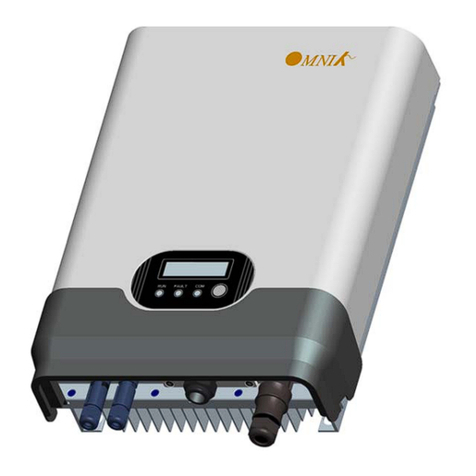
5.3 LED-Display
During normal operation, the PV generators produce a voltage
when sucient daylight or sunlight is present. If this voltage at
a certain level and corresponding time period is applied to the
inverter, the inverter starts to feed into the grid. The inverter is
equipped with an LED, which gives information on the operating
status and causes for non-operation.
Feeding Operation:
Depending on the power the blink frequency is increasing. The
following blink frequencies show percentages as a function of
the device power:
0% to 3% LED 0.5 sec.„ON“ 2 sec.„OFF“
3% to 30% LED 0.5 sec„ON“ 1 sec.„OFF“
30% to 60% LED 0.5 sec„ON“ 0.5 sec„OFF“
60% to 85% LED 0.5 sec„ON“ 0.2 sec„OFF“
85% to 100% LED continuously„ON“
Non-feeding Operation:
When in non-feeding operation, the LED indicates certain
output stages, which are described hereafter. These can be used
to troubleshoot the inverter in case of malfunction. Each stage
indication starts with the following sequence:
Sequence starts: 2 sec„ON“, 0.5 sec “OFF“
Output Stages:
Synchronization running:
LED 1sec„ON“ 0.5sec„OFF“, one pulse
AC Voltage not in tolerance range:
LED 1sec„ON“ 0.5sec„OFF“, two pulses
DC Voltage not in tolerance range:
LED 1sec„ON“ 0.5sec„OFF“, three pulses
AC and DC Voltage not in tolerance range:
LED 1sec„ON“ 0.5 sec„OFF“, four pulses
Internal over-temperature:
LED 1sec„ON“ 0.5 sec„OFF“, ve pulses
5.4 Protection Concepts
The following monitoring concepts and protection plans are
included in the APtronic scope of devices:
• Surge / varistors to protect the power semiconductor
• temperature monitoring
• EMC lters to protect the inverter against high-frequency
power disturbances
• varistors to earth on the mains side to protect the inverter
against surge voltages
• BISI (Bi-directional security interface ) network monitoring
for personal protection and to prevent islanding according
to VDE0126-1-1 / VDE AR-N 4105
6.0 Operating Conditions
The selection of the PV generator is of central importance to the
design of a PV system. It is highly relevant that the PV module
ts to the inverter.
6.1 Dimensioning of the PV-Generators
The number of PV modules connected in series must be
chosen so that the output voltage of the PV generator, even in
extreme outdoor temperatures does not exceeded the allowed
input voltage range of the inverter. In Central Europe, module
temperatures between -15°C to +70°C should be assumed.
Depending on the installation of the generators and the
geographical location, temperatures of +60°C or +70°C are used
in the stress voltage calculation. Please note the temperature
coecient of PV modules. The following criteria must be met for
the voltage of the PV generator:
Uo (-15 ° C) <max. Input voltage
45 V and -15°C for INV250
60 V and -15°C for INV350
The open circuit voltage of the connected PV generator must
be in the allowed input voltage range, even at very low outdoor
temperatures (-10°C). With a lowering of the temperature of 25°C
to -10°C, the open circuit voltage at 12 V modules increases by
approx. 2.8 V per module (approx. 5.6 V at a 24 V module). The
open circuit voltage of the PV generator must be less than 45V
for INV250 and less than 60 V for INV350.
UMPP (+60°C)> min. Input voltage:
18 VDC for INV250
20 VDC for INV350
For the INV250-45US /-RS485 /-PLC this voltage is 18 V.
For the INV350-60US /-RS485 /-PLC this voltage is 20 V.
The UMPP-voltage of the connected circuit branch should
not fall below the allowable input voltage range, even at very
high module temperatures (+60°C). With a temperature rise of
25°C to 60°C, the UMPP-voltage decreases for 12 V modules to
approximately 3.6 V per module (7.2 V at a 24 V module). The
UMPP-voltage of the PV generator should be at least 18V (for
INV250) or 20V (for INV350). If the UMPP-voltage falls below the
allowed input range, the system still works without problems. In
this state, it is not feeding the maximum possible power into the
grid, but slightly less.
It does not aect the inverter when a connected PV generator
supplies a higher than the maximum usable input power,
provided that the input voltage is within the acceptable range.
It may happen that the inverter switches o for safety reasons, if
the PV generator provides more than the max. DC input power
of the inverter for a short time, especially with changing cloud
coverage and relatively low-temperature conditions.
Normally, the control of the inverter is so dynamic that it
continues to operate without interruption.
Generally, in Central Europe a south orientation with 30°
inclination should be chosen for optimum energy yield of the PV
array. The optimum power factor for south-facing systems is 1.10
to 1.25. In an east-west system the power factor can be chosen
to 1.30. Requirement is that all other values of the inverter are
met. For exposed locations in the mountains or in the southern
regions, a corresponding reduction (<1.15) of the power ratio
required.
For questions please contact our customer service.