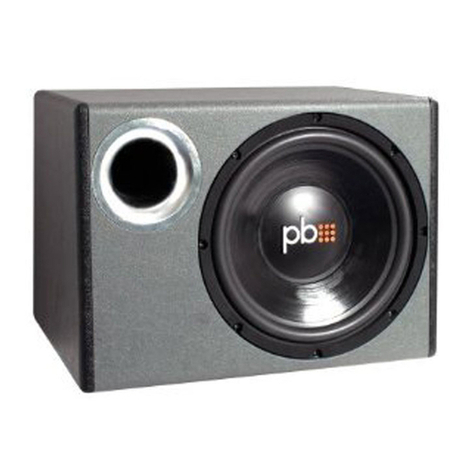
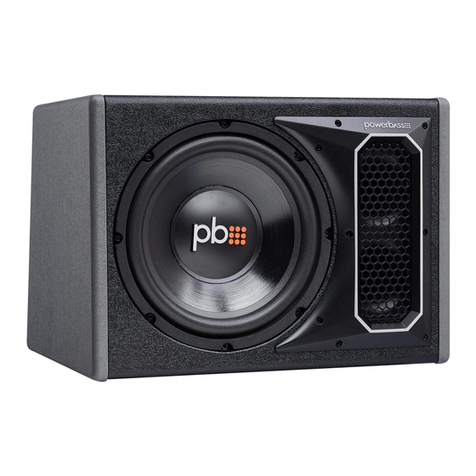
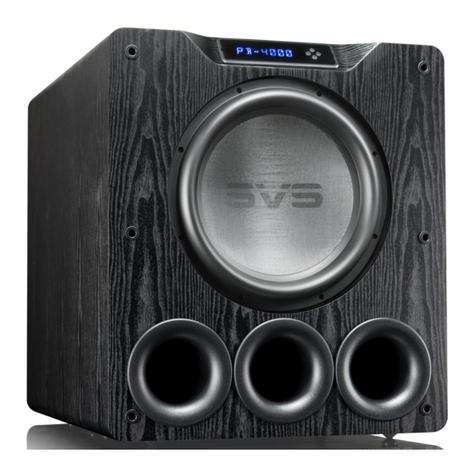
• VENTED BOX: Also known as a ported or bass reflex enclosure, this type of box is almost as
easy to construct as a sealed enclosure. This design however is more efficient and results
in an increase of bass output at certain frequencies. Although vented enclosure has an out-
put advantage at some frequencies, it also has a steeper roll off, which will only affect bass
frequencies below port tuning. Air inside the port will move in phase with the subwoofer re-
inforcing frequencies above the F3 (-3dB point). The SPL advantage of the vented enclosure
comes from the fact that the effect of the vent tuning reduces the excursion of the subwoofer
near the tuning frequency allowing more SPL to be produced before the subwoofer bottoms.
Damping material should also be used to line the internal walls to reduce any sonic reflection. Because
of the characteristics of a vented enclosure, subwoofers typically will become unloaded (act as if it is
not in a box) at frequencies of ½ octave below the enclosure tuning frequency. Using a high pass filter
/ subsonic filter will help prevent the subwoofer from unloading or exceeding its excursion capabili-
ties. It is important to stay within the recommended enclosure designs. (PowerBass recommends
port placement to coincide on the same panel or baffle that the subwoofer resides on.)
• BANDPASS ENCLOSURE: The most common band-pass enclosure is a combination of a
sealed and a vented enclosure working together (4th order or single reflex band-pass system).
The rear of the speaker goes into the sealed chamber while the front of the speaker goes into
the vented chamber. Because the vent produces all the sound generated from this type of en-
closure, sound quality may not be as good as a well-designed ported or sealed design.
Often the sacrifice for sound quality and subwoofer cone control is greater SPL output. However
unlike a sealed or vented enclosure, you can effectively increase the enclosure sensitivity with the
appropriate tuning choices. You can choose to design a narrow frequency band with very high sen-
sitivity or choose a wide frequency band with the sacrifice of lower sensitivity. The damping effect
of the vented chamber reduces the motion of the cone so that potentially higher sound output is
achieved without the subwoofer reaching its mechanical limits. Minor deviations from design recom-
mendations however may result in frequency response and distortion problems.
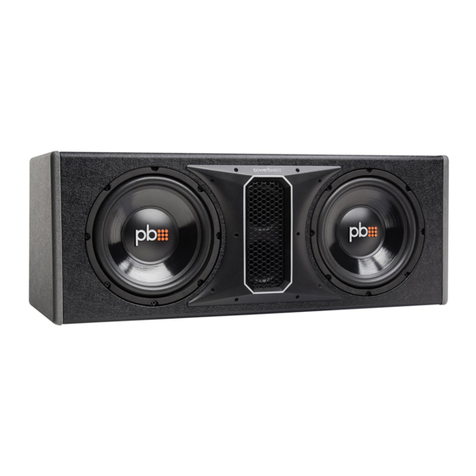
(If you are intending to use multiple subwoofers in your system, PowerBass recommends hav-
ing separate chambers for each subwoofer if the subwoofers will be operated by two different
amplified signals. This will prevent any possible cancellation.)