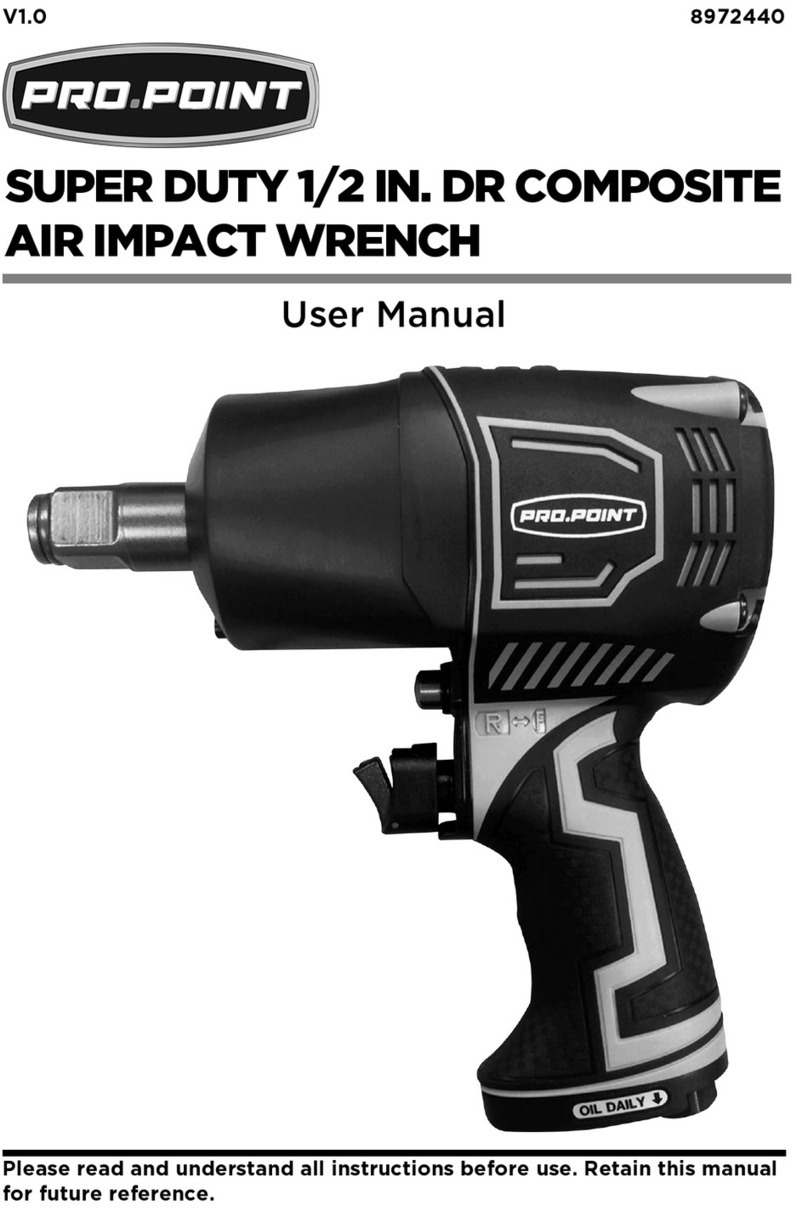
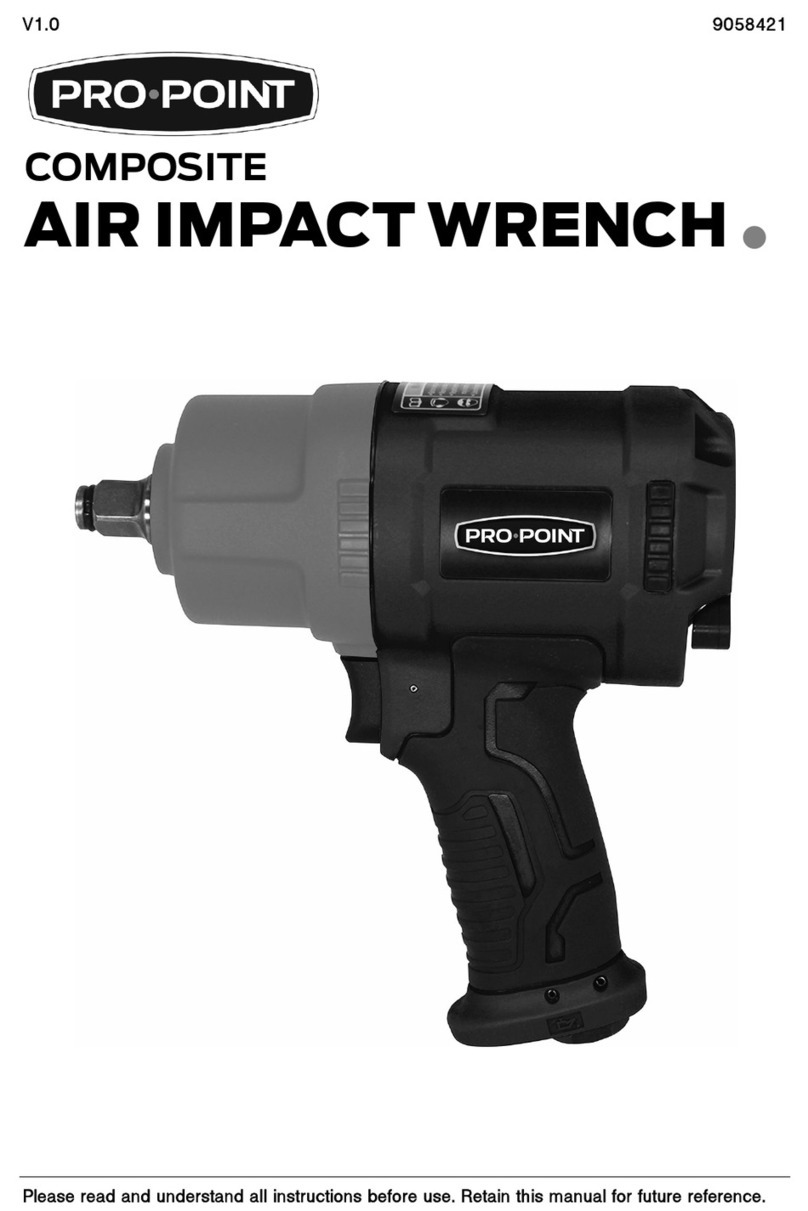
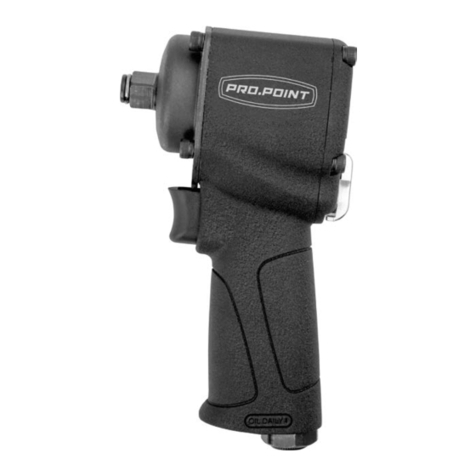
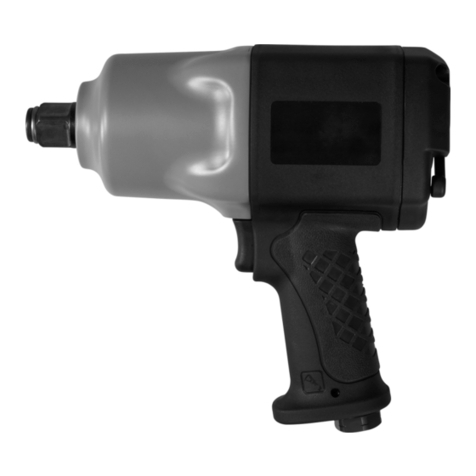
PROPOINT 1" User manual

User Manual
8380206V 2.0
1" Impact Wrench
with 6" anvil
Please read this manual before use.


3
For technical questions call: 1-800-665-8685
8380206V 2.0
1" Impact Wrench
with 6" anvil
SPECIFICATIONS
Max torque 2,000 ft-lb
Working torque 1,500 ft-lb
Average air consumption 9.1 CFM @ 100 PSI
No load speed 5,000 RPM
Max. air pressure 150 PSI
Air inlet 1/2" NPT
Air hose 1/2" I.D.
Drive size 1" square drive with 6" extended anvil
* The actual torque delivered at each setting will depend on the air pressure supplied to the tool. Test the actual torque by
tightening a nut or bolt at each setting, then observing the resultant torque with a mechanical torque wrench (not included).
INTRODUCTION
Through precision machining and high quality componentry, this 1" square drive impact wrench has the power to
deliver up to 2,000 ft-lb of torque. Twin hammer construction and a lightweight composite body provide reliable
continuous torque with less vibration and fatigue for users. The extended 6" anvil allows you to work in tight areas.
IMPORTANT SAFETY PRECAUTIONS
WARNING! Read and understand all instructions before using this tool. Keep this manual for the safety warnings
and precautions, operating, inspection and maintenance instructions. When using this tool, basic precautions
should always be followed to reduce the risk of personal injury and/or damage to the equipment. Note that when
this manual refers to a part number, it refers to the parts list included. Before allowing someone else to use this tool,
make sure they are aware of all safety information.
WORK AREA
1. Keep your work area clean and well lit. Cluttered and dark areas invite accidents.
2. Operate in a safe work environment. Do not use air tools in damp or wet locations. Do not expose to rain.
Do not use power tools in the presence of flammable gases or liquids.
3. Keep children, bystanders and visitors away from the work area. Do not let them handle tools or extension
cords. No one should be in the work area if they are not wearing suitable protective equipment.
4. Store unused equipment. When not in use, tools must be stored in a dry location to prevent rust. Always lock up
tools and keep them out of reach of children.

1" Impact Wrench with 6" anvil
4For technical questions call: 1-800-665-8685
V 2.08380206
PERSONAL SAFETY
1. Dress properly, wear protective equipment. Use breathing, ear, eye, face, foot, hand and head protection.
Always wear ANSI approved impact safety goggles, which must provide both frontal and side protection.
Protect your hands with suitable gloves. Protect your head from falling objects by wearing a hard hat. Wear
an ANSI approved dust mask or respirator when working around metal, wood and chemical dusts and mists.
Wear ANSI approved earplugs. Protective, electrically non-conductive clothes and non-skid footwear are
recommended when working. Wear steel toed boots to prevent injury from falling objects.
2. Do not over reach; keep proper footing and balance at all times. Proper footing and balance enables better
control of the tool in unexpected situations.
3. Keep any articles of clothing, jewelry, hair etc. away from moving parts. These can be caught in moving parts,
resulting in damage to the tool and/or serious injury.
4. Stay alert, watch what you are doing and use your common sense. Do not operate any machine or tool when
you are tired, under the influence of drugs, alcohol or medications.
5. Use clamps or other practical ways to secure and support the work piece to a stable platform. Holding the work
piece by hand or against your body is unstable and may lead to loss of control.
VIBRATION PRECAUTIONS
This tool vibrates during use. Repeated or long-term exposure to vibration may cause temporary or permanent physical
injury, particularly to the hands, arms and shoulders.
1. Anyone using vibrating tools regularly or for an extended period should first be examined by a doctor
and then have regular medical check ups to ensure medical problems are not being caused by or worsened
from tool use. Pregnant women or people who have impaired blood circulation to the hands, past hand
injuries, nervous system disorders, diabetes or Raynaud's Disease should not use this tool. If you feel any
medical symptoms related to vibrations (such as tingling, numbness, and white or blue fingers), seek medical
attention as soon as possible.
2. Do not smoke during use. Nicotine reduces the blood flow to the hands and fingers, increasing the risk of
vibration-related injury.
3. Wear suitable gloves to reduce the vibration effects on the user.
4. Use tools with the lowest amount of vibration when there is a choice between different processes.
5. Do not use for extended periods. Take frequent breaks when using this tool.
6. Let the tool do the work. Grip the tool as lightly as possible (while still keeping safe control of it).
7. To reduce vibrations, maintain tool as explained in this manual. If abnormal vibrations occur, stop using
this tool immediately.
8. This tool will not stop moving immediately. Do not lay the tool down or leave it unattended until it has come
to a complete stop. A part that is moving could make the tool jump or grab a surface and pull the tool out
of your control.

1" Impact Wrench with 6" anvil
5
For technical questions call: 1-800-665-8685
V 2.0 8380206
SPECIFIC SAFETY PRECAUTIONS
1. Do not over-tighten nuts. They could shatter and cause damage to the tool or work piece or cause serious injury.
Use a torque wrench to torque the nut after using the impact wrench.
2. Do not use any additional force upon the wrench in order to remove a nut.
3. Do not allow wrench to run without load for an extended period of time as this will shorten its life.
4. This impact wrench should only be used with impact sockets and extensions. Use of other accessories can cause
them to break, causing permanent damage to the unit and severe injury to the operator.
TOOL USE AND CARE
1. Use the right tool for the job. Do not attempt to force a small tool or attachment to do the work of a larger
industrial tool. The tool will perform better and more safely at the task for which it was intended. Do not modify
this tool or use for a purpose for which it was not designed.
2. Securely hold this tool using both hands. Using tools with only one hand can result in loss of control.
3. Maintain tools with care. Keep tools clean and in good condition for a better and safer performance. Follow
instructions for lubricating and changing accessories. Inspect tool fittings, alignment and hoses periodically and,
if damaged, have them repaired by an authorized technician or replaced. The handles must be kept clean, dry
and free from oil and grease at all times. A properly maintained tool reduces the risk of binding and is easier to
control. Applying excessive force can lead to slips and damage to your work or personal injury.
4. Avoid unintentional starts. Be sure that the throttle is in neutral when not in use and before connecting it to any
air source. Do not carry the tool with fingers near or on the switch.
5. Only use the lubricants supplied with the tool or specified by the manufacturer. Other lubricants may not be
suitable and may damage the tool or even make the tool explode.
6. When not in use for an extended period, apply a thin coat of lubricant to the steel parts to avoid rust.
7. Maintain the label and name plate on the tool. These carry important information. If unreadable or missing,
contact Princess Auto for a replacement.

1" Impact Wrench with 6" anvil
6For technical questions call: 1-800-665-8685
V 2.08380206
AIR SOURCE
1. Disconnect air supply. Disconnect tools from air pressure
source when not in use, before cleaning, servicing or
changing a piece or accessory. After disconnecting,
discharge any residual air pressure.
2. Do not use tools if the trigger switch does not function
properly. Any tool that cannot be controlled with the ON/
OFF switch is dangerous and must be repaired.
3. Use proper size and type of air pressure line and fittings.
The recommended air line for a tool with a 1/2" inlet is
1/2" I.D.
4. Always verify prior to using a tool that the air source has
been adjusted to the rated air pressure or within the rated
air-pressure range. Over pressurizing a tool may cause
bursting, abnormal operation, breakage of the tool or
serious injury to persons. Use only clean, dry, regulated
compressed air at the rated range as marked on the tool.
5. Never use pure oxygen, carbon dioxide, combustible
gases or any bottled gas as an air source for a tool. Such
gases are capable of causing an explosion and serious injury to persons. Do not use an air source besides an
air compressor to power this tool.
6. Always use an air regulator, an in-line filter and a moisture trap in your compressed air system. These
accessories will increase the tool's life and keeps the tool in good working condition. See the diagram above
for recommended components of an air line.
7. Drain the air tank daily. Water in the air line will damage the tool.
8. Clean air inlet filter weekly.
9. Avoid using too long of an air hose. The longer the hose, the lower the pressure will be at the end of the hose,
to the point that it may not meet the minimum required for the tool. As well, a longer hose can become a
tripping hazard.
10. Keep hose away from heat, oil and sharp edges. Check hose for wear, and make certain that all connections
are secure.
11. Always carry a tool by its handle; never carry the tool by the air hose.
12. Line pressure should be increased to compensate for unusually long air hoses (over 26 ft). The hose diameter
should be 1/2" l.D.
13. Air tool CFM consumption ratings are based upon a 25% duty cycle. If you require continuous duty, a larger
compressor will be required (e.g. 4.0 CFM tool at continuous duty requires 16.0 CFM to function at
maximum torque).
For best service, incorporate an oiler, regulator and inline filter as shown in the diagram above.

1" Impact Wrench with 6" anvil
7
For technical questions call: 1-800-665-8685
V 2.0 8380206
AIR SOURCE INSTALLATION
1. Set the air pressure regulator on the air compressor to 90 PSI. Do not exceed the tool's recommended air
pressure. Excess pressure could result in damage to the tool, to your work piece or serious injury.
2. Prepare a standard 1/2" air connector for use with your tool. Wrap the threaded portion of the air connector
with thread tape. Attach it to the tool's air inlet. Tighten securely.
3. Attach a standard quick connector to the air source's hose. Attach the air hose to the tool.
Note: If you are not using an in-line oiler, add a few drops of air tool oil in the tool's air inlet before use. In the
same manner, add a few drops after every hour of use.
4. Check the air line and its connections for air leaks. Do not use this tool until you have repaired all air leaks.
Note: Turn off the air compressor, disconnect the air pressure hose and discharge any residual pressure inside
the tool before changing accessories or making any adjustments to the tool. Failure to do so could result in
severe injury, tool or property damage.
LUBRICATION
1. All air tools are packed in grease to prevent corrosion of internal parts during shipping and storage. We
recommend you clean this out to have optimum performance from your new air tool. Add a generous amount of
air tool oil in the air inlet, and then run the tool under no load until exhaust is clear to remove packing grease.
For future maintenance, add only one or two drops of oil daily.
2. It is very important that the tool be properly lubricated. Without proper lubrication, the tool will not work
properly and parts will wear prematurely. Manually dropping a drop or two of air tool oil once a day into the
tool's male connector is better than using an automatic in-line lubricator, which should only be required when
there are multiple users of the same tool.
3. Keep the in-line lubricator filled and correctly adjusted. It should be regularly checked and filled with air tool
oil. Proper adjustment of the in-line lubricator is performed by placing a sheet of paper next to the exhaust ports
and holding the throttle open approximately 30 seconds. The lubricator is properly set when a light stain of oil
collects on the paper. Excessive amounts of oil should be avoided.
4. Air tool oil is the only recommended lubricant for use in all air tools. Do not try to use other types of lubricants
to oil your tools. Using the wrong lubricant will cause premature tool failure and/or loss of power. Use
only recommended lubricants, specially made for pneumatic applications. Substitutes may harm the rubber
compounds in the tool's O-rings and other rubber parts.
5. Oiling your air tool regularly is important, but it is also important not to over oil your air tool. Over oiling can
cause premature tool failure. Your tool may not be ruined, but it will begin to experience loss of power that will
continually get worse until it no longer works, at which point the tool will have to be taken apart and cleaned of
excess oil.
6. In the event that it becomes necessary to store the tool for an extended period of time (overnight, weekend,
etc.), it should receive a generous amount of lubrication at that time. The tool should be run for approximately
30 seconds to ensure oil has been evenly distributed throughout the tool. The tool should be stored in a clean
and dry environment.
WARNING! NEVER use WD-40 to clean or lubricate your air tool. WD-40 is a solvent that will break down the
internal grease and cause the air tool to seize up.

1" Impact Wrench with 6" anvil
8For technical questions call: 1-800-665-8685
V 2.08380206
UNPACKING
1. Carefully remove the parts and accessories from the box.
2. Make sure that all items listed in the parts lists are included.
3. Inspect the parts carefully to make sure the tool was not damaged while shipping.
4. Do not discard the packaging material until you have carefully inspected and satisfactorily operated the tool.
WARNING! If any part is missing, do not operate the tool until the missing parts are replaced. Failure to do so
could result in serious personal injury.
OPERATION
SOCKET INSTALLATION
Turn off the air compressor and disconnect the air hose when changing sockets. After attaching the socket, attach the
air hose and turn the air compressor on.
The working torque of the impact wrench is 1,500 ft-lb. Make sure that the nut or bolt you are using the tool to tighten
can withstand the rated torque and is rated for 5,000 RPM or greater. If available, check the recommended torque
specifications for the nut.
1. Select the appropriately sized 1" drive impact socket for the job. Push and snap the socket onto the anvil.
Only use impact sockets which are specifically designed for use with an impact wrench. Do not use worn or
damaged sockets.
2. Push and snap the socket (not included) onto the anvil.
OPERATION
WARNING! This tool generates considerable torque when in use. Always hold the tool with both hands when
using, and brace yourself to resist the torque which will be delivered to the work piece.
1. Tighten the nut as far as you can by hand before using the impact wrench.
2. Connect the wrench to the air hose.
3. Place the socket on the nut and grip the impact wrench tightly with both hands. Press the trigger to start the tool.
Note: If the tool stalls while tightening, do not raise the outlet pressure of the air compressor above 90 PSI.
4. Set the reverse lever to the left, so that the anvil turns clockwise (forward.)
5. Place the socket over the fastener, grip the impact wrench firmly with both hands and gently squeeze
the trigger.
6. Turn the air regulator in the direction indicated by the H arrow on the regulator to increase the power. Turn it
toward the L arrow to decrease the power.
Note: If the impact wrench does not tighten the fastener to your satisfaction, do not raise the air pressure on
the compressor over 90 PSI. Pressures above 90 PSI will strip the work piece and damage the tool, potentially
causing tool failure and serious injury. Use other appropriate methods and tools to tighten the nut.
7. When the fastener is tightened, release the trigger and remove the tool and socket.
8. Use a mechanical torque wrench to check fastener torque.
9. To loosen, set the reverse lever to the right, so that the anvil turns counterclockwise (reverse).
10. When finished with the tool, turn off the air compressor, disconnect the air hose and discharge any residual air
remaining in the tool. Put the impact wrench away in a safe storage area.

1" Impact Wrench with 6" anvil
9
For technical questions call: 1-800-665-8685
V 2.0 8380206
MAINTENANCE
WARNING! Disconnect wrench from air supply before changing accessories, servicing or performing maintenance.
Replace or repair damaged parts. Use genuine parts only. Non-authorized parts may be dangerous.
1. Wipe the impact wrench down with a lint free cloth after each use.
2. Make sure the anvil is clear of dirt or debris. If possible, spray it with compressed air before and after each use.
3. Periodically, add a high quality machine oil to the oil inlet by removing the oil screw.
4. If an inline oil/filter system is not used, lubricate the tool daily by holding it so that the air inlet is facing up.
Squeeze the trigger and place one or two drops of oil into the air inlet. Squeezing the trigger allows the oil to
circulate in the motor.
DISPOSING OF THE TOOL
If your tool has become damaged beyond repair, do not throw it out. Bring it to the appropriate recycling facility.
TROUBLE SHOOTING
Problem(s) Possible cause(s) Suggested solution(s)
Tool runs at normal speed but
loses power under load.
Motor parts worn. Have a qualified technician replace worn parts.
Lack of air tool oil. Pour air tool oil into air inlet per instructions.
Tool runs slowly. Air flows
slightly from exhaust.
Motor parts jammed with dirt particles.
1. Check air inlet filter for blockage.
2. Pour air tool oil into air inlet as
per instructions.
3. Operate tool in short bursts quickly
reversing rotation back and forth
where applicable.
4. Disconnect air supply. Free motor by
rotating drive shank manually
where applicable.
5. Repeat above as needed. If this fails,
bring to service center.
Air flow blocked by dirt.
Excessive air tool oil in tool or buildup of
shipping grease.
Run tool under no load for short periods of time until
exhaust clears.
Tools will not run. Air flows
freely from exhaust.
O-rings throttle valve dislodged from seat inlet
valve. Have a qualified technician replace the O-ring.
Damage to, or excessive wearing of
internal parts. Bring to service centre.
Tool will not shut off. O-rings throttle valve dislodged from seat
inlet valve. Have a qualified technician replace the O-ring.
Loss of power or
erratic performance.
Excessive drain on the air line. Moisture or
restriction in the air hose. Incorrect size or
type of hose connectors.
Check the air supply. Ensure tool is connected to a 1/2"
I.D. or larger air hose with no kinks or restrictions and
that the fittings are connected properly.
Air compressor has insufficient flow. Ensure tool is connected to a compressor whose rated
flow matches the tool.
Note: Repairs should be carried out by a qualified person.

1" Impact Wrench with 6" anvil
10 For technical questions call: 1-800-665-8685
V 2.08380206
PARTS BREAKDOWN
This manual suits for next models
1
Table of contents
Languages:
Other PROPOINT Impact Driver manuals
PROPOINT
PROPOINT 8844474 User manual
PROPOINT
PROPOINT 9082710 User manual
PROPOINT
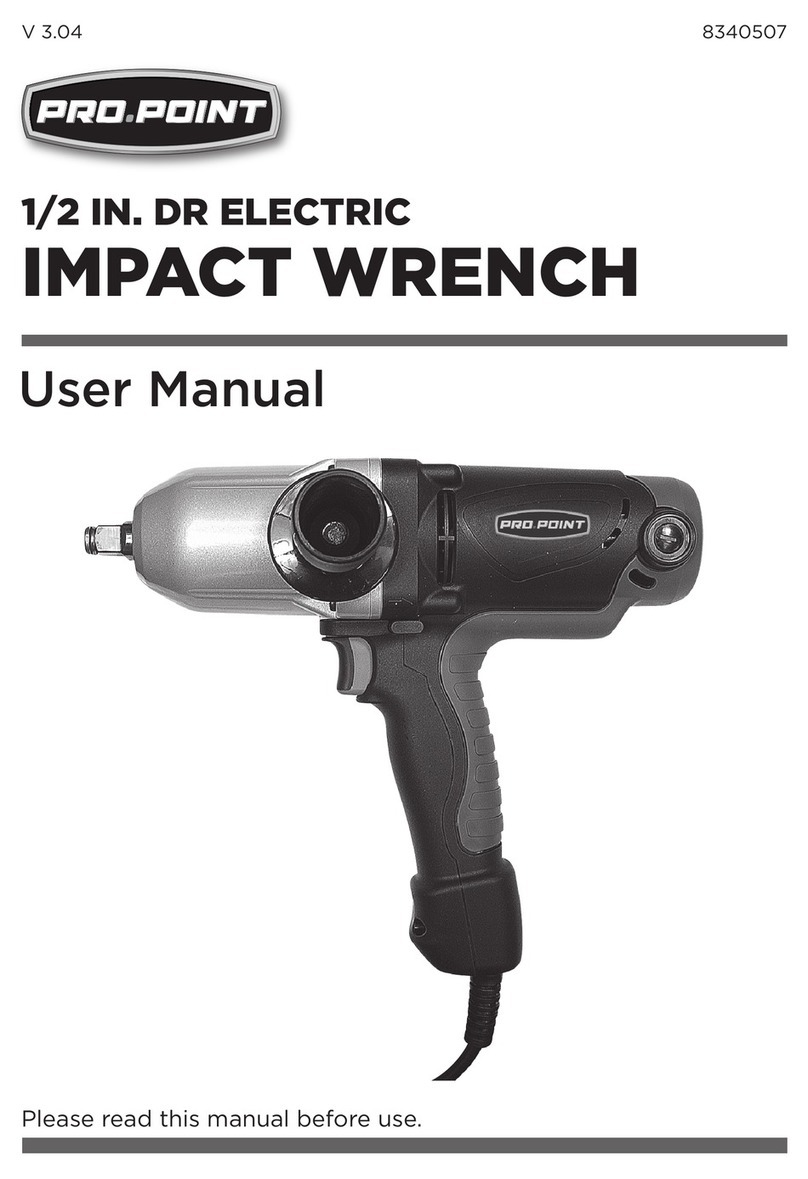
PROPOINT 8340507 User manual
PROPOINT
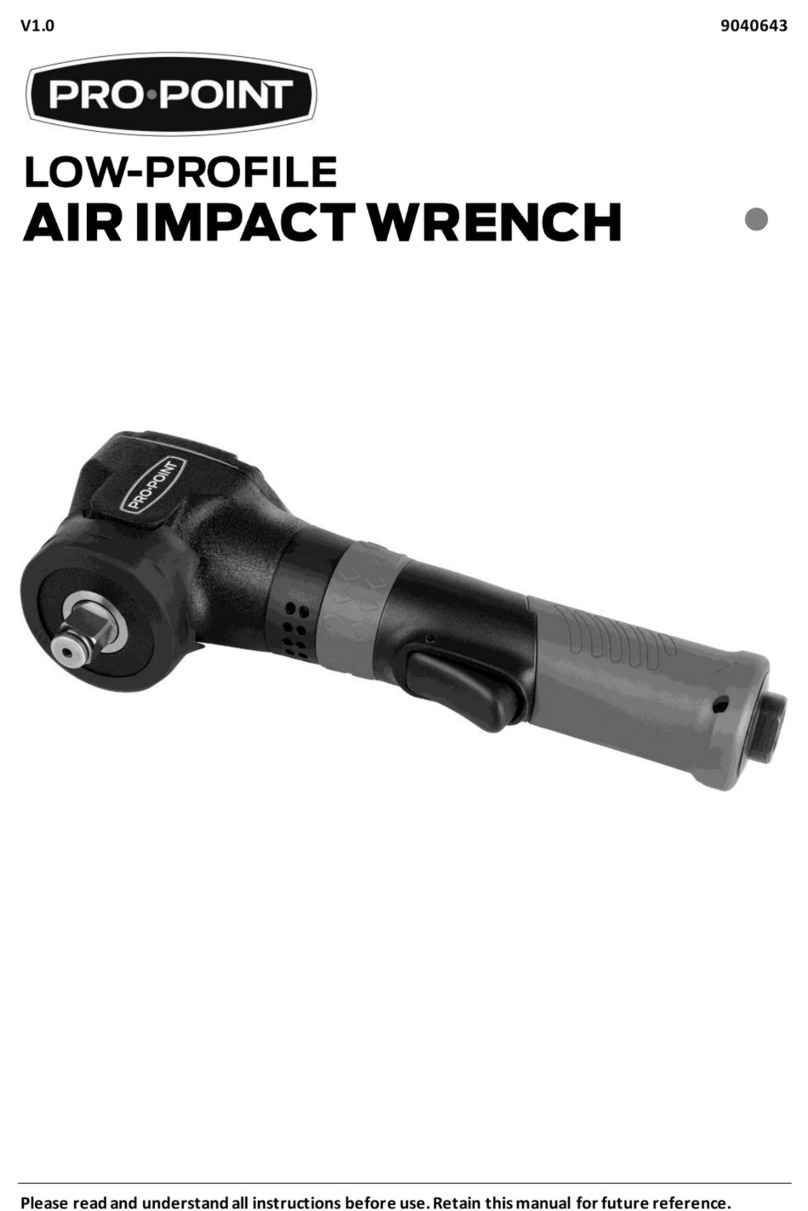
PROPOINT 9040643 User manual
PROPOINT
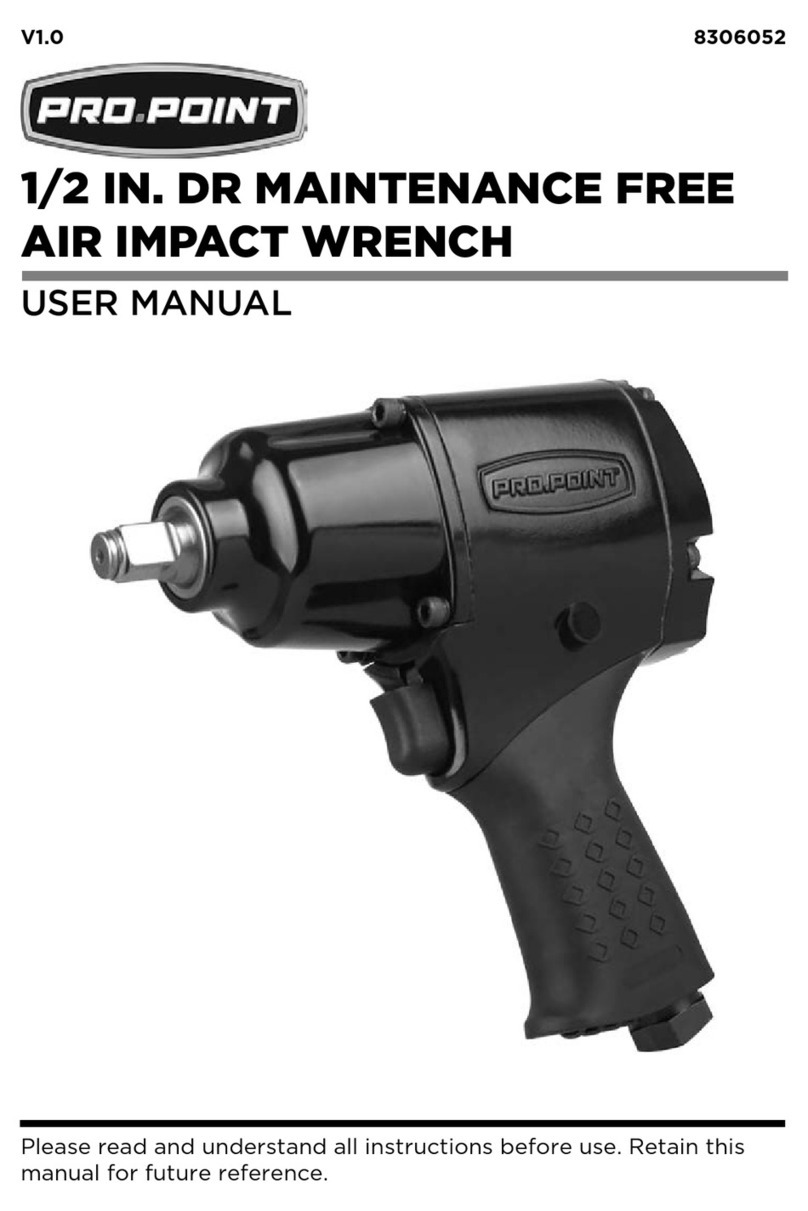
PROPOINT 8306052 User manual

PROPOINT
PROPOINT 9067976 User manual
PROPOINT
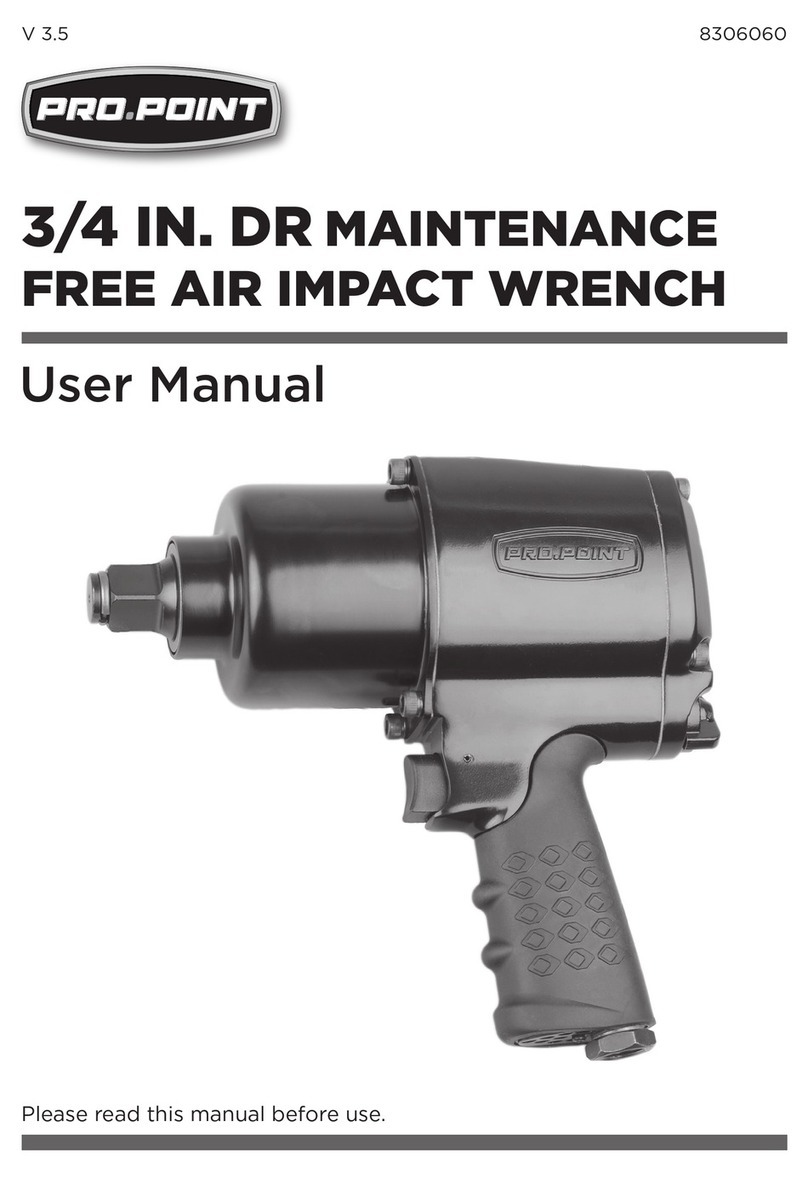
PROPOINT 3/4 IN. User manual
PROPOINT
PROPOINT 8972432 User manual
PROPOINT
PROPOINT 8345233 User manual
PROPOINT
PROPOINT 8327827 User manual