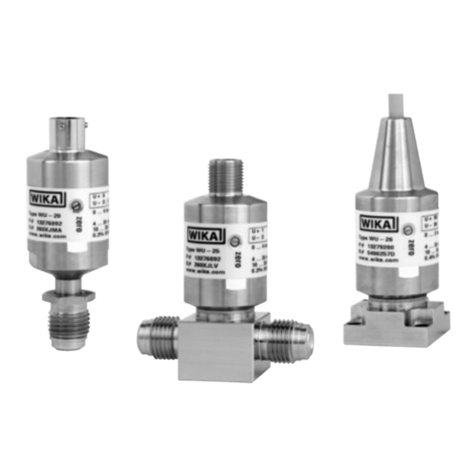
The dBi HART transducer range has been specified and designed
to meet the demanding requirements of today’s process level
measurement applications for liquids and solids.
All dBi transducers are 2 wire and can either be used in digital
HART mode or as 4-20mA loop powered devices. The dBi
transducers are set up using a hart modem with either proprietary
HART software such as Pactware or Pulsar dBi HART PC software.
The dBi unit is based on a PZT ceramic transducer element. The
nominal beam angle is 10 0 @ -3 dB (depending on unit). When
coupled with the DATEM®signal processing they provide
unmatched performance in industrial process level measurement.
All dBi transducers include integral temperature compensation.
Optional submersion shield is available to prevent spurious signal if
the transducer becomes submerged.
A range of flange mounting options (ANSI & EN1092) with or
without a PTFE facing to give improved chemical resistance is
available.
An aiming kit is recommended for solids level measurement to help
focus on the material surface with the angle of repose.
Standard cable lengths: 5, 10, 20 or 30m.
Process Connection: 1” BSP, M20 adapter option.
Operating Temperature: -40 to +80°C
Ingress Protection: IP68
Enclosure material: Valox 357 or PVDF.
HAZARDOUS AREA INSTALLATION
The dB transducer should be installed directly above the liquid or
solid level with the transducer axis perpendicular to the surface to be
measured.
The transducer can be installed using the 1” BSP thread on the top of
the transducer or with the supplied 1” BSP to M20 thread adapter.
See figure 1 for examples.
In some applications, it may not be possible to install the transducer
using either a flange or the 1” BSP thread, in these circumstances it
may be possible to suspend the transducer from its cable. In these
installations, it is recommended that the transducer be secured using
a chain fitted to one of the chain holes on the top of the transducer,
see figure 2.
When installing the transducer avoid aiming the transducer directly at
fixed obstructions as they may mask the required return echo from
the liquid or solid level being monitored, see figure 3.
NOTE: Extension cables must use 2 or 3 core screened conductors.
Capacitance must not exceed 100nF between conductor to screen.
Resistance should not exceed 40Ωper conductor
Ex ia (Intrinsically Safe) dBi transducers are certified for
use in hazardous zones 0, 1, 2 (gas) & 20, 21, 22 (dust).
A certified safety barrier is required.
Ex mb (encapsulated) dBi transducers are certified for use
in hazardous zones 1, 2 (gas) & 21, 22 (dust).
No barriers are required but they must be supplied from
apparatus that provides protection from prospective short-
circuit currents of at least 1500A.
HAZARDOUS AREA INSTALLATION, Exia
HAZARDOUS AREA INSTALLATION, Exmb
X Limitations on use:
1. The transducers must be routinely inspected to avoid the build-
up of a dust layer when installed in Zones 20, 21 & 22.
2. Electrostatic hazard –The transducers must only be wiped with
a damp or anti-static cloth.
3. Only fuses listed on drawing D-804-0978 may be used with the
Ex mb approved dBi transducers.
EN1092 (BS 4504) All dimensions in mm
Flanged versions of the transducer should be installed using plastic bolts with an
insulating gasket between the transducer flange and the process vessel flange. The
bolts should not be fully tightened as this may cause acoustic resonance that results in
increased ring down. A typical flange application is shown above.