manuals.online logo
Brands
  1. Home
  2. •
  3. Brands
  4. •
  5. Pyle
  6. •
  7. Amplifier
  8. •
  9. Pyle PP444 User manual

Pyle PP444 User manual

Other Pyle Amplifier manuals

Pyle PTAU23 User manual

Pyle

Pyle PTAU23 User manual

Pyle PWMA80UFM User manual

Pyle

Pyle PWMA80UFM User manual

Pyle PT210 User manual

Pyle

Pyle PT210 User manual

Pyle PFA320BT User manual

Pyle

Pyle PFA320BT User manual

Pyle PFA200 User manual

Pyle

Pyle PFA200 User manual

Pyle PT270AIU User manual

Pyle

Pyle PT270AIU User manual

Pyle PLMRC300X2 User manual

Pyle

Pyle PLMRC300X2 User manual

Pyle PTA66BT User manual

Pyle

Pyle PTA66BT User manual

Pyle PLMRC500X1 User manual

Pyle

Pyle PLMRC500X1 User manual

Pyle PDA35BT User manual

Pyle

Pyle PDA35BT User manual

Pyle PDA7BU User manual

Pyle

Pyle PDA7BU User manual

Pyle PVC8U User manual

Pyle

Pyle PVC8U User manual

Pyle PDA69BU User manual

Pyle

Pyle PDA69BU User manual

Pyle PFA330BT User manual

Pyle

Pyle PFA330BT User manual

Pyle PCAU46BA User manual

Pyle

Pyle PCAU46BA User manual

Pyle P3201BT User manual

Pyle

Pyle P3201BT User manual

Pyle PMZ300A User manual

Pyle

Pyle PMZ300A User manual

Pyle PCM20A User manual

Pyle

Pyle PCM20A User manual

Pyle PDA22BT User manual

Pyle

Pyle PDA22BT User manual

Pyle Blue Series User manual

Pyle

Pyle Blue Series User manual

Pyle PTA2 User manual

Pyle

Pyle PTA2 User manual

Pyle PLCD54MP User manual

Pyle

Pyle PLCD54MP User manual

Pyle PFMRA340BB User manual

Pyle

Pyle PFMRA340BB User manual

Pyle PLMRA210BT User manual

Pyle

Pyle PLMRA210BT User manual

Popular Amplifier manuals by other brands

Magnat Audio EDITION FOUR Owner's manual/warranty document

Magnat Audio

Magnat Audio EDITION FOUR Owner's manual/warranty document

Inter-m PA-2000A Operation manual

Inter-m

Inter-m PA-2000A Operation manual

Yamaha TX6n owner's manual

Yamaha

Yamaha TX6n owner's manual

Peavey TNT 150 user guide

Peavey

Peavey TNT 150 user guide

Bosch LBB 1903/10 Installation and user instructions

Bosch

Bosch LBB 1903/10 Installation and user instructions

Avocent Emerge DA1200D Installer/user guide

Avocent

Avocent Emerge DA1200D Installer/user guide

Redgum RGi35 operating instructions

Redgum

Redgum RGi35 operating instructions

Cambridge Audio AXA25 user manual

Cambridge Audio

Cambridge Audio AXA25 user manual

Alpine MRP-M200 owner's manual

Alpine

Alpine MRP-M200 owner's manual

Technical Pro H1502UrBT user manual

Technical Pro

Technical Pro H1502UrBT user manual

FMS EMGZ307 operating manual

FMS

FMS EMGZ307 operating manual

Racal Instruments 5601 user manual

Racal Instruments

Racal Instruments 5601 user manual

Valcom V-1094A Technical specifications

Valcom

Valcom V-1094A Technical specifications

Cambridge Audio 851D user manual

Cambridge Audio

Cambridge Audio 851D user manual

QSC 3800 Specifications

QSC

QSC 3800 Specifications

NAD C300 owner's manual

NAD

NAD C300 owner's manual

Rotel RMB-1077 owner's manual

Rotel

Rotel RMB-1077 owner's manual

Peavey Monitor 300 Series operating guide

Peavey

Peavey Monitor 300 Series operating guide

manuals.online logo
manuals.online logoBrands
  • About & Mission
  • Contact us
  • Privacy Policy
  • Terms and Conditions

Copyright 2025 Manuals.Online. All Rights Reserved.

13. Non-use Periods:
The power cord of
the appliance should
be unplugged from
the outlet when the
appliance is to be left
unused for a long
period of time.
14. Object and Liquid Entry:
Care should be taken so that objects do not fall
and liquids are not spilled into the enclosure
through openings.
15. Carts and Stands: If the appliance is
used with a cart or stand, the cart or
stand should be a type recommended
by the manufacturer. An appliance and
cart combination should be moved with care.
Quick stops, excessive force, and uneven surfaces
cause the appliance and cart combination to
overturn.
16. Mounting: The appliance should be mounted
only as recommended by the manufacturer.
17. Damage Requiring Service: The appliance should
be serviced by qualied service personnel when:
A. The power-supply cord or plug has been
damaged.
B. Objects have fallen into, or liquid has been
spilled into the appliance enclosure.
C. The appliance has been exposed to rain.
D. The appliance has been dropped, or the
enclosure damaged.
E. The appliance does not appear to operate
normally or exhibits a marked change in
performance.
18. Servicing: The user should not attempt to
service the appliance beyond that described in
the user’s operating instructions. All other servicing
should be referred to qualied personnel.
19. Overloading: Do not overload wall outlets and
extension cords as this can result in a risk of re or
electric shock.
20. Replacement Parts: When replacement parts
are required, be sure the service technician has
used replacement parts specied by the manufac-
turer or have the same characteristics as the
original part. Unauthorized substitutions may
result in re, electric shock or other hazards.
21. Safety Check: Upon completion of any service
or repairs to this appliance, ask the service techni-
cian to perform safety checks to determine that
the appliance is in proper operating condition.
IMPORTANT SAFETY INSTRUCTIONS
1. Read Instructions: All the safety and operating
instructions should be read before the appliance
is operated.
2. Retain Instructions: The safety and operating
instructions should be retained for future reference.
3. Heed Warnings: All warnings on the appliance
and in the operating instructions should be
adhered to.
4. Follow Instructions: All operating and use
instructions should be followed.
5. Water and Moisture: The appliance should not
be used near water-for example, near a bathtub,
washbowl, kitchen sink, laundry tub, swimming
pool, or a wet basement.
6. Ventilation: The appliance should be situated so
that its location or position does not interfere with
its proper ventilation. For example, the appliance
should not be situated on a bed, sofa, rug, or
similar surface that may block the ventilation
openings: or placed in a built-in installation, such
as a bookcase or cabinet that may impede the
ow of air through the ventilation openings.
7. Heat: The appliance should be situated away
from heat sources such as radiators, heat registers,
stoves, or other appliances (including ampliers)
that produce heat.
8. Power Sources: The appliance should be
connected to a power supply only of the type
described in the operating instructions or as
marked on the appliance.
9. Grounding or Polarization: Precaution should
be taken to insure that the grounding or polariza
tion means of an appliance is not defeated.
10. Power-Cord Protection: Power supply cords
should be routed so that they are not likely to be
walked on or pinched by items placed upon or
against them, paying particular attention to cords
at plugs, convenience receptacles, and the point
at which they exit from the appliance.
11. Cleaning: The appliance should be cleaned only
as recommended by the manufacturer.
12. Power Lines: An outside antenna system should
not be located in the vicinity of overhead power
lines or other electric light or power circuits, or
where it can fall into such power lines or circuits.
When installing an outside antenna system,
extreme care should be taken to keep from
touching such power lines or circuits as contact
with them might be fatal.

13. Non-use Periods:
The power cord of
the appliance should
be unplugged from
the outlet when the
appliance is to be left
unused for a long
period of time.
14. Object and Liquid Entry:
Care should be taken so that objects do not fall
and liquids are not spilled into the enclosure
through openings.
15. Carts and Stands: If the appliance is
used with a cart or stand, the cart or
stand should be a type recommended
by the manufacturer. An appliance and
cart combination should be moved with care.
Quick stops, excessive force, and uneven surfaces
cause the appliance and cart combination to
overturn.
16. Mounting: The appliance should be mounted
only as recommended by the manufacturer.
17. Damage Requiring Service: The appliance should
be serviced by qualied service personnel when:
A. The power-supply cord or plug has been
damaged.
B. Objects have fallen into, or liquid has been
spilled into the appliance enclosure.
C. The appliance has been exposed to rain.
D. The appliance has been dropped, or the
enclosure damaged.
E. The appliance does not appear to operate
normally or exhibits a marked change in
performance.
18. Servicing: The user should not attempt to
service the appliance beyond that described in
the user’s operating instructions. All other servicing
should be referred to qualied personnel.
19. Overloading: Do not overload wall outlets and
extension cords as this can result in a risk of re or
electric shock.
20. Replacement Parts: When replacement parts
are required, be sure the service technician has
used replacement parts specied by the manufac-
turer or have the same characteristics as the
original part. Unauthorized substitutions may
result in re, electric shock or other hazards.
21. Safety Check: Upon completion of any service
or repairs to this appliance, ask the service techni-
cian to perform safety checks to determine that
the appliance is in proper operating condition.
FEATURES AND CONTROLS
Features and Technical Specs:
• Converts Phono Signals to Line LevelSignals
• State-of-the-Art Circuitry Accommodates Magnetic Pickups
• Ultra-Low Noise Operation Improves Sound Performance
• Connects to Turntables and Other Studio Equipment
• Input Sensitivity: 3mV at SOK Ohms (Phono)
• Dedicated RCA and 1/4" Output Connectors
• Power On LED Indicator
• Power Supply Included,DC 12V/150mA
• Dimensions (W x D x H):4.09" x 2.28" x 1.38"
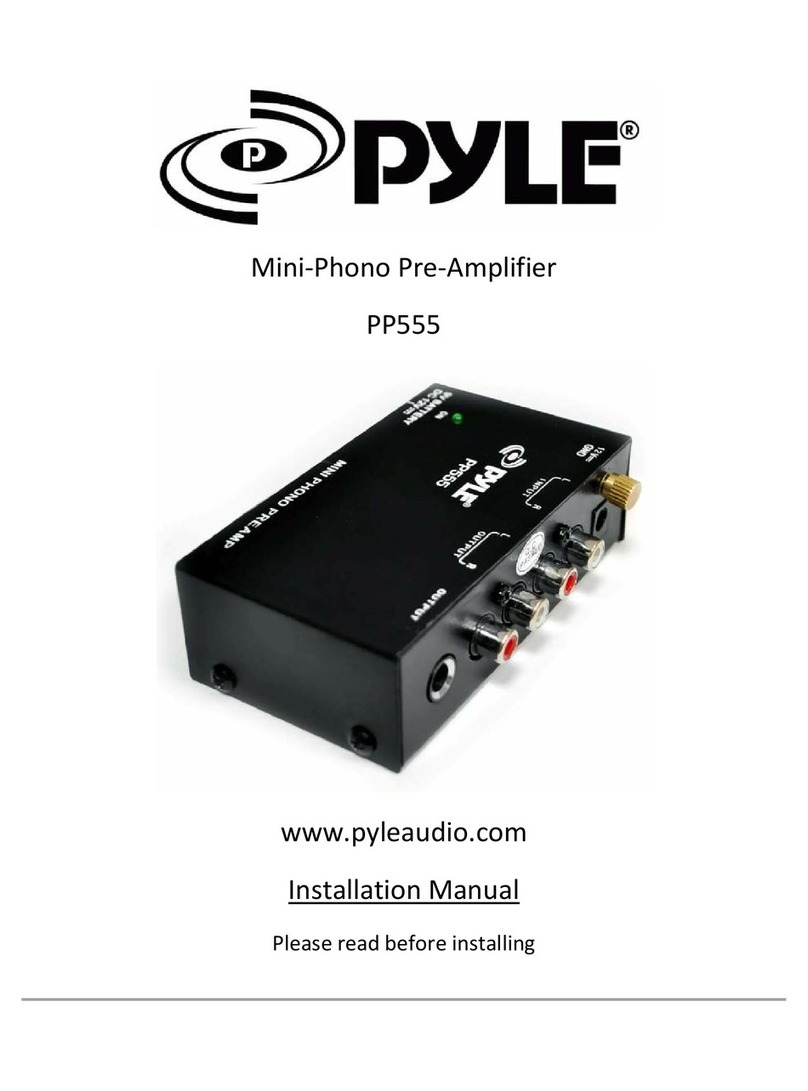
Pyle Phono Turntable Preamp MiniElectronic Audio Stereo Phonograph Preamplier with RCA Input, RCA
Output & Low Noise Operation Powered by 12 Volt DC Adapter.
This electronic preamplier stands up to the test and will provide you with serious sound performance. The
PP444 is perfect for bringing your studio equipment's phono-level output to a more suitable line-level output.
It'll take your audio signal, amplify its strength and prepare it for further processing by your receiver or amplier.
Preamps technically provide voltage gain to your desired equipment and are key to assisting the signal source,
whether it's a turntable, musical instrument or microphone. The ultra-low noise audio conditioning circuitry
allows the preamp to boost audio to levels that are more manageable for various types of audio equipment.
You'll nd it easier to adjust the recording level volumes of dierent sources from microphones and instruments
alike. You should position your preamp close to the source to reduce unwanted noise and interference.
Preamps can sometimes come built into the stereo equipment, but if that's not the case, the PP444 is an easy
install, wise choice and great addition to any musician or producer. Take your sounds and audio production
skills to the next level with the PP444 Preamplier.
Questions? Issues?
We are here to help!
Phone: (1) 718-535-1800
Email: suppor[email protected]om
This product can expose you to a chemical or group of checmicals, which
may include ”Nickel Carbonate” which is known in the state of California to
cause cancer, birth defects, or other reproductive harm. For more info, go to
https://www.p65warnings.ca.gov/.