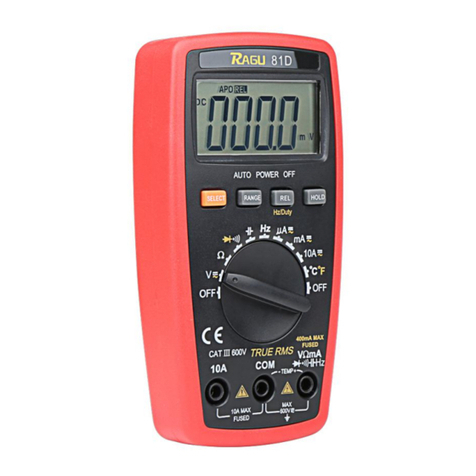
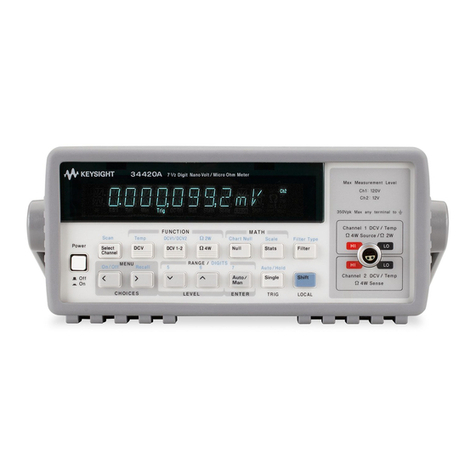
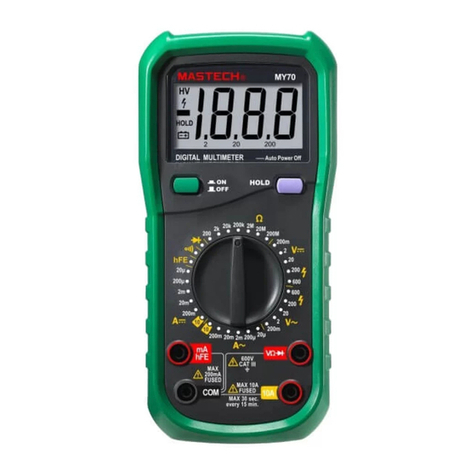
meter.
-When measuring high voltage, more attention should be paid to personal safety and avoid
your body getting in touch with high voltage circuit.
- After measuring, disconnect test leads from circuit under test immediately.
3. AC voltage measurement
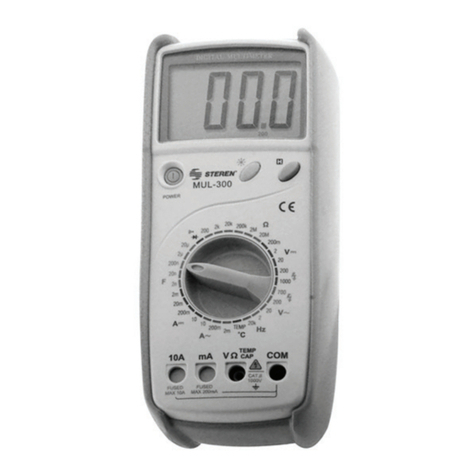
A) Insert red test lead and black test lead into V/Ω/Hz and COM input jacks respectively.
B) Rotate function selection switch to , which is for AC voltage measurement.
C) Connect test end of the test lead with circuit under test.
D) Read the measured value from the display screen.
Note:
-Before measuring, since the influences of previous measurements or test environment around,
the values showed on display screen maybe not return 0. Don’t worry about that, it will not
affect the measuring results for this time.
-Do not measure input voltage which is higher than 750Vrms. Otherwise, it may cause
damage to the meter.
-When measuring high voltage, please pay more attention to prevent electric shock.
-After measuring, disconnect test lead from circuit under test immediately.
4. DC current measurement
A) Insert the black test lead into COM input jack and red one into mA/uA jack (Max 600mA),
or insert the red one into 10A input jack(Max 10A). The initiate state of the measuring current
is DC current. Press “Select” button to switch the mode.
B) Rotate function selection switch to DCA. Then connect the test leads to the tested circuit in
series, the tested current value and the current polarity of the point, where the red test lead is
contacted, will be displayed on the screen simultaneously.
Note:
-Turn off the power of the circuit before connecting the test leads to the circuit in series.
-Select the maximum range if you don’t know the extract current range, then adjust the range
according to the measured results on the display screen. If “OL” is showed, it indicates the
tested current value has exceeded the present range limit, please select higher range to
complete the measurement.
-The maximum input value is 600mA or 10A(depending on the socket where the red test lead
is contacted). For mA input, the overrated current will lead to fuse melt. For 10A input, the
measuring time should not exceed 10 seconds for each time, the overrated current will lead
to overheat or even damage the meter.
- Do not connect the test leads to other circuits in parallel after connecting the test leads to
current input sockets, it will damage the fuse and the meter.
-After measuring, turn off the power of the circuit, then disconnect test lead from circuit
under test immediately(especially for high current measurements).
-The input voltage between current input socket and COM socket, cannot be higher than 36V
DC or 25V AC.