aaaaaaaaa
aaaaaaaaaaa
aa
ac
3. Safety Precautions
This model is not a toy!
• Thisradiocontrolledmodelisnotatoy.Learninghowtocontrolitcorrectlyis
a gradual process.
• Childrenunder14yearsofageshouldbesupervisedbyanadult.
Driving a radio controlled car is a fascinating hobby. However, it has to be practi-
sed with the necessary caution and respect.
Aradiocontrolledmodelcarcancausedamageandinjuryandtheuserisliable
for any such incident.
Make sure that you have sufficient insurance cover when practising your hobby.
Only a well maintained model will function in a correct manner. Only use appro-
ved spare parts and never improvise with any unsuitable items.
It is the user’s responsibility to ensure that the model is functioning correctly and
that all nuts, bolts and screws are properly tightened.
Pay attention to the charge level indicator lamps of your
transmitter.
• Batteriesfortransmitterandreceiverarewellchargedandofthecorrect
voltage.
• Alwayschecktherangeofradiooperationbeforestartingthecar.
• Makesurethatallservosrespondcorrectlytothesignalsofthetransmitter.
• Alloperablepartsareingoodconditionandyouhavetestedtheiroperation.
• Youhavemadesurethatallscrewsaretightened.
• ThereisnootherRCorsimilartransmitternearby,whichcouldcauseinterfe-
rence. Any further radio signal on the same frequency can cause the loss of
control for your
model. Always switch on the transmitter first to avoid any uncontrolled reac-
tion of the receiver to a foreign radio impulse.
• Fullyextendthetransmitterantennaandmakesurethatnobodyinyouren-
vironment controls a model with the same frequency (number on the crystal)
and that there is no discernable interference. To end the operation switch off
the receiver first, then the transmitter.
• Keepyourcarawayfromhighvoltagecablesorradiomasts.
• Neverusethemodelduringlightning.
• Atmosphericdisturbancescanaffectthesignalsofyourremotecontrolling
transmitter.
• Donotusethemodelinwetareas.Theelectricalconnectionofthemodel
is not waterproof. Therefore do not drive while it‘s raining, snowing, or in
puddles or wet grass.
• Alwaysavoidrunningradiocontrolmodelsinrestricted,confinedorpopulated
areas.
• Keepawayfromroads,highways,peopleandanimals.
• Chooseasufficientlyopenandlargearea;itshouldbefreeofobstacles.
• Donotdrive,ifyouareovertiredoryourreactivityisimpairedinanotherway.
• Watchyourmodelconstantlyanddonotbecomedistracted.
• Thebodyshellshouldbecorrectlyattachedtothevehiclebeforedriving.
• Allowcoolingtimefortheenginecomponentsbeforeremovingthebodyshell.
• Someparts(e.g.themotorandthemuffler)becomeextremelyhotduring
operationandcouldcauseseriousinjury.
Pay attention to charge announcement of your transmitter.
• Ensurethatthebatteriesfortheradioandreceiverarefullychargedand
of the correct voltage. When the batteries are running low you might loose
control of your model.
• Neverusefullyloadedbatteriesandbatterieswhichhavealreadyrunlow,or
batteries of a different capacity at the same time.
• Neverloadbatterieswhicharenotrechargeable.
If you do not use the model for a longer time you must remove the rechargeable
battery.
Safety Instructions and Intended Use
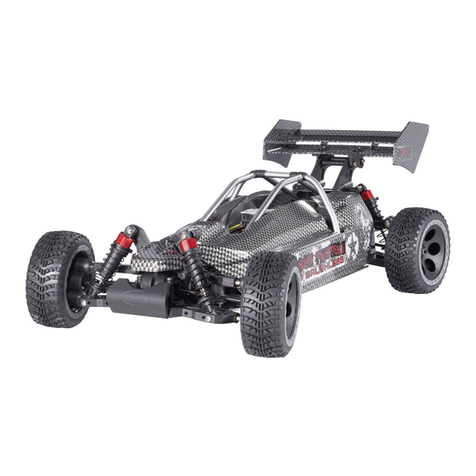
This internal combustion engine R/C car is a remote-controlled, two-stroke
engine-driven model car. It is designed for recreational purposes only and should
only be driven on designated tracks or in designated areas. Do not use this
model car in enclosed spaces. These cars should not be driven close to people
or animals.
Never transport goods, people or animals on an internal combustion engine R/C
model car.
In order to prevent errors, always read the operating instructions carefully prior
to use!
The R/C model car should only be driven in suitable areas. Never race it on
public roads. Model cars should only be used with a correctly fitted upper body.
Prior to removing the upper body, always turn off the engine and allow it to cool
down, as the cooling head and exhaust pipe become hot during operation. The
model car should not be used in close proximity to people over a longer period,
since hearing loss may occur.
To prevent malfunctioning of the control system, and therefore erratic driving
behaviour, always check the correct charge state of the batteries in the transmit-
ter and the receiver. For simultaneous operation of several vehicles, the model
car should only be operated at a free frequency.
Always check that the model car is assembled correctly prior to and after each
use. If necessary, retighten nuts, bolts and screws. Always check that the tank
system is sealed correctly prior to each use. The fuel tank cap has to be closed
tightly.