7
INSTALLATION AND OPERATING INSTRUCTIONS
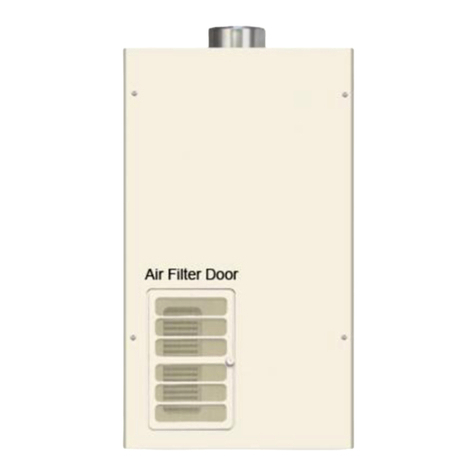
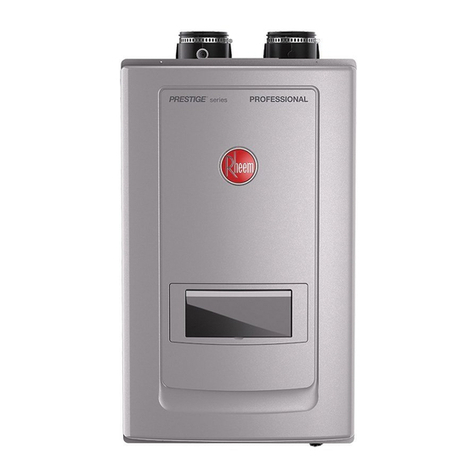
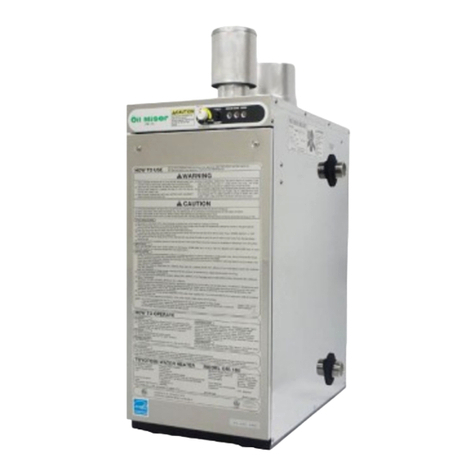
TANKLESS WATER HEATER 199
PRE-INSTALLATION CHECK
Carefully consider clearances and access, vent travel and termination, gas
supply, condensate removal and combustion air supply.
Consider the following:
•Install the water heater in areas where the combustion air source is free of
contamination. Exposure to corrosive chemical fumes such as chlorinated
and/oruorinatedhydrocarbonscanreducethelifeofaunit.Cleaners,
bleaches,airfresheners,refrigerants,aerosolpropellants,dry-cleaninguids,
de-greasers and paint-removers all contain vapors that can form corrosive
acidcompoundswhenburnedinagasame.Avoidairbornechloridessuch
as those released with the use of laundry detergents.
•Locate the unit where water leakage will not result in damage to the area (for
example,donotinstallabovecarpeting).Ifyoucannotndasuitablelocation,
installadrainpanwithanadequatedrainundertheappliance.
•At a new construction site, or during renovations, protect the unit from drywall
dust or other construction related contaminants.
○Ensure combustion air is drawn from a CLEAN source (e.g. outdoors).
○Isolate the unit from interior dust sources.
•When the unit is in operation, assess the impact of the steam plume normally
experienced at the exhaust terminal of a condensing water heater. Generally,
intake and exhaust pipes should terminate at a rooftop or wall location free of
obstructions. Water heater condensate is corrosive. Protective measures must
be taken to prevent corrosion damage to metal roofs or other metal building
components in contact with the condensate. Keep exhaust plumes well
away from all building air intakes including those of neighboring properties
byfollowingallrequirementsofthejurisdictionhavingauthorityandthis
installation manual.
•Place the exhaust outlet so it reaches 12" minimum above the down-turned
intaketoavoiduegascontaminationofthecombustionair.
•For sidewall venting options: Both the inlet and exhaust terminations must
be located on the same side of the building. You can elevate both pipes
in“periscopestyle”afterpassingthemthroughthewalltogainrequired
clearance above grade and snow level.
•Examine the condensate outlet to ensure proper disposal of condensate
will occur during operation. A condensate neutralizer must be installed if the
condensatewillowintoadrainsubjecttocorrosion.
•Ensure that the pressure relief valve is installed with no valves or other
means of isolation between its inlet and the unit. Pipe the relief valve with
unobstructed piping (minimum 3/4" diameter) to a safe discharge location.
• Inlocationswherepowersupplyqualityvariesorisunstable,consider
installing surge protection and power conditioners (up to and including battery
back-up uninterrupted power supply devices).
•Ensure the domestic hot water demands are considered before purchasing
the Tankless Water Heater. You may need to add a storage tank.
CAUTION
Care must be taken to
properly size the unit for
its intended use. Prolonged
full-re run time, over-
sizing or under-sizing,
and incorrect ow rates
through the unit can lead
to increased maintenance
costs, equipment stress and
premature failure.
WARNING
Do not use this unit if any
part has been under water.
Immediately call a qualied
service technician to inspect
the unit and to replace any
part of the control system and
any gas control that has been
under water.
DANGER
Should overheating occur
or the gas supply fails to
shut o, do not turn o or
disconnect the electrical
supply to the pump. Instead
shut o the gas supply at
a location external to the
appliance.