Rob Papen QUAD 5
Sub
Sub controls the volume of the sub-oscillator. The sub-oscillator is tuned to one octave below
the oscillator. The sub-oscillator knob lets you select two different waveforms. A counter
clockwise position produces a sinus waveform. Turn it clockwise and it produces a square
waveform. The centre position turns the sub-oscillator off.
Drift
Drift adds slight irregular variations’ to the oscillator pitch. This can make a sound livelier and
is an essential ingredient for when you want to simulate the behaviour of older analogue
synthesizers that operate to a certain extent unstable and temperature dependent electronic
circuits.
Volume
This control sets the volume of the oscillator in decibels. When the oscillator is used as the
modulator for frequency or ring modulation, it controls the modulation amount.
Filter (Oscillator 1 Only)
The Filter switch allows you to disable the oscillator output to the filter. This may be useful
when you are using Oscillator 1 as a modulation source rather than a sound source as is the
case with FM and ring modulation configurations. Typically, you will want to leave this switch
on so that oscillator 1 sound flows through the filter.
Sync (Oscillator 2 Only)
The Sync control allows you to synchronise (Sync) the oscillator 2 Pitch to the pitch of
Oscillator 1. In Hard Sync mode, Oscillator 2’s waveform is reset every time Oscillator 1
waveform ends its cycle. This essentially cuts of the Oscillator 2 waveform and resets it to
zero, in sync with oscillator 1. Because of the reset, the oscillator 2 waveform will undergo
abrupt changes in its shape. These abrupt changes are audible as additional overtones
(harmonics). The pitch control of oscillator 2 has now become a harmonics control.
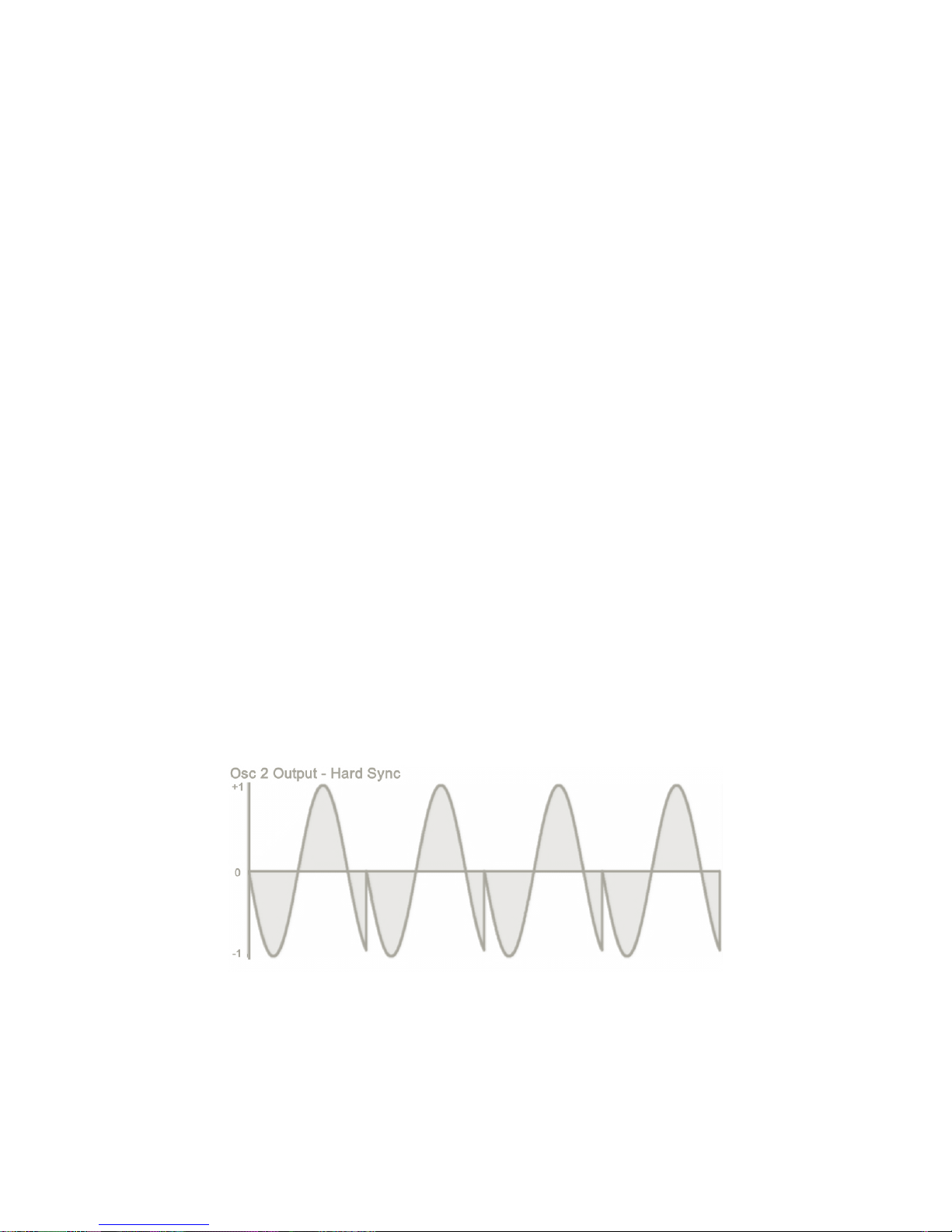
In the example below, Oscillator 2 is hard synced to Oscillator 1 where Oscillator 1 is tuned 3
semitones below Oscillator 2. When Oscillator 1 completes its cycle, you can see Oscillator 2
being reset to its initial position, resulting in a (harmonic) spike towards the end of its
wave cycle. This is what generates the additional harmonics.
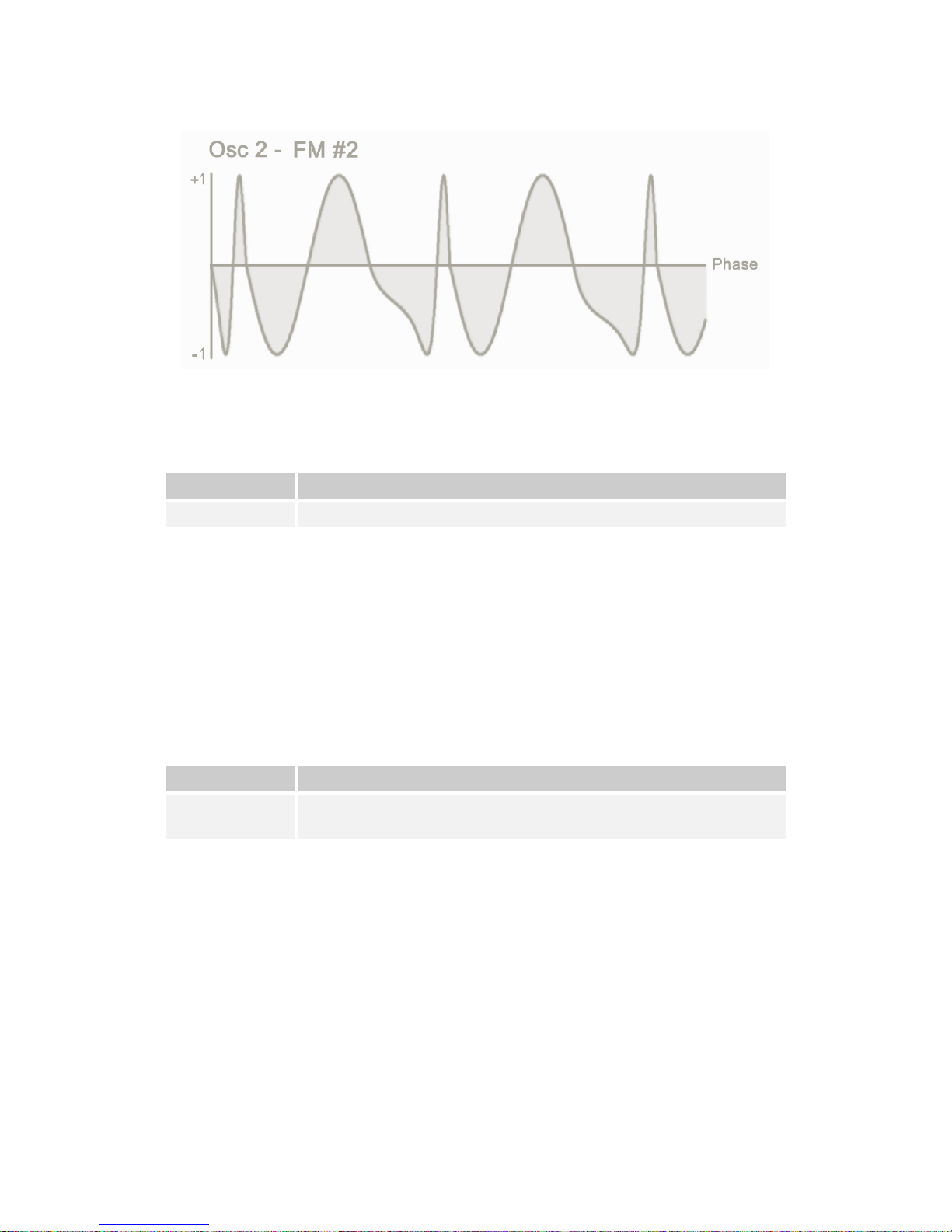
In Soft Sync mode, Oscillator 2’s waveform is also coupled to Oscillator 1’s wave cycle, but in
a much more subtle way. When oscillator 1 finishes its wave cycle, it reverses the synced
oscillator 2 waveform direction Oscillator 2 retains its own pitch, but the reversal of its
waveform introduces additional overtones in the oscillator output. It is a much more subtle
effect than hard sync.