B
green yellow : earth blue : neutral brown : live
As the colours of the wires in the mains lead of this appliance may not correspond with the coloured
markings identifying the terminals in your plug, proceed as follows.
- The wire which is coloured green and yellow must be connected to the terminal in the plug which is
marked with the letter E or by the earth symbol or coloured green or green and yellow.
- The wire which is coloured blue must be connected to the terminal which is marked with the letter N
or coloured black.
- The wire which is coloured brown must be connected to the terminal which is marked with the letter
L or coloured red.
ATTENTION E
T
1) raw a vertical line onto the wall from the centre of the cooking appliance up to the ceilling, using a
spirit level and a marker pen as illustrated in . This is to ensure the correct align-
ment of the chimney hood.
2) Place one of the brackets on the wall about 1 or 2 mm from the ceiling or from the upper limit,
aligning its centre (notches) on the vertical line. ark the two eyelet holes of the bracket onto the
wall. Place the other bracket on the wall, aligning it with the vertical line, at a distance
measured as in equal to the height of the upper chimney stack provided with the
hood. The measurement may have different values, according to the available heights of the upper
chimney stack. rill the holes for the 2 xing brackets using an mm masonry bit. Fix the chimney
brackets using the 4.2 x 44.4 mm screws and rawl plugs supplied.
3) rilling xing holes ( :
ark a point on the vertical line at a distance from the cooking appliances of:
d (easurement without splashback).
d height of the splashback + (easurement with splashback).
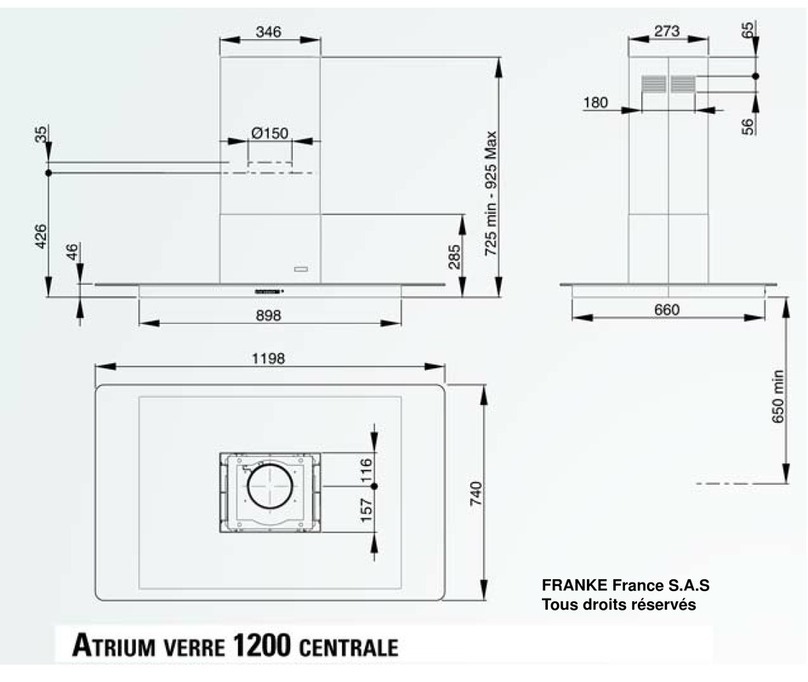
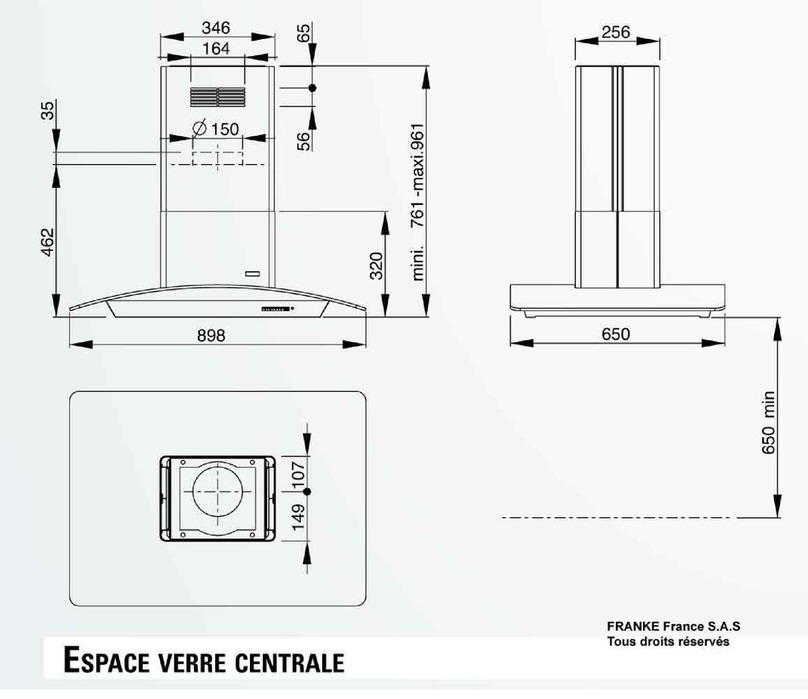
The distance H is the minimum height in mm from the cooking appliances to the bottom edge item 3 of
the front panel of the hood.
At the point marked, draw a horizontal line parallel to the cooking appliances. rill two holes in the wall
using an mm drill bit and insert the rawl plugs and screws into the holes (4.2 x 44.4 screws). Fix
the screws, leaving a space of required to hook up the canopy ( ). Small adustments
can be made using the hood adustment screws (see Fitting the canopy). The hood should have a
maximum excursion of .
Splashback (optional): hen a splashback is to be tted, the distance between the hood and the cooking
appliances will be determined by the height of the splashback and whether or not there is
a raised back on the worktop. The splashback is to be installed before installing the canopy. If the
splashback is to be xed to the wall using both the top and bottom xing holes, Care must be taken
to ensure that the splashback is tted at the correct height before xing the base units or at least the
worktop covering them. As this is a complex operation, it should only be undertaken by the technician
installing the kitchen units or by a competent person who knows the nal dimensions of the units.
4) Fixing the canopy: Before starting to x the canopy it will be necessary to adust the support brackets
by turning the adustment screws in a clockwise direction until their reach their limit ().
Hook the canopy onto the two size 4.2 x 44.4 screws 12b tted as described above (2/).
Level the hood by turning the adustment screws and then locking the screws 12b.
5) ucting:
The hood is more effective when used in the extraction mode (ducted to the outside). hen the cooker
hood is ducted to the outside, charcoal lters are not required.The ducting used must be 150 mm (6
INS), rigid circular pipe and must be manufactured from re retardant material, produced to BS.46
or IN 4102-B1. herever possible use rigid circular pipe which has a smooth interior, rather than
the expanding concertina type ducting.
aximum length of ducting run: