ROBOOTER E40 User manual
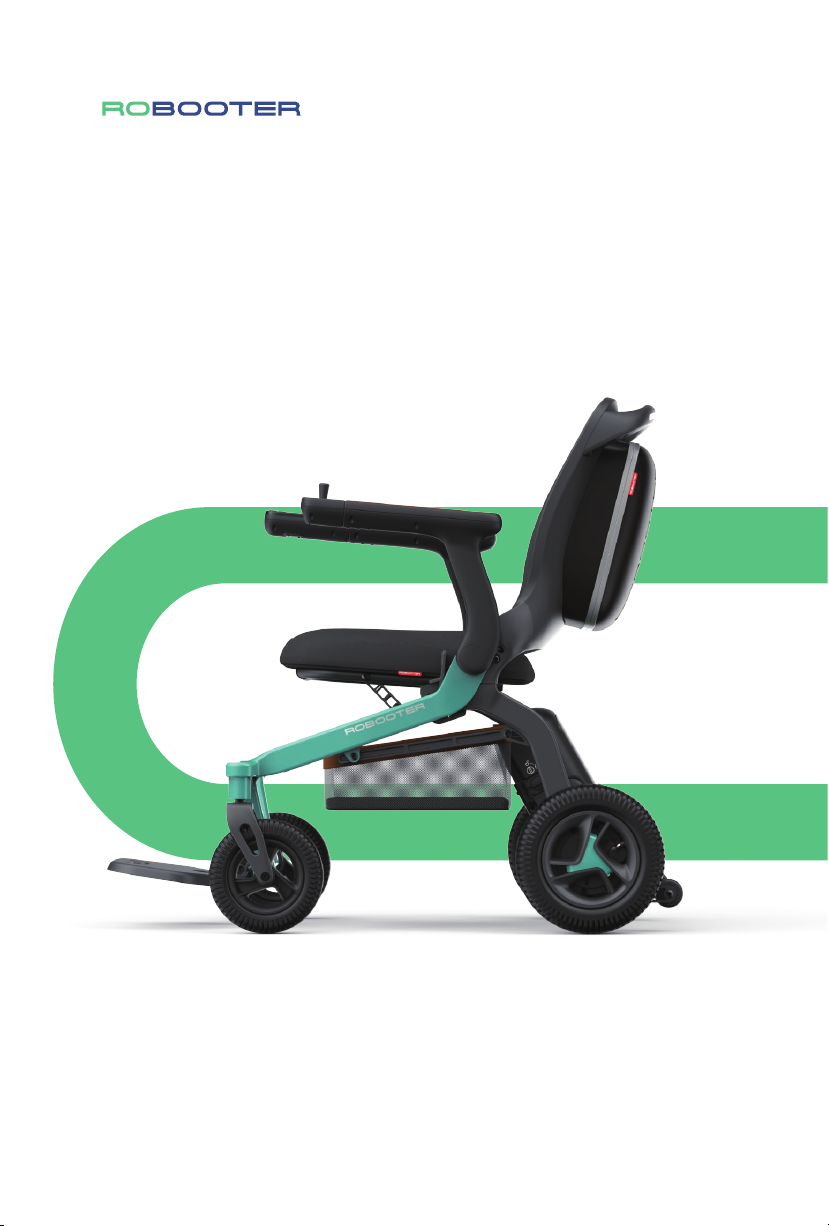
instruction manual
ROBOOTER E40
Shanghai Bangbang Robotics Co., LTD.
BBR-QP-BOX-01, Rev.VE1.0
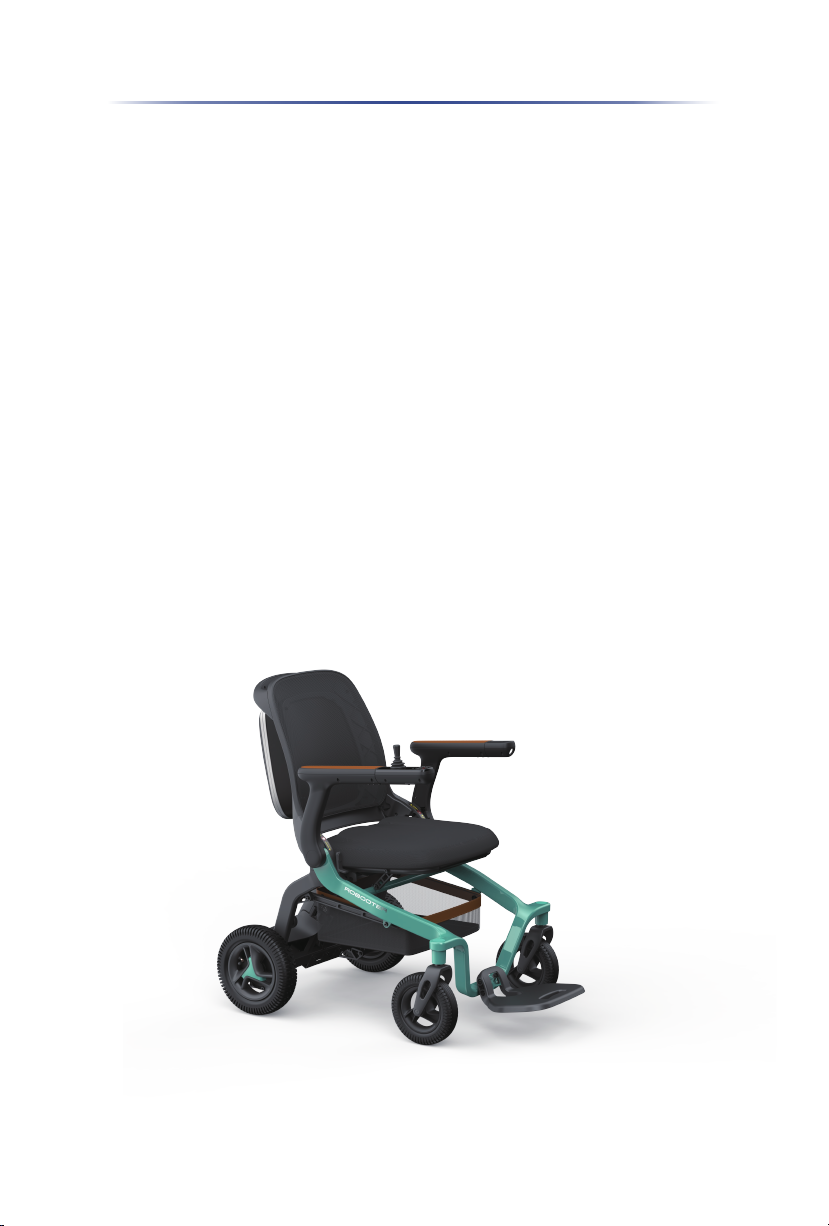
Dear users:
Thank you for choosing the electric wheelchair of Shanghai Bangbang Robotics
Co., LTD. Robooter E40 Product Manual is an important document that provides
the product information, operation methods and after-sales service information
of the electric wheelchair. Before use, please carefully read Robooter E40
Product Manual for correct operation and maintenance. This manual contains
information protected by patent rights and copyright. Do not copy the content
either partially or completely without the written permission of Shanghai
Bangbang Robotics Co., LTD. The contents of this manual are subject to change
without prior notice. For the latest information on the equipment, please visit
the Robooter website.
CONTENTS
01

8.Packing list
CONTENTS INCLUDE
1.Safety precautions 2.Product introduction
3.Part introduction
of the electric wheelchair
4.Use of the
electric wheelchair
5.Maintenance and
troubleshooting
6.APP operation guide
of the electric wheelchair
7.Disclaimer
02

This electric wheelchair has passed the test in accordance with ISO 7176-9
Climatic Test.
1.Safety precautions
1.1 Symbol description
1.2 Applicable range of this product
1.3 People unsuitable for using this product
Warning
The text contents with this symbol mean that, in case of being ignored,
there may be serious injury.
Notes
Warning
Contraindications: The patients with mental problems, including the users
who temporarily or permanently lose attention or judgment, are not allowed
to use this product.
1.4 Precautions for electrical safety
The text contents with this symbol mean that, in case of being ignored,
there may be slight or moderate damage or material damage.
Notes
helping disabled, elderly and frial people who have difficulty walking to move.
03

1.5 Product use conditions
Notes
Notes
Environmental temperature: -10℃~50℃; Relative humidity: 20%~95%;
Atmospheric pressure: 70kpa~110kpa; No strong electromagnetic interference.
The safety belt is used as a safety accessory; it is used to prevent the user from
rushing out of the Electric Wheelchair when it stops in operation to ensure the
safety of the user.
1.6 Disposal considerations
This test ensures that the users or escorts of the electric wheelchair have
enough time to move the electric wheelchair from the rain to a safe place;
Do not operate the electric wheelchair in thunderstorms;
Do not place this electric wheelchair under a rainstorm;
Do not place this electric wheelchair in a wet place for a long time;
Do not spray or wash the electric wheelchair with an automatic car wash. If
being directly exposed to rain, smog or wet air, the electric wheelchair may
have an electrical and mechanical fault or go rusty.
1.Safety precautions
04
In accordance with local laws and regulations, your product shall be processed
separating from the domestic waste. The product shall be recycled in the
recycling point designated by local government. The classified collection and
recycling of this product facilitate conservation of natural resources.

1.7 Precautions during use
(1) Driving on slopes
This electric wheelchair has passed the test requirements of climbing on a slope of
not exceeding 9° with a load of 150kg. Do not try to climb the slopes exceeding 9°.
During reversing on a slope, please be sure to slow down the electric wheelchair. Do
not reverse on a slope exceeding 9°. During reversing, please be extremely careful.
(2)The ability of climbing slope and driving distance are affected by battery and
following environment:
For example: Weight of the users; Topography (such as grass or gravel); Gradient
of hill; Battery life and service life; Extreme temperature; Use and weight of the
fittings, etc.
(3) Braking
When the electric wheelchair brakes, please sit down and hold the handrail firmly.
When releasing the upper controller rocker, the electric wheelchair will stop within
seconds.
Note: Electromagnetic brake will not take effect immediately and will take effect
after the wheel rotates.
(4) Emergency braking
In case of critical situation or unexpected movement, press the power switch key to
make the electric wheelchair stop (this emergency brake is effective, however, it
shall not be used under normal conditions).
Note: Frequent use of emergency brake may make the motor faulty and further
prevents the electric wheelchair from being normally used.
(5) Use of mobile phone
Do not drive the wheelchair with Mobile Application at any time. Please pay
attention toroad condition when you driving. The Mobile Application only can be
used to help patient move wheelchair and set parameters, NOT used to drive
wheelchair.
(6)The Electric wheelchair may not be fixed as a seat in a moving vehicle.
(7)The speed of the whole vehicle will vary depending on the tire pressure, ground,
environment and power.
Please follow the traffic rules.
05
1.Safety precautions

1.8 Specific warnings (please read carefully)
1.8 Specific warning (please read carefully)
Do not perform snake driving, high-speed sharp turn and other dangerous driving
operations, otherwise it may lead to the electric wheelchair tilt and human injury;
Do not use the electric wheelchair on escalators, which may increase the risk of
being injured;
Do not drive on the motor vehicle lane or non-pedestrian;
Do not drive on the surface of water, oil, ice or other slippery objects. If not, the
electric wheelchair may be out of control;
Do not try to cross the obstacle or ditch of 40mm. If not, personal injury may be
caused;
Do not sharply bend or move backwards under high speed driving;
Do not take passengers on the electric wheelchair;
Do not operate the electric wheelchair without checking the fasteners, connectors
or detachable parts for correct connection and fastening. Please always pay
attention to the surrounding environment;
Do not repair any part, fitting or adapter of the electric wheelchair without
authorization;
Do not get on without braking;
Do not operate the electric wheelchair when your judgment may be affected
(such as drink, take drugs or take medicine);
Do not operate the electric wheelchair when you are suddenly out of sorts;
Do not operate the electric wheelchair when your sight is seriously weakened;
For the injury accident caused by violation of local or international laws or
regulations, we undertake no responsibility;
All the functions can only be operated after you correctly sit on the seat;
Do not place your feet in any part out of the pedal;
Do not stand on the electric wheelchair;
Do not try to go up and down the slope exceeding 9°;
Do not reverse on the slope exceeding 9°;
When driving on the slope, release the control system, and the electric wheelchair
may step back; When moving forward or backward, the electric wheelchair may roll
06
1.Safety precautions

before the braking function takes effect. Please take care of safety;
Before use of the electric wheelchair, please check the connection of all electrical
parts for safety and reliability;
Do not disconnect, snip or modify the wiring harness parts which have been
installed on the electric wheelchair under any condition.
Do not use other unqualified batteries, such as the lead acid batteries which cannot
be recycled, the batteries of other manufacturers, etc.
Before installation, please read the information related to batteries and battery
charger.
The Electric wheelchair may not be fixed as a seat in a moving vehicle.
In case of violation of the above requirements, there may be unexpected damages.
1.Safety precautions
07

1.9 Excerpts from EMC-related guidelines and statements
in manufacturer's accompanying documents
1.Safety precautions
Phenomenon
RF emissions
Harmonic distortion
Voltage fluctuations and flicker
Compliance
CISPR 11 Group 1,Class B
IEC61000-3-2 Class A
IEC61000-3-3 Compliance
Electromagnetic environment
Home healthcare environment
Home healthcare environment
Home healthcare environment
EMS Compliance Table (Table2-5)
EMI Compliance Table(Table 1)
Table 1-Emission
Phenomenon
Electrostatic
Discharge
Radiated RF
EM field
Proximity fields
From RD
Wireless
communications
equipment
Rated power
Frequency
Magnetic fields
Basic EMC standard
IEC 61000-4-2
IEC 61000-4-3
IEC 61000-4-3
IEC 61000-4-8
Immunity test levels
Home healthcare environment
±8kV contact
±2kV,±4kV,±8kV,±15kV air
20V/m
26MHz-2.5GHz
80% AM at 1kHz
10V/m
80MHz-2.7GHz
80% AM at 1kHz
Refer to table 3
30A/m
50Hz or 60Hz
Table 2-Enclosure Port
08

Table 3 ‒ Proximity fields from RF wireless communications equipment
1.Safety precautions
Test
Frequency
(MHz)
385
450
710
745
780
810
870
930
1720
1845
1970
5785
Band
(MHz)
380-390
430-470
704-787
800-960
1700-1990
Immunity test levels
Home healthcare environment
Pulse modulation 18Hz,27V/m
FM,±5kHz deviation 18Hz sine,28V/m
Pulse modulation 217 Hz sine, 28V/m
Pulse modulation 18Hz sine, 28V/m
Pulse modulation 217Hz sine, 28V/m
Table 4 ‒ Input a.c. power port
Electrical fast
Transients/burst
Surges
Line-to-line
Conducted
Disturbances
Induced by RF
fields
Voltage dips
Voltage
interruptions
Standard
IEC 61000-4-4
IEC 61000-4-5
IEC 61000-4-6
IEC 61000-4-11
IEC 61000-4-11
Home healthcare environment
±2KV
100kHz repetition frequency
±0.5kV,±1kV
3V, 0.15MHz-80MHz
6V in ISM bands and amateur radio bands
Between 0.15MHz and 80MHz
80%AM at 1kHz
0% UT;0.5 cycle
At 0°,45°,90°135°,180°,225°,270° and 315°
0% UT; 1 cycle
and
70% UT;25/30 cycles
Single phase: at 0°
0% UT; 25/30 cycles
UT=rated input Voltage
09
Table of contents