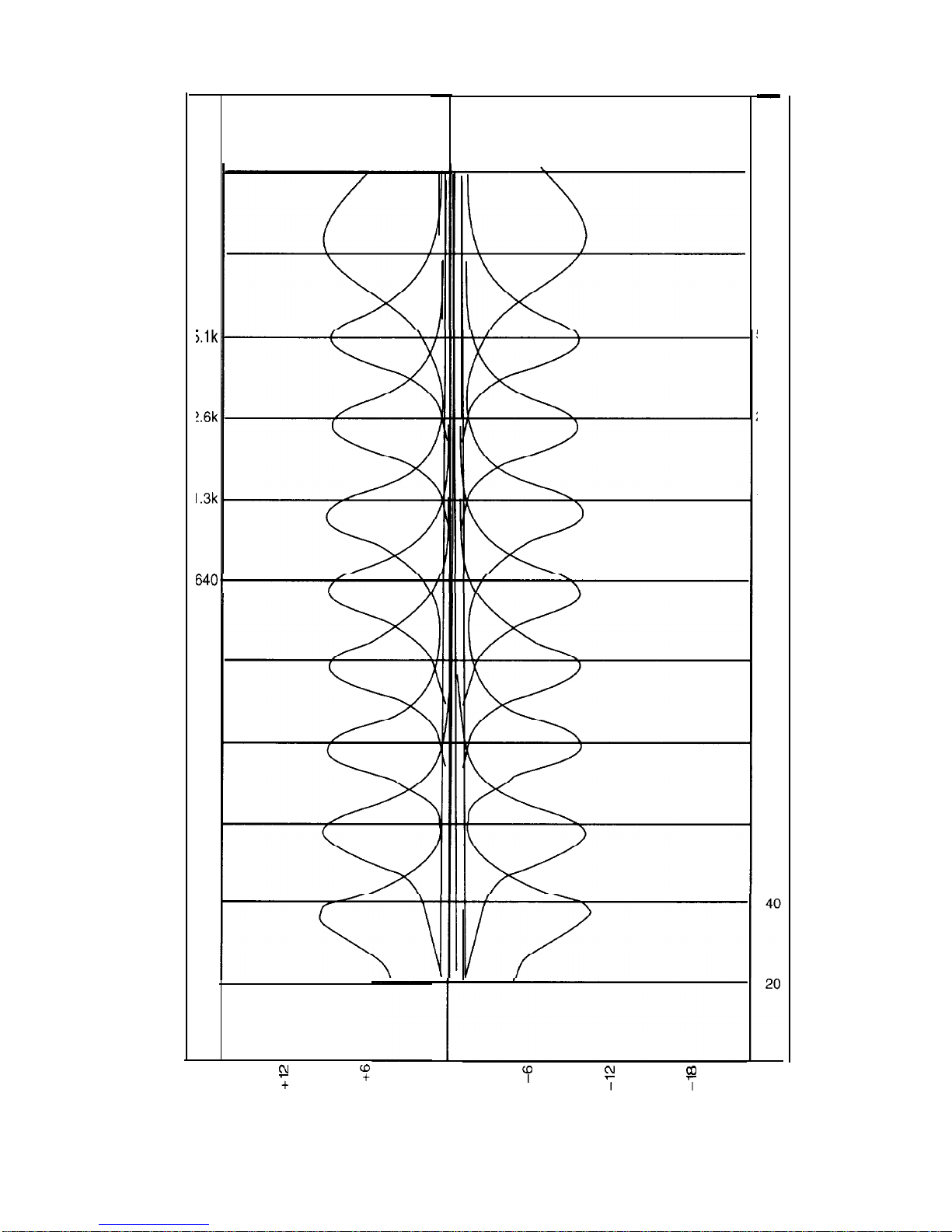
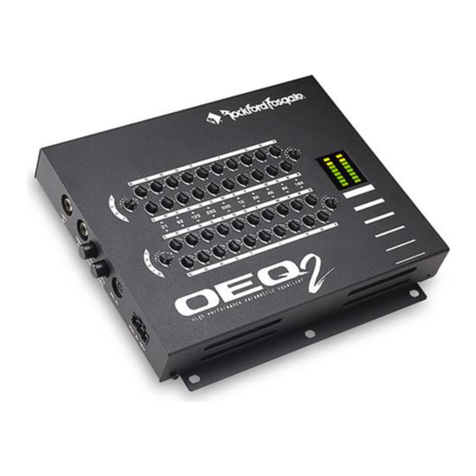
FREQUENCY SHIFT: When a high-resolution test instru-
ment (one-third Octave RTA or swept tone analyzer) is used,
it is common to find that a problem dip or peak is located
between the band centers of the equalizer. The OEQ-I has
controls to shift the center frequency of each band up or
down one-half octave, eliminating this frustrating problem.
FULLY-FLOATING POWER SUPPLY: Most autosound
signal processors use the battery voltage to power internal
circuitry. This practice leads to two potential problems:
inadequate headroom and noise. The noise associated with
directly battery-powered equipment arises from the pres-
ence of a direct ground path from circuitry to chassis. This
provides the potential for a ground loop, a path for alternator
whine and electrical system noises to enter the system. The
headroom issue resolves itself to a simple lack of voltage.
Typical maximum voltages available from a battery alone
amount to about 3.5 Volts RMS. Many sources put out over
one Volt RMS, leading to less than 11dB or headroom.
The OEQ-1 employs a fully isolated 36-Volt (plus and minus
18 Volt) supply. There is no DC path to chassis ground, so
ground loops are eliminated. The high voltages allow pre-
and de-emphasis for the most sensitive frequencies lead to
exceptional noise performance.
EQUALIZING WITH A REAL TIME ANALYZER
For best resolution, a 30-band (1/3 Octave) Real-Time
Analyzer (RTA) or a swept spectrum analyzer with
1/3-
Octave resolution should be used. A lo-band, l-Octave
resolution RTA will give decent results, but is harder to use.
Either RTA method will require a pink noise generator.
An extender cable is available from Rockford which allows
the equalizer to be adjusted from a convenient location.
NOTE: If you would like further advice on acquiring the
above mentioned support equipment, feel free to call
Rock-
ford at 602-967-3565.
Step 1: The RTA or analyzer microphone should be set up
near the driver’s listening location. Microphone placement
will have a significant effect on frequency response, and
moving the microphone around in the driver’s area will give
a good idea of overall response.
2