Amplification Considerations
Almost any microphone preamplifier, with nominal gain characteristics and a built-in 48-volt
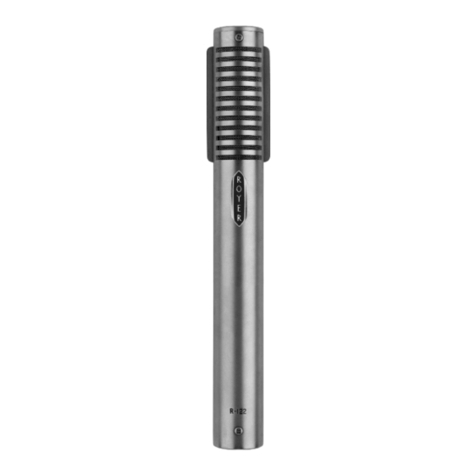
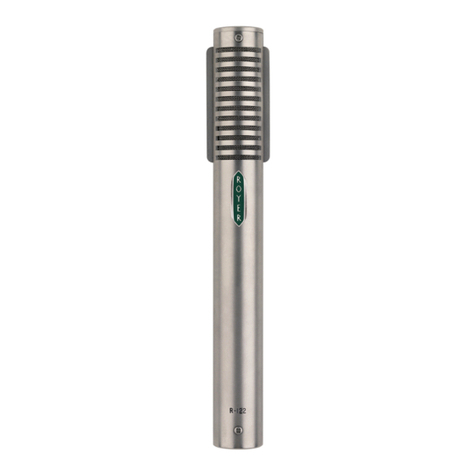
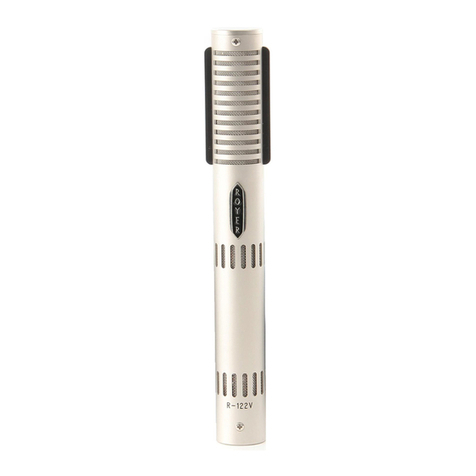
phantom power source, will give excellent results with your R-122 MKII active ribbon
microphone. Unlike standard ribbon microphones, which depend on a proper impedance match
to deliver optimal performance, the input impedance of your preamplifier will have minimal
effect on the R-122 MKII’s operational performance because the ribbon element is loaded
perfectly via the microphone’s electronics package.
Careful consideration should be given to the quality of the microphone preamplifier. Studio grade
preamplifiers usually sound much better than cheap ones. Headroom, noise floor, transparency
and coloration are all factors to consider in determining which preamplifier is suitable for your
studio or live sound application. Other features are usually secondary and fall into the category
of conveniences or interface capabilities (such as digital or optical outputs).
A good preamplifier should sound natural, with no sign of edginess or excessive noise. Vacuum
tube preamplifiers sound warm, yet wonderfully airy and transparent. Do not expect a vacuum
tube preamplifier to be as quiet as a solid-state preamp, as electron emissions from tubes tend to
convey more “thermal” noise than transistors. Tube preamplifier noise is far less of an issue with
the R-122 MKII than with conventional ribbon microphones because the R-122 MKII’s high
output will help to override the noise. Transformer coupled designs tend to sound punchy and
full-bodied and offer the added benefit of true electronic isolation. This greatly enhances their
ability to interface with other equipment with minimal noise or hum. There are many excellent
preamplifiers on the market today. Choose one that fits your budget and offers good performance,
but remember that you get what you pay for. If you have the opportunity to audition one or more
preamplifiers before you buy one, do so. Microphones and preamplifiers work together like a
team and some are just better matches than others.
The R-122 MKII active ribbon microphone is capable of substantial output signal, especially if
used in conjunction with very loud signal sources such as guitar amplifiers. Judicious use of the
switchable pad and cut filter can be very useful in taming difficult sound sources. Signals that are
extremely loud may require additional padding at the preamplifier, and most quality
preamplifiers offer a switchable input pad in -10 dB, -15 dB or -20 dB steps. Some preamplifiers
are more thoughtfully designed than others, and a suitable pad will be provided before the active
electronics, not incorporated into a “feedback loop” as some cheaper models do. The latter
design could still produce unwanted distortion due to overloading, even if the pad were used.
Although this is rarely an issue, we felt that it was important to cover the subject.
Equalization & Ribbon Microphones
One of the great strengths of ribbon microphones is how well they take EQ. Even with
substantial amounts of equalization, ribbons retain their natural, “real” quality. For example,
when a lead vocal is being performed on an R-122 MKII, you can actually boost upper-end
frequencies to the point where the R-122 MKII emulates the performance curve of a condenser