5
Stand 03/20187 TM
5
OPERATION / OPERATION
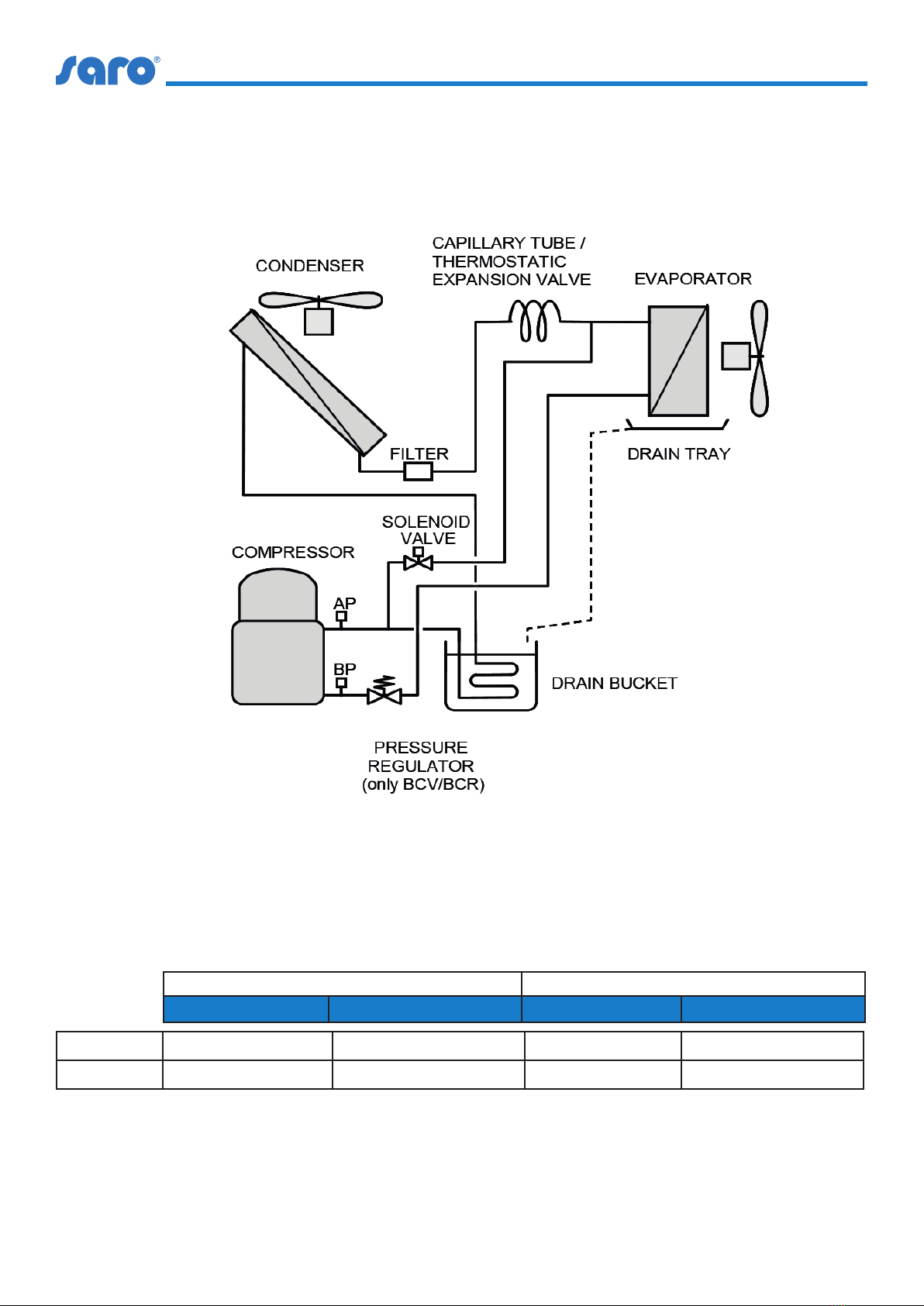
INTARBLOCK and INTARTOP are refrigeration machines
operating under a vapour compression cycle.
Refrigeration cycle
The refrigeration cycle uses a phase change refrigerant uid
in a closed circuit, with the following four
steps:
Expansion: refrigerant expansion takes place in the capillary
tube between high and low pressure sections. During the
expansion, liquid refrigerant cools down to the evaporating
temperature.
Evaporation: In the evaporator the refrigerant evaporates
under constant temperature and pressure absorbing
heat from the cold room. Once the refrigerant vapour has
been fully evaporated, it is slightly overheated beyond the
evaporation temperature.
Compression: The resultant refrigerant vapour is suctioned
from the evaporator by the compressor through the suction
line. The compressor compresses the refrigerant vapour up to
high pressure and temperature.
Condensation: the hot high pressure gas is desuperheated
and condensed, at a constant pressure
and temperature, in the el condenser by exhausting the latent
evaporation to the outer ambient. Once
the refrigerant has been fully condensed, the liquid
refrigerant is overcooled beyond the condensing
temperature.
High pressure liquid refrigerant is then driven to the capillary
tube, and therefore closing the circuit.
Defrost cycle
Because of the evaporator temperature can be below 0ºC
(32ºF), frost is likely to deposit on the vaporator surface
through the condensation of the water vapour contained in
the air. To prevent the air ow from being obstructed with the
consequently loss of performance, the instrument switches
automatically to the defrost operation mode every given
period of time.
During the defrost cycle, by opening the solenoid valve, part
of the hot gas from the compressor discharge is injected
into the evaporator. The evaporator temperature is rapidly
increased in order to melt the frost on it while the inside fan
is o.
The defrost water is collected in the drain tray and conducted
to the drain bucket. This drain bucket contains a hot gas
coil to progressively evaporate the drain water to the outer
ambient.
INTARBLOCK und INTARTOP sind Kältemaschinen, die unter
Dampfverdichtung arbeiten.
Kältekreislauf
Der Kältekreislauf verwendet ein Phasenwechsel-Kältemittel
in einem geschlossenen Kreislauf mit den folgenden vier
Schritten:
Expansion: Die Kältemittelausdehnung ndet im Kapillarrohr
zwischen Hoch- und Niederdruck statt.
Sektionen. Während der Expansion kühlt üssiges Kältemittel
auf die Verdampfungstemperatur ab.
Verdampfung: Im Verdampfer verdampft das Kältemittel
unter konstanter Temperatur und Druck, wobei die
Wärme aus dem Kühlraum absorbiert wird. Nachdem der
Kältemitteldampf vollständig verdampft ist, wird er über die
Verdampfungstemperatur hinaus leicht überhitzt.
Verdichtung: Der entstehende Kältemitteldampf wird vom
Verdampfer durch den Verdichter über die Saugleitung aus
dem Verdampfer angesaugt. Der Kompressor verdichtet den
Kältemitteldampf unter hohen Druck und Temperatur.
Kondensation: Das heiße Hochdruckgas wird bei konstantem
Druck destilliert und kondensiert.
und Temperatur, im el-Kondensator durch Absaugen der
latenten Verdampfung in die äußere Umgebung. Einmal
Das Kältemittel wurde vollständig kondensiert, das üssige
Kältemittel wird über die Kondensation hinaus überkühlt.
Temperatur.
Das üssige Hochdruck-Kältemittel wird dann zum
Kapillarrohr geleitet und schließt den Kreislauf.
Abtauzyklus
Da die Temperatur des Verdampfers unter 0ºC (32ºF) liegen
kann, ist es wahrscheinlich, dass sich durch die Kondensation
des in der Luft enthaltenen Wasserdampfs Frost auf der
Verdampferoberäche ablagert. Um zu verhindern, dass der
Luftstrom mit dem daraus resultierenden Leistungsverlust
behindert wird, schaltet das Gerät automatisch nach jeder
Zeit in den Abtaubetrieb.
Während des Abtauzyklus wird durch Önen des
Magnetventils ein Teil des Heißgases aus dem
Verdichteraustritt in den Verdampfer eingespritzt. Die
Verdampfertemperatur wird schnell erhöht, um den Frost
auf dem Verdampfer zu schmelzen, während der Innenlüfter
ausgeschaltet ist.
Das Tauwasser wird in der Auangwanne gesammelt und in
den Auangbehälter geleitet. Dieser Abusskübel enthält
eine Heißgasschlange, um das Abusswasser nach und nach
an die äußere Umgebung verdampfen zu lassen.