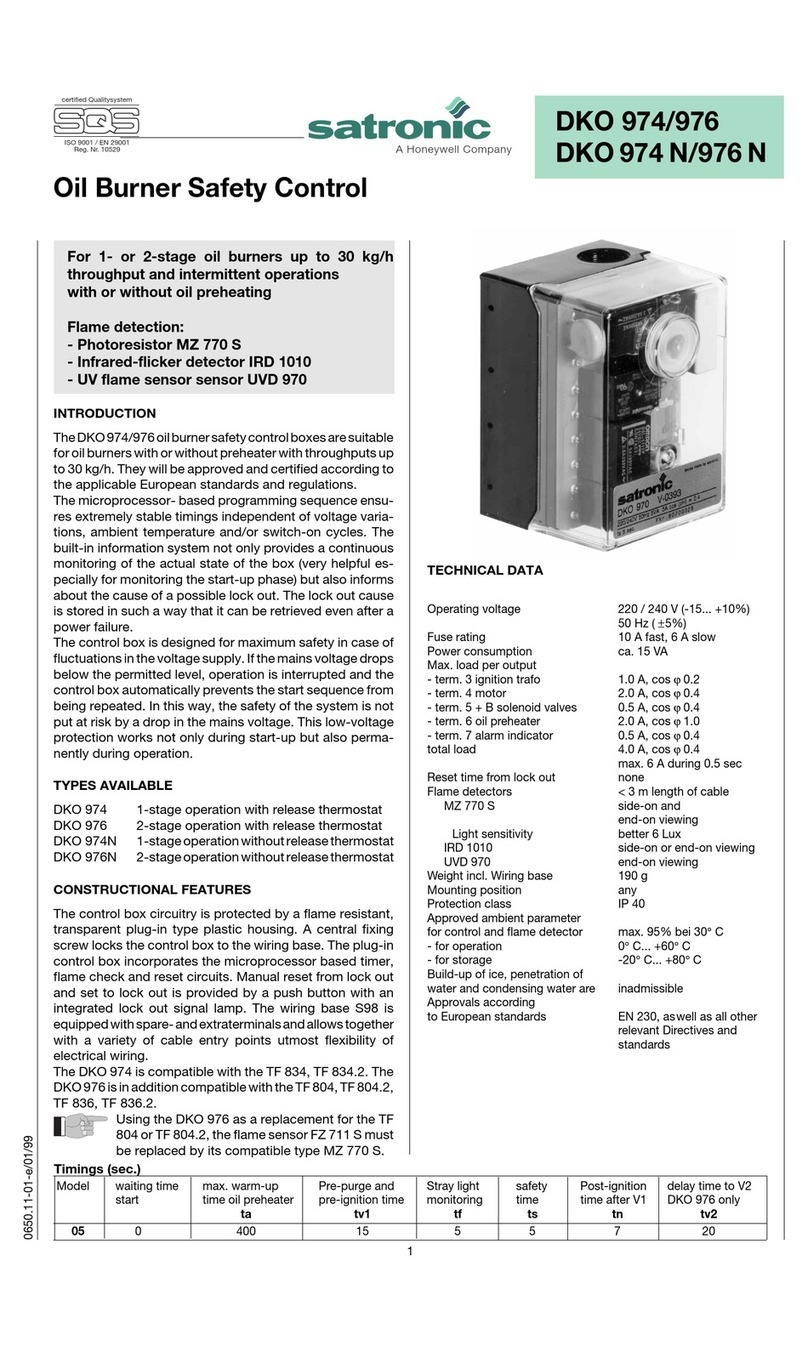
Satronic IRD 810 User manual

1
A Honeywell Company
IRD 810 / 820
740e/05/94
INTRODUCTION
The IRD 810 or 820 is employed to monitor the flame of an
oil and/or gas burner. This flame monitoring device should
be connected to a Satronic oil or gas burner control box.
Monitoring is based on the infra-red flicker principle, in other
words, the flickering infra-red light of the flame is detected.
The steady radiation from, for example, the glowing refractory
layer on the inside of the boiler, has no effect on the detector.
The detectors are also available in 110 V versions or in an
industrial version which has a particularly robust and water-
proof detector probe.
TYPES AVAILABLE
IRD 810 No potential difference at working contact
4-pole connection
IRD 820 With simulation of ionisation current
For 3-pole connection to Satronic gas burner
control boxes
CONSTRUCTIONAL FEATURES
The monitoring device consists of the detector probe and
the electronics. The infra-red sensor and the pre-amplifier
are hermetically sealed in glass and along with the electronics
form an integral part of the flame detector.
The indicator control unit contains a mains transformer and
a relay which transmits the flame signal to the appropriate
control box via a working contact which carries no other
potential difference. Signal strength is indicated by a row of
5 LED’s. Beside the LED’s is a potentiometer for infinitely
variable adjustment of the sensitivity.
A fixed cable runs between the flame detector and the
indicator control unit. This cable must not be disconnected.
Power is supplied through either a 3 or 4-core cable (live,
neutral and flame signal).
Infrared Flicker Detector
TECHNICAL DATA
Supply voltage 220 / 240 V (-15... +10%)
50 Hz (40 - 60 Hz)
Power consumption 2 VA
Max. current output terminal 2 A, 250 V
Permissible ambient temp. -20°to +60°C
Insulation standard IP 41
Mounting attitude any
Weight 250 g
Flame viewing attitude side-on and end-on
Spectral response 800 - 1100 nm
Max. sensitivity 950 nm
Frequency range 15 - 150 Hz
Max. sensitivity 30 Hz
Response time 0,1 sec.
Cancelling time 0,5 sec.
Cable length, detector -
indicator ctrl. unit
Normal version 0,5 m
Industrial version 1,0 m
Flame monitoring device for
oil and/or gas flames
With a row of 5 LED indicators and
adjustable sensitivity

2
TECHNICAL FEATURES
1. Oil and/or gas flames can be monitored.
2. The flame detector and indicator control unit are suitable
for operation where the ambient temperature lies within
the range -20°to +60°C. (Please contact the manufac-
turer for information on higher temperatures.)
3. The working contact carries no potential difference,
allowing the flame signal to be transmitted over large
distances.
4. The influence of possible stray light during the pre-purge
phase or the intensity of the flame when the burner is
operating is indicated by the row of 5 LED’s. The status
of the relay is visible at any time.
5. Sensitivity is adjustable.
6. The compact dimensions of the detector allow it to be
installed on any burner.
7. The industrial version differs from the normal version by
having a larger, robust, absolutely waterproof detector.
8. Unlike UV tubes, the IRD 810/820 flicker detector does
not deteriorate with age.
INSTALLATION INSTRUCTIONS
1. The detector probe should be fitted so that it receives the
light which pulsates most strongly. This can be achieved
by positioning the detector as close as possible to the
flame or by directing it at a particular zone of the flame.
2. No stray light must be allowed to fall on the detector (e.g.
through cracks or from a sight glass). Pulsating stray
light (e.g. from fluorescent lighting or light bulbs) could
cause the system to switch to lockout.
3. The infra-red flicker detector should be fitted in such a
way that the ambient temperature cannot under any
circumstances rise above 60°C. At higher temperatures,
there is a risk of incorrect operation and the life expectancy
of the unit could be reduced. In addition, care should be
taken that the detector is not subjected to unusually
harsh vibration and receives no hard knocks.
4. The cable connecting the detector with the indicator
control unit must not be disconnected. It must not,
therefore, be shortened or lengthened.
COMMISSIONING AND MAINTENANCE
During commissioning and after servicing, the flame
monitoring system should be checked for faultless operation
as follows:
1. Check that the detector is connected properly. Wrong
connections are a risk to safety, and could cause damage
to the detector unit or burner system.
2. Adjust to maximum sensitivity and start the burner. After
the start impulse, no LED should light up during the pre-
purge phase.
3. With the system set for normal operation, pull out the
detector probe and cover it up to cut off light. The LED
indicators must go out. The control box should switch to
lockout or attempt to restart the sequence.
4. Attempt to restart with the flame detector covered. There
must be no indication from the LED’s. The burner control
box must switch to lockout at the end of the safety
interval.
5. Attempt to start the burner with the detector exposed to
stray light e.g. from fluorescent lighting, a cigarette
lighter or light bulb (not daylight!). Depending on the type
of control box, it should switch to lockout either
immediately or at the end of the pre-purge, as a result of
stray light.
6. Re-insert the detector into its mount. When the burner is
operating normally, carefully turn back the sensitivity
control until only one LED is lit. The control box must
switch to lockout or restart the sequence.
7. Adjust the sensitivity to maximum. When the burner is
operating normally, turn back the sensitivity control until
only 4 LED’s light continuously.
We recommend this method of adjustment, because in
this way, changes in the burner settings, dirty detector
probe etc. or also the influence of stray light, can be
detected very easily. (The internal relay is activated when
2 LED’s light.)
The flame detection device requires no maintenance of any
kind, and as it is classed as safety equipment, no attempt
should be made to open the housing. The LED indicators
should be checked visually at regular intervals. If a lower
signal strength is indicated, it could mean that the burner
settings have changed or that dirt and dust have reduced
the amount of light reaching the detector.
FAULT FINDING
1. LED’s light up during the pre-purge phase (control box
switches to lockout):
a) Stray light
b) Ignition spark visible to detector (only oil burners)
Correct by preventing direct sight of ignition spark or
install Satronic high-frequency ignition transformer.
c) Interference from ignition cable (lay cables some distance
apart)
d) Live and neutral wired incorrectly
e) Burner not earthed/grounded
f) Detector or indicator control unit defective
2. No indication from LED’s after establishment of flame:
a) Incorrect or faulty wiring
b) Detector probe incorrectly installed („sees“ no light)
c) Detector is dirty
d) Sensitivity set at minimum
e) Detector probe or indicator control unit defective
220 V
Ph
Mp
IRD 810
black
black
brown
light blue
2 A
250 V
Ionisation probe connection to
o
il burner control boxes
Ph
Mp
IRD 820
black
brown
light blue
Ionisation probe connection to
o
il and gas burner control boxe
s
IRD 810/820

3
CONNECTING THE IRD 810 TO SATRONIC OIL BURNER CONTROL BOXES (PHOTO-CELL CONNECTION)
Control box type IRD 810 - cable core colours max. cable length IRD
corresponding to control box (m)
terminal no. brown light blue black black multiple cables laid separately
TF 801 9 8 1 2 2 10
TF 802 9 8 1 2 2 10
TF 830 9 8 1 2 2 10
TF 832 9 8 1 2 2 10
TF 834 9 8 1 2 2 10
TMO 720- 4 20 8 1 2 2 200
CONNECTING THE IRD 820 TO SATRONIC OIL BURNER CONTROL BOXES (IONISATION PROBE CONNECTION)
Control box type IRD 820 - cable core colours max. cable length IRD
corresponding to control box (m)
terminal no. brown black light blue multiple cables laid separately
MMI 810 9 2 8 2 200
MMI 812 9 2 8 2 200
MMG 810 9 2 8 2 200
TMG 740-2 / 740-3 20 1 8 2 200
IRD 810 AND 820 DETECTOR
50Hz 3VA˜220V
IRD 810
SR1
IP41
Swiss made by Satronic
s
06
24
3
15
bei Vorspulung
keine Anzeige bei Betrieb
min. 3 LED
18
11
28
58
85
25 18
59.5
5
5555
2A
Connection to burner control box,
standard cable length 0.5 m
IRD 810/820

4
A Honeywell Company
Satronic AG
Honeywell-Platz 1
Postfach 324
CH-8157 Dielsdorf
IRD 810 / 820
IRD 810 AND 820 DETECTORS
NORMAL VERSION
ORDERING INFORMATION
ITEM DESIGNATION ITEM NO.
Flame detector IRD 810 16001
Flame detector IRD 820 16201
Flame detector IRD 810 Industrial 16002
Flame detector IRD 820 Industrial 16202
Flame detector IRD 810 110 volts 16021
Flame detector IRD 820 110 volts 16221
Flame detector holder FZ Holder M 68 59068
Flame detector holder FZ Holder M 74 59074
Flame detector holder FZ Holder M 75 59075
Holder Industrial, UVZ + FZ 18807
The above ordering information refers to the standard version.
Spezial versions are also included in our product range. Specifications subject to change without notice.
M 74 DETECTOR MOUNT
NORMAL VERSION
2
8
ø 6,3
40
50
3
35
ø14
+0.05
0
4.5
26
47
ø20
48
IRD 810 AND 820 DETECTORS
INDUSTRIAL VERSION
DETECTOR MOUNT
INDUSTRIAL VERSION
26
30.5
42 75
96
138
22
R 40
30
10
48
36
22
8
4
This manual suits for next models
1
Other Satronic Security Sensor manuals