SMS-1001-00 | 009-1469-01 | 170330!
45 Perseverance Way, Hyannis, MA 02601!
Copyright © 2017 Savant Systems, LLC
Savant.com | 508.683.2500
Installation
The SMS-1001 can be mounted to a wall or similar, or can be installed on
a solid, flat, level surface such as a table, cabinet, or shelf. The location
should be dry, well ventilated, and out of direct sunlight.
Flat Surface Installation
When installing onto a flat surface such as a shelf, the wall bracket
should not be installed. This will allow for a flat, level installation.
Wall Bracket Installation
A two-piece wall mount bracket is included for installation to a wall or
similar. Wall mount instructions are provided below.
1!Attach the bracket that
mounts to the bottom of the
chassis using the included M3
x 6mm flat-head screws.
2!Attach the wall bracket
securely to the wall. If
mounting to drywall, a sturdy
anchor such as a threaded
drywall anchor should be used.
3!Position SMS-1001 over the
wall bracket and gently slide
into place. See image.
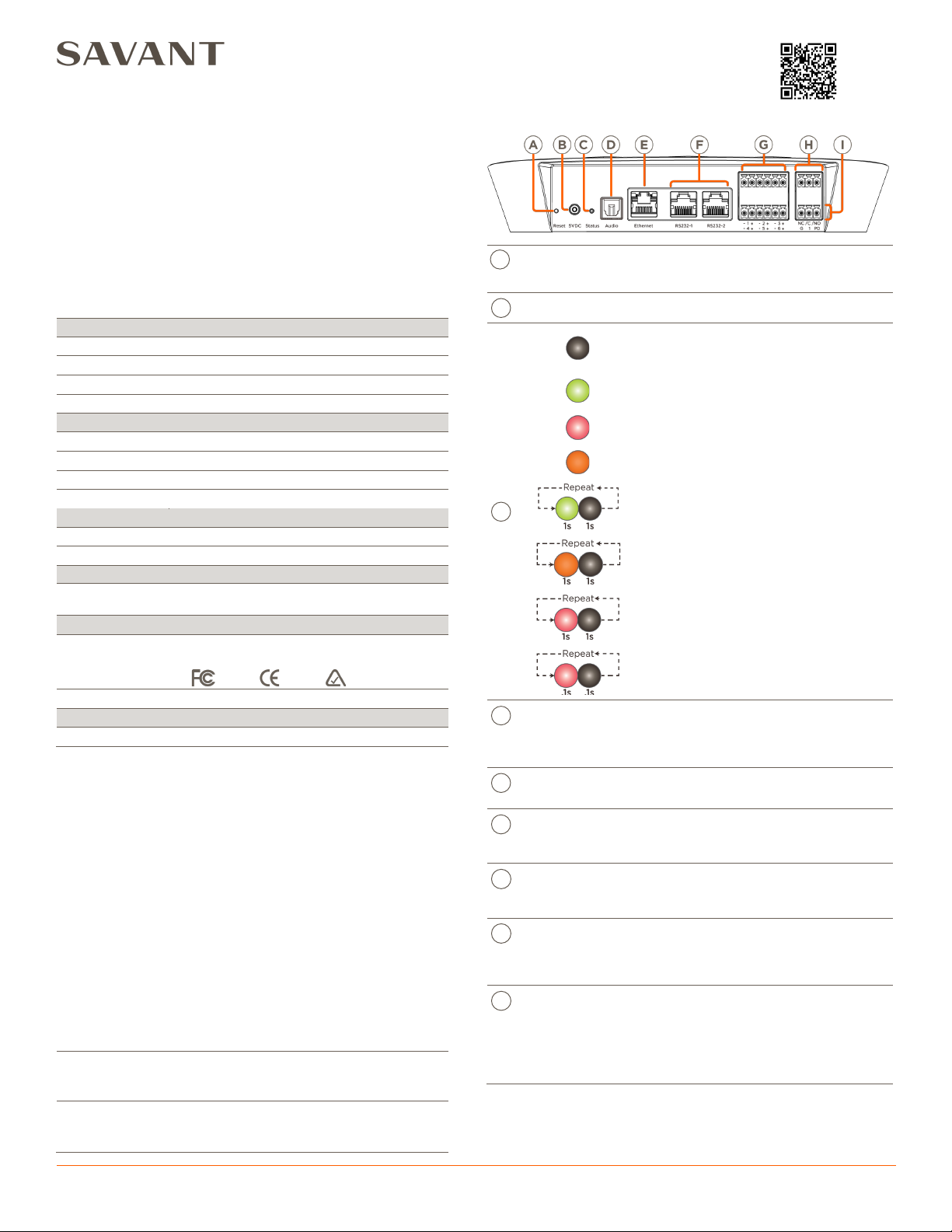
Audio and Ethernet Connections
-!Connect a Cat 5e/6/7 Ethernet cable between SMS-1001 and the
local network router.
-!Connect a Digital Optical (Toslink) cable between the Audio output
port on the SMS-1001 and an audio input port on a Savant
SmartAudio chassis or amplifier. An adapter or convertor (not
included) may be required to connect to non-Toslink type input
ports.
-!Connect the power cable to the 5V DC port and apply power to the
system. Savant recommends a pure sine wave uninterruptible power
supply when connecting to an AC power source. The SMS-1001 will
automatically obtain an IP Address through DHCP.
Control Port Connections
Connections for the Control ports are shown below. More information
on each port, can be found in theSMS-1001 Savant Music Server 1
Deployment Guide located on the Savant Customer Community.
RS-232
-!Pins 7 and 8 are only
required for CTS/RTS
handshaking.
-!Wire color is included
to identify pins and do
not represent any
wiring standard.
-!Refer to the RS-232 Conversion to DB9 and RS-422/485 Pinout
Application Note located on the Savant Customer Community for
more information on RJ-45 to DB-9 adapters offered through Savant.
-!The SMS-1001 does not support the RS-422 or RS-485 standards.
Relay
-!Both Normally Closed and
Normally Open outputs are
available.
GPIO – General Purpose Input/Output
-!GPIO’s configured as an
output can be used to trigger
an action within the system
such as switching on a device.
-!GPIO configured as an input
can detect a state change and
trigger a workflow.
-!GPIO pins configured as an input are pulled high to (+12V) during the
booting process. To force the GPIO signal low during boot up, connect
the PD pin to the GPIO pin. This forces the GPIO output to (< .8V)
during the processor boot times.
IR (Infrared)
-!Ensure all IR emitters are
within 15 feet (4.6 meters)
from the controller’s location.
-!Use of 3rd party flashing IR
emitters with Talk Back is not
recommended. These types of
emitters can draw voltage
away from the IR signal that
can degrade performance.
-!IR connections 4 to 6 (not shown in diagram) follow the same wiring as
connections 1 to 3.
Additional Documentation
Additional Documents are available on the Savant Customer Community.
-!Savant Music Server 1 Deployment Guide (009-1473-xx)
-!Relay and General Purpose Input/Output Profiles: Application Note
-!RS-232 Conversion to DB-9 and RS-422/485 Pinout: Application Note
Regulatory
15.19. This device complies with part 15 of the FCC Rules. Operation is subject to the following two
conditions: (1) This device may not cause harmful interference, and (2) this device must accept any
interference received, including interferences that may cause undesired operation.
15.21. The changes or modifications not expressly approved by the party responsible for compliance could
void the user's authority to operate the equipment.
15.105. This equipment has been tested and found to comply with the limits for CLASS B digital device,
pursuant to Part 15 of FCC Rules. These limits are designed to provide reasonable protection against
harmful interference when the equipment is operated in a residential environment. This equipment
generates, uses and can radiate radio frequency energy and, if not installed and used in accordance with
the instructions, may cause harmful interference to radio communications, However there is no guarantee
that interference will not occur in a particular installation, If this equipment does cause harmful interference
to radio or television reception, which can be determined by turning the equipment off and on, the user is
encouraged to try to correct the interference by one or more of the following measures:
- Reorient or relocate the receiving circuit different from that to which receiver is connected.
- Increase the separation between the equipment and the receiver.
- Consult the dealer or experienced radio/TV technician for help.
IC Regulations
RSS-Gen 7.1.3. This device complies with Industry Canada license-exempt RSS standard(s). Operation is
subject to the following two conditions: (1) This device may not cause interference, and (2) This device
must accept any interference, including interference that may cause undesired operation of the device.
RSS-21- Annexe 9: A 9.4. Le présent appareil est conforme aux CNR d'Industrie Canada applicables aux
appareils radio exempts de licence. L'exploitation est autorisée aux deux conditions suivantes: (1) l'appareil
ne doit pas produire de brouillage, et (2) l'utilisateur de l'appareil doit accepter tout brouillage
radioélectrique subi, même si le brouillage est susceptible d'en compromettre le fonctionnement.
Printed in China
Part # HDH6A003010 Rev 3B