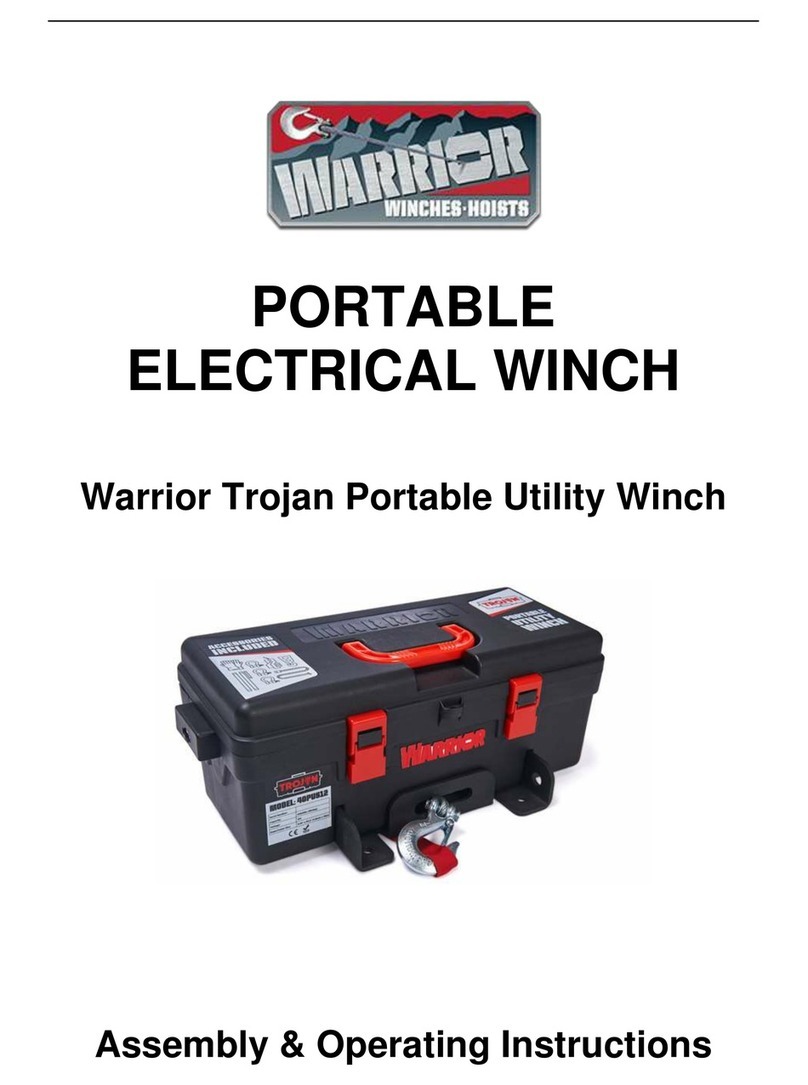
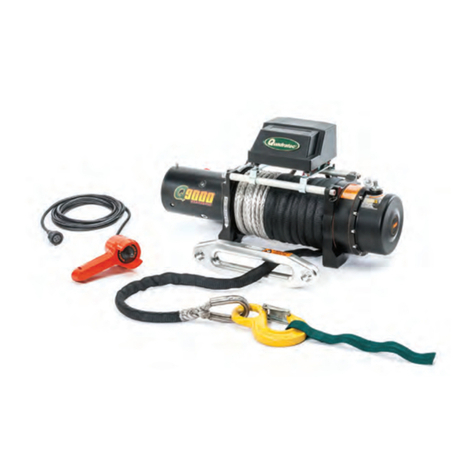
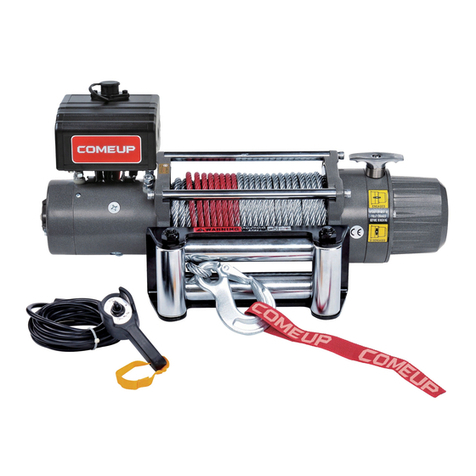
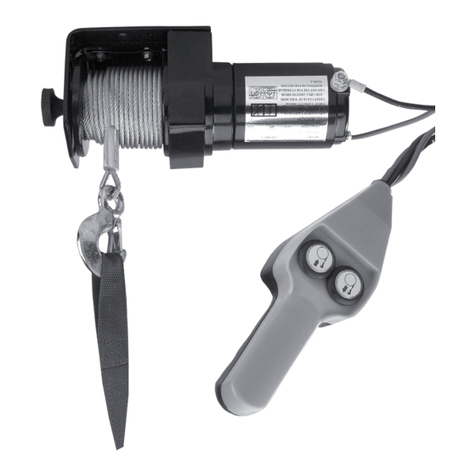
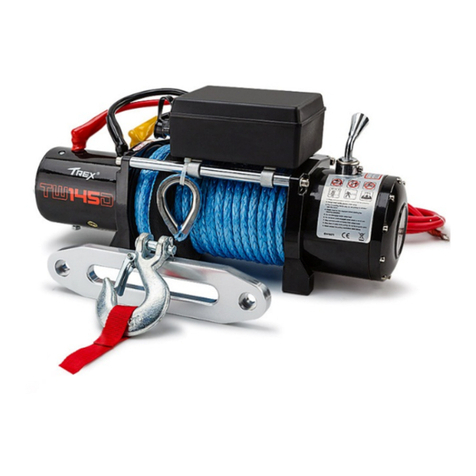
12V Electric Winch
5
silverlinetools.com
c) Do not expose power tools to rain or wet conditions. Waterenteringapowertoolwill
increase the risk of electric shock.
d) Do not abuse the cord. Never use the cord for carrying, pulling or unplugging the power
tool. Keepcordawayfromheat,oil,sharpedgesormovingparts.Damagedorentangledcords
increase the risk of electric shock.
e) When operating a power tool outdoors, use an extension cord suitable for outdoor use.
Useofacordsuitableforoutdoorusereducestheriskofelectricshock.
f) If operating a power tool in a damp location is unavoidable, use a residual current device
(RCD) protected supply.UseofanRCDreducestheriskofelectricshock.
3) Personal safety
a) Stay alert, watch what you are doing and use common sense when operating a power
tool. Donotuseapowertoolwhileyouaretiredorundertheinuenceofdrugs,alcoholor
medication.Amomentofinattentionwhileoperatingpowertoolsmayresultinseriouspersonal
injury.
b) Use personal protective equipment. Always wear eye protection. Protective equipment
suchasdustmask,non-skidsafetyshoes,hardhat,orhearingprotectionusedforappropriate
conditionswillreducepersonalinjuries.
c) Prevent unintentional starting. Ensure the switch is in the off-position before connecting
to power source and/or battery pack, picking up or carrying the tool.Carryingpowertools
withyourngerontheswitchorenergisingpowertoolsthathavetheswitchoninvitesaccidents.
d) Remove any adjusting key or wrench before turning the power tool on. A wrench or a key
leftattachedtoarotatingpartofthepowertoolmayresultinpersonalinjury.
e) Do not overreach. Keep proper footing and balance at all times. Thisenablesbettercontrol
of the power tool in unexpected situations.
f) Dress properly. Do not wear loose clothing or jewellery. Keep your hair, clothing and
gloves away from moving parts. Looseclothes,jewelleryorlonghaircanbecaughtinmoving
parts.
g) If devices are provided for the connection of dust extraction and collection facilities,
ensure these are connected and properly used.Useofdustcollectioncanreducedust-related
hazards.
4) Power tool use and care
a) Do not force the power tool. Use the correct power tool for your application.The correct
powertoolwilldothejobbetterandsaferattherateforwhichitwasdesigned.
b) Do not use the power tool if the switch does not turn it on and off. Any power tool that
cannotbecontrolledwiththeswitchisdangerousandmustberepaired.
c) Disconnect the plug from the power source and/or the battery pack from the power tool
before making any adjustments, changing accessories, or storing power tools. Such
preventivesafetymeasuresreducetheriskofstartingthepowertoolaccidentally.
d) Store idle power tools out of the reach of children and do not allow persons unfamiliar
with the power tool or these instructions to operate the power tool. Power tools are
dangerousinthehandsofuntrainedusers.
e) Maintain power tools. Check for misalignment or binding of moving parts, breakage of
parts and any other condition that may affect the power tool’s operation. Ifdamaged,have
thepowertoolrepairedbeforeuse.Manyaccidentsarecausedbypoorlymaintainedpower
tools.
f) Keep cutting tools sharp and clean. Properlymaintainedcuttingtoolswithsharpcuttingedges
arelesslikelytobindandareeasiertocontrol.
g) Use the power tool, accessories and tool bits etc. in accordance with these instructions,
taking into account the working conditions and the work to be performed.Useofthe
power tool for operations different from those intended could result in a hazardous situation.
5) Service
a) Have your power tool serviced by a qualied repair person using only identical
replacement parts. This will ensure that the safety of the power tool is maintained.
Vehicle-Mounted Electric Winch
Safety
WARNING: Never use the winch to pull xed or obstructed loads.
a) This tool is to be used by trained personnel only. Do not operate this tool without proper
understandingofitsuseandfeatures.Readtheentireinstructionmanualbeforeuse.
b) Always use the instruction manual for reference. Do not try to implement procedures not
describedinthemanufacturer’sinstructionmanual.
c) Ensure proper cable management at all times. Alwaysconrmthecableiswoundina
uniformfashionwhenextracting/withdrawing.Ifthecableiswoundincorrectly,stopandrewind
thecable.
d) Always maintain cable tension before load movement.Donotallowtheloadtomovebefore
thecableisproperlytensioned.Loadmovementwithaslackcablewillplacethewinchunder
unnecessarystrain,puttingtheoperatorornearbybystandersindanger.
e) DO NOT attempt to move loads above the rated load capacity. Refertothemanufacturer’s
specicationorinstructionmanualforspecicinformationonthetool’sloadcapacity.
f) DO NOT perform excessive ‘inching’ with the winch.Inchingistheoperationinwhichthe
winchisoperatedinshortburstsinquicksuccession.Inchingcanrapidlyoverloadthemotor
causingfailurethatcanleadtooperatororbystanderinjury.
g) Never use the winch as a hoist, or to tow another vehicle.Prolongedloadwillcausedamage
to the internal components.
h) Never use the winch to transport/tow people or animals. Thiswinchisnotdesignedfor
carrying,towingorrecoveringpeopleandanimals;attachingpeopleoranimalstothewinchcan
causesevereharmandinjury.
i) Never lift objects vertically. Thiswinchwasdesignedforhorizontalloadmovementsonly.
j) Do not modify or attach unapproved accessories to the winch.Attemptingtoalterthewinch
byttingunapprovedmodicationsisdangerousandwillcausethewinchtooperateoutsideits
designspecication.
k) Always perform proper maintenance and check for damage before every use. Due to the
highstressesinictedonthistool,itisimperativetoregularlymaintainandcheckforcomponent
damagebeforeeveryuse.
l) Do not apply load to the cable when fully extended. Always maintain at least 4 turns of the
cablereelonthewinchdrum.
m) Never try to cross or stand between the winch and the load whilst operating the winch.
Keepyourselfandbystandersawayfromthepathofthecableduringoperation.
n) Always secure the load after operation. The winch does not feature a locking mechanism
and is not designed to be under strain for extended periods of time. Secure the load after
thewinchingoperationhasbeenperformed.
o) If loading a boat onto a trailer without a keel or hull rollers, ensure the trailer is
submerged in the water whilst the boat is being winched.Donotattempttodragtheboat
onto the trailer.
p) Always secure the winching vehicle using wheel chocks or similar. Do not rely on the
vehicle’sparkingbraketosecurethevehicleinposition.
q) Maintain lubrication of moving components. Cleanandlubricatethewinchassembly
frequently;componentssuchasthecable,hook,bearingsandgearboxshouldremainlubricated
at all times.
r) Leaving the winch permanently connected to the vehicles power supply may drain the
battery.Withoutabuilt-inswitchboxthewinchwillpersisttodrawcurrentfromthevehicle’s
battery.Topreventconsistentlydrainingthebattery,installarelayordisconnectthewinchfrom
thepowersupplywhennotinuseandleaveampletimeforthebatterytorecharge.
Note:Ifyouwishtohavethewinchturnonandoffwiththevehicle’signition,useafusedrelay
circuitsothatalowcurrentcircuitcanturnonandoffahighcurrentconnectionthatisdirectly
connectedtothebattery.
748850_Manual.indd 5 16/10/2019 12:37