2
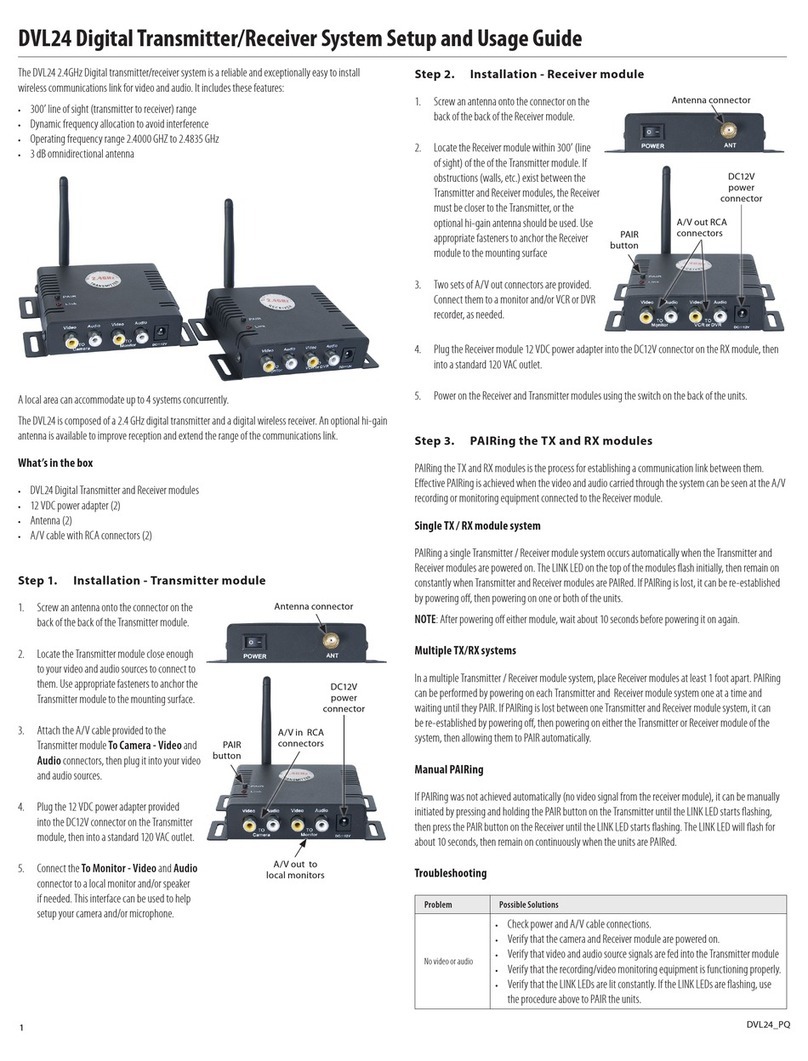
Step 3. PAIRing the TX and RX modules
The TX and RX modules of each DVXL24WR product are factory congured to synchronize only with each
other. Eective synchronization is achieved when the video carried through the system can be seen at the
video recording or monitoring equipment connected to the RX (receiver) module, and an RS485 controller
at the RX module can control a PTZ device connected to the TX module.
Synchronization of a single TX / RX module pair occurs automatically after the TX and RX modules are
powered on. If synchronization is lost, it can be re-established by powering o, then powering on one or
both of the modules. After powering o either module, wait 10 seconds before powering it on again.
To automatically synchronize a TX and RX module pair:
1. Plug the 12 VDC power adapter for the TX module into a standard 120 VAC outlet.
2. Plug the 12 VDC power adapter for the RX module into a standard 120 VAC outlet.
3. Verify that you can see video from your video source equipment (transmitter) at your video recorder.
4. Verify that you can control the remote RS485 (PTZ) device using your RS485 controller.
Multiple TX/RX systems
When setting up multiple DVLX24WR systems in the same vicinity, observe the following guidelines:
• Place RX modules at least 1 ft apart.
• Power on each DVLX24WR TX and RX module pair one at a time and allow the pair to synchronize as
described above before powering on another DVLX24WR module pair.
NOTE If multiple DVLX24WR systems are setup in the same vicinity and pairing is lost between one or more
TX/RX module pairs, power o the modules of the pairs that failed, then power on each pair one at a
time and allow it to synchronize before powering on another pair.
Troubleshooting
Problem Possible Solutions
No video or audio
• Check power and video cable connections.
• Verify that the camera and RX module are powered on.
• Verify that video source signals are fed into the TX module
• Verify that the recording / video monitoring / RS485 controller equipment is
functioning properly.
Interference in video
• Adjust the orientation of the antennas on the TX and RX modules.
• Move the equipment away from devices that emit high radiation, such as
microwave ovens, wireless phones, etc.
Specications - system
Item Specication
Transmission channels 80 channels, auto selected
Video bit rate Up to 12 Mbps
ID codes Up to 4 M
Video resolution 720 x 480 @ 30 fps (NTSC)
Operational range Dependent on installation environment
RS485 link For controlling a RS485 device remotely (PELCO-D / PELCO-P protocols)
Specications - Transmitter module
Item Specication
Operating frequency 2.4000 GHz – 2.4835 GHz
Transmit power 200 mW (maximum)
Modulation 16 QAM / QPSK / BPSK
Video input level 1 ± 0.2 Vp-p @ 75 Ω
Audio input level 1 ± 0.2 Vp-p @ 600 Ω
Antenna Omnidirectional
Power consumption 1.9 W
Power adapter 12 VDC / 1A
Dimensions (W x D x H) 6.28” x .5.37” x 1.37” (159.5 mm x 136.4 mm x 34.8 mm) without antenna and drop cable
Weight 19 oz (538 g)
Specications - Receiver module
Item Specication
Operating frequency 2.4000 GHz – 2.4835 GHz
Receiver sensitivity -85 dBm minimum
Video output level 1 ± 0.2 Vp-p @ 75 Ω
Audio output level 1 ± 0.2 Vp-p @ 600 Ω
Antenna Omnidirectional
Power consumption 1.9 W
Power adapter 12 VDC / 1A
Dimensions (W x D x H) 6.28” x .5.37” x 1.37” (159.5 mm x 136.4 mm x 34.8 mm) without antenna and drop cable
Weight 19 oz (538 g)
For product support, please contact your distributor.