TAG GD3030 User manual

TAG GD3030
User Manual
TAG Global Systems

©2015 TAG Global Systems Corporation. All rights reserved. TRADEMARKS
TAG Global Systems logo is a trademark of TAG Global Systems, LLC, registered in the United
States Patent and Trademark Ofce and in other countries. Microsoft and the Windows logo are
either registered trademarks or trademarks of Microsoft Corporation in the United States and/or other
countries.
Microsoft products are licensed to OEMs by Microsoft Licensing, Inc., a wholly owned subsidiary of
Microsoft Corporation. The Bluetooth® word mark and logos are registered trademarks owned by
Bluetooth SIG, Inc. All other brand and product names are trademarks or registered trademarks of
their respective owners.
Images shown in this document may vary slightly from actual products at time of shipping. Information
in this manual is subject to change without notice.
i

TABLE OF CONTENTS
ABOUT THIS MANUAL
Related Information 1
Conventions 1
BASIC SAFETY GUIDELINES
Intended Use 2
Maintenance and Operation Overview 2
Safety 3
Electrical Hazards 3
Environmental 3
Radio Transmissions 4
Cleaning and Servicing 4
Regulatory and Certication 4
Lithium Battery Safety Statement 5
CHAPTER 1. INTRODUCTION
About This Guide 6
Unpacking the Device 6
Technical Specications 6
TAG GD3030 Conguration Options 8
Parts List 9
Identifying the Device 10
LED Status 11
Identifying the Digitizer 14
Dimensions 15
Touch Screen Features 16
CHAPTER 2. GETTING STARTED
First Time Use 17
Charging the Battery 17
Powering the Device On and Off 18
Installing the Micro SIM Card 19
Removing the Micro SIM Card 20
ii

Installing the MicroSD Card 21
Removing the MicroSD Card 22
Using the Digitizer 23
Removing the Protective Film from the Display 24
CHAPTER 3. OPERATION
Opening the I/O Compartment Cover 25
Closing the I/O Compartment Cover 26
Connecting to External Cabling 27
Handstrap, Carrying Handle and Shoulder Strap 29
Installing the Standard Battery 33
Removing the Standard Battery 34
Connecting to a Wireless Network 35
CHAPTER 4. USING BIOS SETUP UTILITY
When to Use the BIOS Setup Utility 37
Accessing the BIOS Setup Utility 37
Installation an Operating System 38
BIOS Passwords 41
EC and BIOS 43
CHAPTER 5. USING THE DASHON UTILITY
Overview 48
CHAPTER 6. TROUBLESHOOTING
Troubleshoot the Wi-Fi Connection 49
Troubleshoot Operating the Computer 50
Call Product Support 50
CHAPTER 7. MAINTENANCE
Cleaning the Device 51
Returning the Device 51
Contacting TAG Global Systems 51
iii

About This Manual
The TAG GD3030 User’s Manual provides instruction for qualied personnel to follow when setting up
a new TAG GD3030 device.
This document is intended for use by qualied personnel to compliment the training and expertise, not
to replace it.
Related Information
Current information and manuals are available for download at the following website:
www.tagglobalsystems.com
Conventions
Bolded or underlined text is used to emphasize the designated information.
A Note is used to provide additional information for the device or settings.
A Caution is used to warn against potential hazards or to caution against unsafe
practices.
A Warning is used to identify immediate hazards for property damage, injury or death.
TAG GD3030 Page 1 of 51

Basic Safety Guidelines
The following safety guidelines are intended to help protect the user from injury and prevent damage
to the hardware.
■ Do not place anything on the AC adapters power cable and make sure the cable is not located
where it can be tripped over or stepped on.
■ Do not cover the AC adaptor as it reduces the cooling.
■Do not use the AC adapter while it is inside the carrying case.
■Use only the AC adapter, power cord, and batteries that are approved for use with the device.
Use of another type of battery or AC adapter may cause risk of re or explosion.
■If you use an extension cable with the AC adapter, ensure that the total ampere rating of all
products plugged in to the extension cable does not exceed the ampere rating of the extension
cable.
■If the device is moved between environments with very different temperature and/ or humidity
ranges, condensation may form on or within the device. Avoid damaging the device by allowing
sufcient time for the moisture to evaporate before using the device.
■When disconnecting cables, pull on the connector or on its strain relief loop, not on the cable
itself. When pulling out or plugging in the connector, keep it evenly aligned to prevent bending
the connector pins.
Intended Use
The TAG GD3030 rugged tablet is equipped with multi-functional terminals for stationary and mobile
applications in industrial environments such as logistics, warehousing, eet management, manufac-
turing and the automotive industry.
Read the safety guidelines thoroughly before starting any servicing on the device. Read the guide-
lines before powering up the device, and keep this document for later use.
The operator is solely responsible for any damage resulting from unauthorized modications to the
device.
Unintended Application Use
The device is not designed for use in life-support systems or critical safety/security systems where
system malfunction can lead to the direct or indirect endangerment of human life. The operator is fully
responsible for using the device in these situations.
Maintenance and Operation Overview
The TAG GD3030 is designed and manufactured according to strict controls and following the stated
safety regulations. The following list identies incorrect operating uses of the TAG GD3030. Incorrect
use of the TAG GD3030 can lead to hardware damage, safety issues and possible risk to personnel
health:
■ The TAG GD3030 is under operation by untrained personnel;
■ The TAG GD3030 is not maintained as recommended;
■ The TAG GD3030 is not used as intended.
TAG GD3030 Page 2 of 51

Safety
To prevent injury and damage, read the following safety guidelines prior to operating the device. The
manufacturer assumes no liability for any and all damages arising from misuse or noncompliance with
these guidelines.
Electrical Hazards
Cleaning/Servicing: Power Off the TAG GD3030
■ Disconnect the TAG GD3030 from power before cleaning or servicing it.
Power Adapter
Contact an authorized service personnel for repairs to the power pack. In the event of a blown fuse
after replacing the fuse, contact an authorized service personnel to avoid electrical shock.
Use only Supplied Power Cables
TAG Global Systems power cables meet industrial requirements for low-temperature exibility, UV
resistance, and oil resistance. Use only supplied power cables from TAG Global Systems.
If other power cables are used, the following may apply:
■The operator is solely responsible for the resulting damage;
■ All TAG Global Systems warranties are void.
Environmental Hazards
Do not use the TAG GD3030 in locations near/with ammable gases or vapor. The use of electrical
equipment in explosive environments can be dangerous.
■ Turn off the device when near a gas station, fuel depot, chemical plant or a place where
blasting operations take place.
Environmental
Ambient Temperature
The TAG GD3030 operates on the basis of a passive cooling concept which internal waste heat is
released via the housing surface and requires fresh airow in the environment.
■ Operating the TAG GD3030 with no fresh cooling air may cause overheating and damage to
the device.
■ The operating environment should not be enclosed to prevent the cool air being heated by the
heat waste from the device.
Connecting and Disconnecting External Devices
To prevent the considerable damage, the TAG GD3030 and the external device should be
disconnected from power when connecting/disconnecting excluding USB devices.
Only Use Authorized Accessories
Only use the supplied cables, power packs and other accessories that have been tested and
approved by TAG Global Systems. Contact your local distributor for further information.
TAG GD3030 Page 3 of 51

Radio Transmissions
Permitted Transmission Power
Follow the national regulations for the maximum permitted transmission power. The operator is solely
responsible for this type of operation.
Radio Frequency Limited Locations
Considering the radio frequency limitation in hospitals and aircraft, the TAG GD3030 can only be
installed with permission.
Industrial computers may affect the function of implanted medical devices such as pacemakers and
may cause malfunction.
Cleaning and Servicing
■ Disconnect the TAG GD3030 from power before cleaning or servicing.
■ Never clean the TAG GD3030 with compressed air, a pressure washer or a vacuum cleaner.
■ If necessary, clean the housing of the TAG GD3030 with a damp cloth.
■ Clean the touch-screen with a nonabrasive cloth.
Regulatory and Certication
FCC
This equipment has been tested and found to comply with the limits for a Class B digital device,
pursuant to part 15 of the FCC Rules. These limits are designed to provide reasonable protection
against harmful interference when the equipment is operated in a commercial environment.
This equipment generates, uses, and can radiate radio frequency energy and, if not installed
and used in accordance with the instruction manual, may cause harmful interference to radio
communications. Operation of this equipment in a residential area is likely to cause harmful
interference in which case the user will be required to correct the interference at his own expense.
However, there is no guarantee that interference will not occur in a particular installation. If this
equipment does cause harmful interference to radio or television reception, which can be determined
by turning the equipment off and on, the user is encouraged to try to correct the interference by one
or more of the following measures:
■ Reorient or relocate the receiving antenna.
■ Increase the separation between the equipment and receiver.
■ Connect the equipment into an outlet on a circuit different from that to which the receiver is
connected.
■ Consult the dealer or an experienced radio / TV technician for help.
Any changes or modications not expressly approved by the grantee of this device
could void the user’s authority to operate the equipment.
This device is operation in 5.15 – 5.25GHz frequency range, then restricted in indoor
use only, Outdoor operations in the 5.15 – 5.25GHz is prohibit.
This device is slave equipment; the device is not radar detection and not ad-hoc
operation in the DFS band.
TAG GD3030 Page 4 of 51

Labeling Requirements
This device complies with Part 15 of the FCC Rules. Operation is subject to the following two
conditions: (1) this device may not cause harmful interference, and (2) this device must accept any
interference received, including interference that may cause undesired operation.
RF Exposure Information (SAR)
This device meets the government’s requirements for exposure to radio waves. This device is
designed and manufactured not to exceed the emission limits for exposure to radio frequency (RF)
energy set by the Federal Communications Commission of the U.S. Government.
The exposure standard employs a unit of measurement known as the Specic Absorption Rate,
or SAR. The SAR limit set by the FCC is 1.6 W/kg. Tests for SAR are conducted using standard
operating positions accepted by the FCC with the EUT transmitting at the specied power level in
different channels.
The highest SAR value for the device as reported to the FCC is 0.55 W/kg when placed next to the
body.
CE Marking
This product has passed the CE test for environmental specications when shielded cables are
used for external wiring. We recommend the use of shielded cables. Please contact your local
representative for ordering information.
This product has passed the CE test for environmental specications. Test conditions for passing
included the equipment being operated within an industrial enclosure. In order to protect the product
from being damaged by ESD (Electrostatic Discharge) and EMI leakage, we strongly recommend the
use of CE-compliant industrial enclosure products.
R&TTE
This device complies with the essential requirements of the R&TTE Directive 1999/5/EC.
This device is classied as class 2 in Article 1(2) of Decision 2000/299/EC due to its capability of
operating WLAN in the band 5.15 to 5.35 GHz.
CB
This device complies with the IEC 60950-1:2005+A1.
Lithium Battery Safety Statement
Lithium battery inside. Danger of explosion if battery is incorrectly replaced. Replace
only with same or equivalent type recommended by battery manufacturer
TAG GD3030 Page 5 of 51
Chapter 1. Introduction
The TAG GD3030 is a rugged device equipped with 802.11, Bluetooth and GNSS for wireless data
communications.
The TAG GD3030 is a rugged 10.1” tablet computer capable of 1920 x 1200 resolution. The TAG
GD3030 supports the following operating systems:
■ Windows® Embedded 8.1 Industry 64bits
■ Windows® Embedded Standard 7 64bits
■ Windows® 7 Professional 64bits
■ Windows® Embedded Standard 8 64bits
About This Guide
The TAG GD3030 User Manual provides instruction for qualied personnel to use as a guide for setup
of the device. This document is not intended to replace the training and expertise of the end-user.
Unpacking the Device
Before you begin the installation or conguration process make sure to inspect all components and
accessories. Contact your representative if there are any missing or damaged items. See “Contacting
TAG Global Systems” on page 52.
Technical Specications
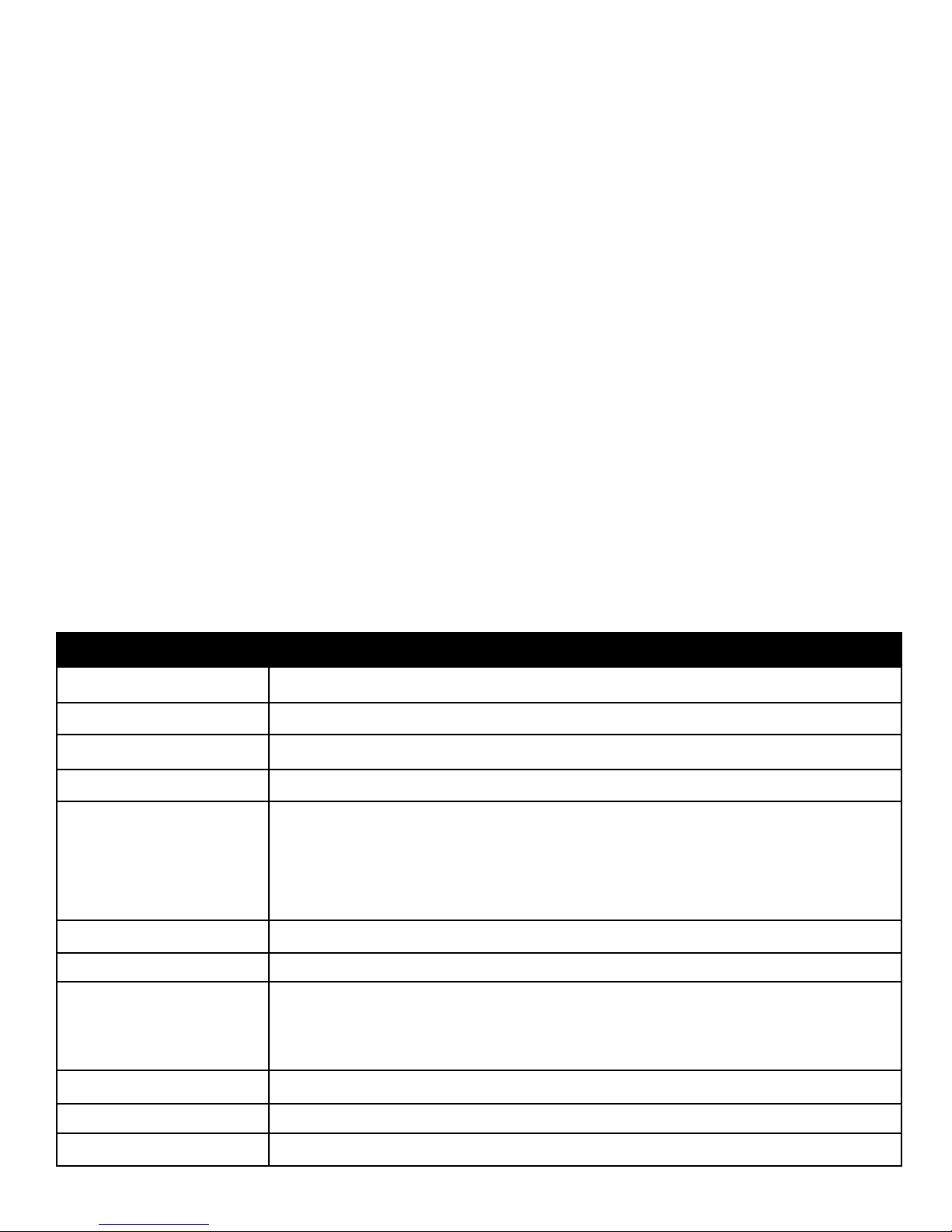
Table 1. Technical Specications
Item Description
Display 10.1-inch LED Backlight, 1920 (W) x 1200 (H) WUXGA
Touch screen 10-point capacitive touch screen with digitizer
Brightness 1000 nits (before touch)
CPU Intel Core i5-5350U 1.8 GHz
Operating System
(Optional)
■ Windows® Embedded 8.1 Industry 64bits
■ Windows® Embedded Standard 7 64bits
■ Windows® 7 Professional 64bits
■ Windows® Embedded Standard 8 64bits
RAM DDR3L@1600 MHz 4 GB RAM (optional: 8 GB)
Storage mSATA SSD 120 GB (optional: 240 GB)
Battery
■ Standard hot swappable battery: 10.8V, 4500mAh, Li-polymer
■ Extended hot swappable battery: 10.8V, 9000 mAh, Li-polymer
(optional)
Power Supply AC 100V ~ 240V, 50~60Hz input; [email protected], 65W
Dimensions (W x H x L) 280 mm (11”) x 23 mm (0.9”) x 195 mm (7.7”)
Weight 1.36 kg (3 lbs)
TAG GD3030 Page 6 of 51
Table of contents
Other TAG Tablet manuals

Popular Tablet manuals by other brands

Laser
Laser MID-1060 Quick operation guide

MUNBYN
MUNBYN IRT09J Easy setup guide
Motorola
Motorola MC3090R - Win CE 5.0 Professional 520 MHz quick start guide
Dell
Dell Latitude ST Setup and features information

Lenovo
Lenovo IdeaTab S6000L Hardware Maintenance Manual
Venturer
Venturer WT9L11 quick start guide