SAFETY & TRANSPORT
Electrical Performance Safety
PV modules can produce DC current under sunlight. Any contact of exposed metal at
module's wiring parts may result in electrical shock or burn. Any contact of 30V or larger
DC Voltage can be fatal.
In case of no connected load or external circuits, modules can still produce voltage.
Please use insulation tools and wear rubber gloves when operating modules in the
sunlight.
No switch is on the PV modules. Operating of PV modules can only be stopped when
they are kept from sunlight or covered by hard board or UV-proof materials or when the
angle of the modules facing sun are placed on smooth and flat surfaces.
To avoid electric arc or electric shock hazards, please do not break down electric
connection in loaded conditions. Incorrect connections will also lead to electric arc or
shock. Keep connectors dry and clean and make sure that they are in good operating
condition. Do not insert other metals into the connectors or carry out electric connection
by whatever means.
Snow, water or other reflective medium in surrounding environments that intensify light
re-flection will increase output current and power. And module voltage and power will
increase under low temperature condition.
If module glass or other sealing materials are damaged, please wear personal protective
equipment and then isolate modules from the circuit.
Work only under dry conditions,and use only dry tools. Do not operate when modules
are wet unless you wear personal protective equipment. Please follow the cleaning
requirements in this manual when cleaning modules.
Installation must be carried out under the guidance of a qualified electrician.
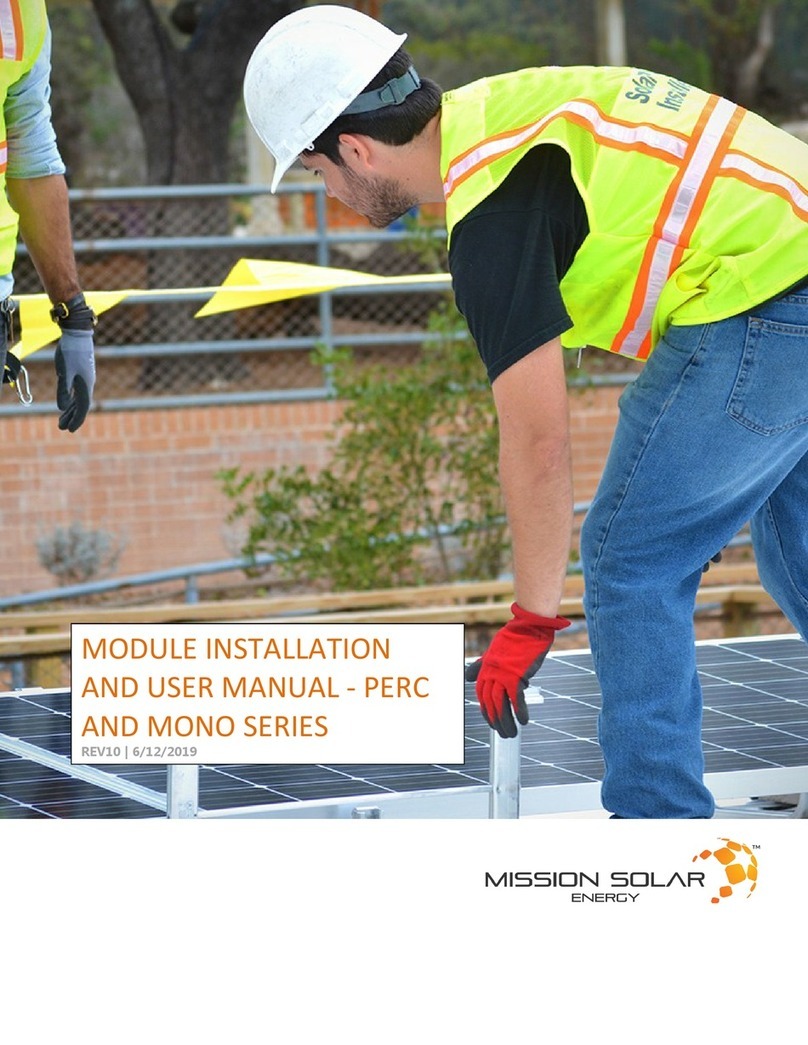
No matter how weather condition is, personnel entering the power station shall wear
safety helmet, insulating gloves and insulating shoes correctly, taking-safety protection
measures.
The application class of TW module is Class A (IEC61730:2005) and Class II (IEC61730:2016),
which can be used in systems operating at greater than 50 V DC or 240W, where general contact
access is anticipated;