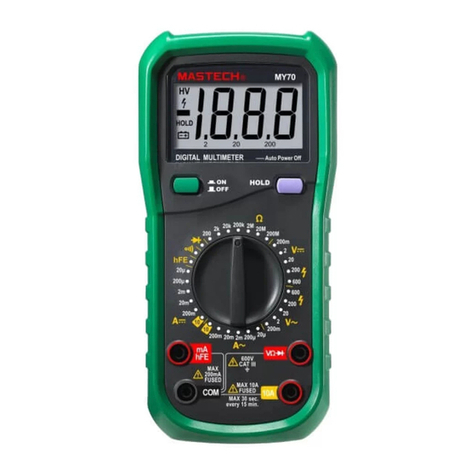
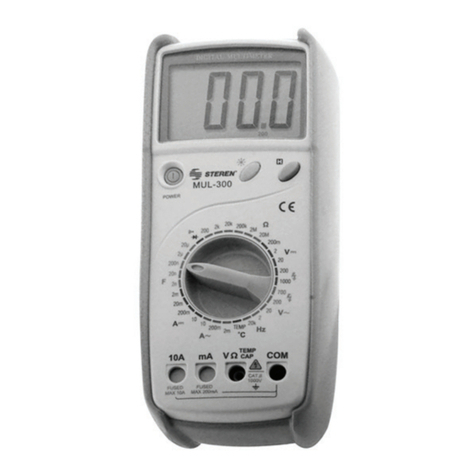
To
Measure
Rotate
Dial To
Connect Input Jacks FUNC
Features Safety Warnings, Cautions and Operational Notes
10A COM
AC/DC Voltage OPEN BLACK
LEAD
RED
LEAD
Toggles between
AC ( ) & DC ( ) Voltage
WARNING : Don’t measure any RMS voltage higher than 600V DC or AC, to prevent
injury or damage to meter and equipment.
• Display shows voltage polarity (connected with red test probe) when measuring DC
voltage.
AC/DC Current
> 400mA
RED
LEAD
BLACK
LEAD OPEN Toggles between
AC ( ) & DC ( ) Current
WARNING : Turn off the power to the circuit to be tested. Discharge all high voltage
capacitors on the circuit to be tested.
WARNING : To prevent injury or damage to meter or equipment, do not make cur-
rent measurements if voltage exceeds 600V.
• Before measuring current, rst check the meter’s fuse. When measuring, use correct
input end and function. When the test probe is inserted to the current input end, don’t
connect the other end of the test probe with any circuit in parallel.
• Turn off the circuit to be tested. The black test probe is connected to one end of
disconnected circuit (low voltage relatively), and the red test probe is connected to the
other end of the disconnected circuit (high voltage relatively).
• Connecting test probe reversely make readings negative, but will not damage meter.
• Overload is indicated with “OL” on the display.
AC/DC Current
< 400mA OPEN BLACK
LEAD
RED
LEAD
Toggles between
AC ( ) & DC ( ) Current
AC/DC Current
< 400mA OPEN BLACK
LEAD
RED
LEAD
Toggles between
AC ( ) & DC ( ) Current
Resistance OPEN BLACK
LEAD
RED
LEAD
Toggles between
Resistance ( )
Capacitance ( )
Diode ( )
Continuity ( )
WARNING : When measuring resistance or circuit continuity, to avoid injury or meter
damage, turn off the power to circuit and discharge all capacitors.
• The resistance measured on a circuit is usually different from the rated value of
resistance. This is because the test current of the meter will ow through all possible
channels between test probes.
• When measuring low resistance, to ensure accuracy, make a short circuit between the
test probes and read the resistance value of the short circuit. This resistance value
should be subtracted after measuring the resistance to be tested.
• When there is no input (for example, open circuit), the display will show “OL”, which
means that the measured value is out of range.
Capacitance OPEN BLACK
LEAD
RED
LEAD
WARNING : When measuring capacitance, to avoid injury or meter damage, turn off
the power to the circuit to be measured discharge all capacitors.
• When measuring bulk capacitors with this meter, readings will stabilize after a few
seconds.
Diode OPEN BLACK
LEAD
RED
LEAD
WARNING : When measuring diodes, to avoid injury or meter damage, turn off the
power to the circuit to be measured discharge all capacitors.
• The meter will display the diode’s forward bias voltage value. If the test probe polarity
is reversed, the meter will display “OL”, which distinguishes the diode’s cathode and
anode.
Continuity OPEN BLACK
LEAD
RED
LEAD
WARNING : When measuring resistance or circuit continuity, to avoid injury or meter
damage, turn off the power to the circuit to be measured and discharge all capacitors.
• If the measured circuit resistance is less than about 50Ω, the buzzer will sound
continuously.
Frequency/
Duty Ratio OPEN BLACK
LEAD
RED
LEAD
Toggles between
Frequency ( ) Duty ( )
WARNING : Don’t input voltage higher than 60V DC or 30V AC in frequency/duty
ratio measurement position, to prevent electric shock or meter damage
Temperature Fahrenheit OPEN - Temp
LEAD
+ Temp
LEAD WARNING : Don’t input voltage higher than 30V in temperature measurement posi-
tion, to prevent electric shock or meter damage.
Temperature Celsius OPEN - Temp
LEAD
+ Temp
LEAD
WARNING
To avoid electric shock or personal injury, please read SAFETY INSTRUCTIONS, WARNINGS
and CAUTIONS carefully before use.
SAFETY INSTRUCTIONS: Read Before Use
The UTLDM2 digital multimeter has been designed according to International Electro Safety Standard IEC-
1010 (61010-1@IEC: 2001) concerning safety requirements for electronic measuring instruments and hand-
held digital multimeters. It meets the requirements for CAT III 600V of IEC1010 and pollution degree 2.
▶Users should use the meter strictly according to the provisions of this manual. Otherwise, the war-
ranty for the meter may become invalid.
▶The warnings in the user manual are used to remind users of possible danger or dangerous action.
▶Cautions in the user manual are used to remind users of possible meter damage or condition or action
of measured object.
WARNING
To avoid possible electric shock or personal injury as well as damage to the meter or measured objects,
please use the meter according to the following procedure methods:
▶Check the case before using the meter. Don’t use the meter when the case is damaged. Check to see
if the case is cracked or lacks plastic parts. Please pay special attention to joint insulating layer.
▶Check to see whether test leads insulation damage or exposed bare metal. Check test lead continuity.
If the test leads are damaged, please replace them with a new set before using the meter.
▶Measure known voltage with the meter to verify that the meter is working properly. If the meter is
working abnormally, stop using it immediately. A protective device may be damaged. If there is any
doubt, please have the meter inspected by a qualified technician.
▶Do not test voltage exceeding rated voltage marked on the meter.
▶When testing voltage exceeding 30v AC voltage RMS, 42v AC peak or 60v DC, be particularly careful
to avoid electric shock.
▶When measuring, use correct jack, function and measuring range.
▶Do not use the meter in explosive gas, vapor or dusty environments.
▶When using the probe, fingers should be behind the probe protection device.
▶When connecting circuits, please connect the common test line first, then connect the charged test
line. When disconnecting circuits, please disconnect the charged test line first, then disconnect the
common test line.
▶Before measuring resistance, continuity, and diodes, first turn off power and discharge all high volt-
age capacitors.
▶If the meter is not used in accordance with the instructions, the meter’s safety protection function
may become invalid.
▶For all DC measurements, to avoid the risk of electric shock due to possible incorrect readings, please
use AC function to verify the existence of any AC voltage. Then, select DC voltage measuring range
equal to or greater than the AC measuring range.
▶Before measuring current, check the meter fuse, shut off power to the circuit to be tested, then con-
nect the meter and energize the circuit.
▶When opening the case (or part of the case), turn the meter off.
▶When the battery low voltage indicator “ ” becomes lit, replace the battery at once. A low bat-
tery will cause meter reading errors and may result in electric shock or personal injury.
▶Before opening case or battery cover, remove the test leads from the meter.
▶When maintaining the meter, use replacement parts specified by the factory.
Test Equipment Depot - 800.517.8431 - 99 Washington Street Melrose, MA 02176
TestEquipmentDepot.com