6
other factors affecting the power tool work safety. If any
damage to the power tool is detected, it should be repaired
before use. Improper power tool maintenance is a reason for many
accidents.
f) Cutting tools should be sharp and clean. Keeping sharp cutting
edges in good condition reduces the risk of jamming and facilitates
operation.
g) Power tools, equipment, working tools etc. should be used
according to this user's manual taking into account operating
conditions and the work to be done. Misusing a power tool can
result in dangerous situations.
h) At low temperatures and after a long brakes in operation it is
recommended to turn the power tool to operate it with no
load for a few minutes to provide proper grease distribution
inside its driving mechanism.
i) Use soft, damp (cannot be wet) cloth and soap to clean power
tools. Do not use petrol, solvents and other agents that may
damage your equipment.
j) Power tools can be stored/carried after making sure that all
moving components are locked and protected against
release with original devices intended for this purpose.
k) Store power tools in a dry, dust and water-protected place.
l) Carry your power tool in its original packaging to provide
protection against mechanical damage.
m) Keep handles and grip surfaces clean and free from oil and
grease. Secure grip and control over the tool in unexpected
circumstances are impossible if handles and grip surfaces are slippery.
WARNING! General warnings regarding the use of
power tools.
Repair:
a) Warranty and post-warranty repairs of its power tools are
carried out by PROFIX Service, which guarantees the best
quality or repair and use of genuine spare parts.
b) Under no circumstances repair damaged batteries. All
activities related to battery repair may be performed only by
the manufacturer or by authorised service centres.
WARNING! Circular saw – safety warnings
Personal safety:
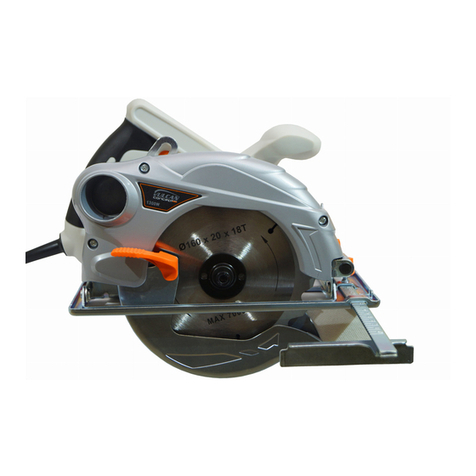
a) Keep your hands away from the cutting area and the blade.
Keep your second hand on the ancillary handle or on the
motor housing. If both hands are holding the saw, they cannot be cut
by the blade.
b) Do not reach underneath the workpiece. The guard cannot
protect you from the blade underneath the workpiece.
c) Set the cutting depth to match the thickness of the item to be
cut. The saw blade should extend below the workpiece by no more than
the height of the tooth.
d) Never hold the item being cut in your hands or across your leg.
Fix the item to a stable base. Stable fixing of the item being cut is
necessary to minimize body exposure, blade binding, or loss of control.
e) Hold the saw by the insulated gripping surfaces when
performing an operation where the saw may contact hidden
live wiring or its own cord. Contact with a “live” wire will also make
exposed metal parts of the tool “live” and shock the operator.
f) When ripping always use a rip fence or straight edge guide.
This improves the accuracy of cut and reduces the chance for blade
binding.
g) Always use blades with correct size and shape (diamond vs.
round) arbor holes. Blades that do not match the mounting
hardware of the saw will run eccentrically, causing loss of control.
h) Never use damaged or incorrect blade washers or bolts. The
blade washers and bolt were specially designed for the specific saw, for
optimum performance and safety of operation.
Causes and prevention of kickback:
- kickback is a sudden reaction to a pinched, bound, or misaligned saw
blade, causing an uncontrolled saw to lift up and out of the workpiece
toward the operator;
- when the blade is pinched or bound tightly by the kerf closing down,
the blade stalls and the motor reaction drives the unit rapidly back toward
the operator;
- if the blade becomes twisted or misaligned in the workpiece, the
teeth at the back edge of the blade can dig into the top surface of the
wood, causing the blade to climb out of the kerf and jump back toward
the operator.
Kickback is the result of improper use of the saw or incorrect
operating procedures or conditions and can be avoided by taking
proper precautions, as listed below.
a) Maintain a firm grip with both hands on the saw and position
your arms to allow you to resist the kickback force. Stand on
one side of the saw so as to be away from the cutting line of
the saw. Kickback may cause the saw to jump backward, but the
kickback force can be controlled by the operator if proper precautions
have been observed.
b) When blade is binding, or when interrupting a cut for any
reason, release the trigger and hold the saw motionless in
the material until the blade comes to a complete stop. Never
attempt to remove the saw from the workpiece or pull the
saw backward while the blade is in motion or kickback may
occur. Investigate and take corrective actions to eliminate the cause of
blade binding.
c) When restarting a saw in the workpiece, center the saw blade
in the kerf and check that saw teeth are not engaged into the
material. If the blade is binding, it may walk up or kickback from the
workpiece when the saw is restarted.
d) Support large panels to minimize the risk of blade pinching
and kickback. Large panels tend to sag under their own
weight. Supports must be placed under the panel on both sides, near
the line of cut and near the edge of the panel.
e) Do not use dull or damaged blades. Unsharpened or improperly
set blades produce a narrow kerf causing excessive friction, blade
binding and kickback.
f) Blade depth and bevel adjusting locking levers must be tight
and secure before making a cut. If blade adjustment shifts while
cutting, it may cause binding and kickback.
g) Use extra caution when making a “pocket cut” into existing
walls or other blind areas. The protruding blade may cut objects
that can cause kickback.
h) Before each cut, check if the lower guard is positioned