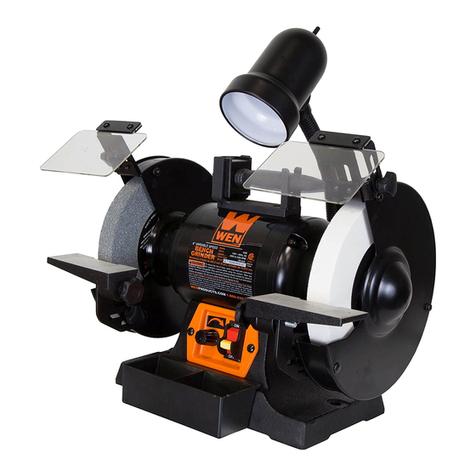
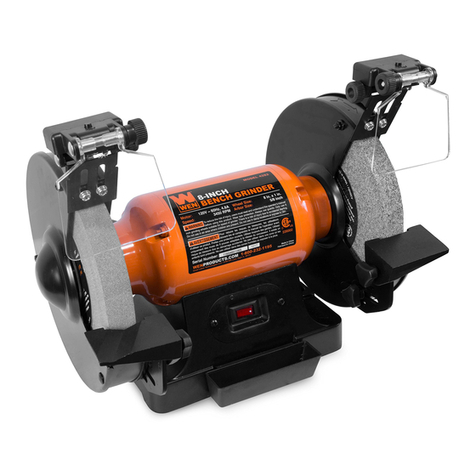
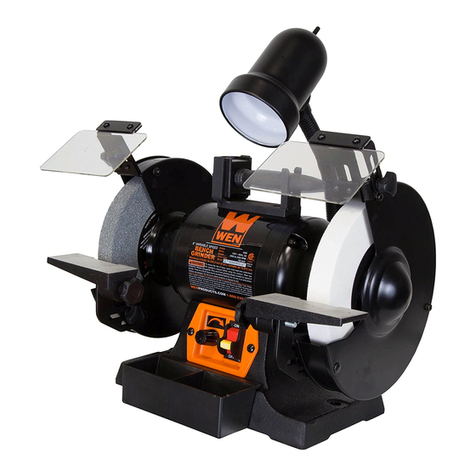
Wen 4276 User manual

Model # 4276
6-INCH BENCH
GRINDER
bit.ly/wenvideo
Your new tool has been engineered and manufactured to WEN’s highest standards for dependability,
ease of operation, and operator safety. When properly cared for, this product will supply you years
of rugged, trouble-free performance. Pay close attention to the rules for safe operation, warnings,
and cautions. If you use your tool properly and for intended purpose, you will enjoy years of safe,
reliable service.
IMPORTANT:
NEED HELP? CONTACT US!
Have product questions? Need technical support?
Please feel free to contact us at:
800-232-1195
WENPRODUCTS.COM
(M-F 8AM-5PM CST)
For replacement parts visit
WENPRODUCTS.COM
226002
NOTE: Please refer to wenproducts.com for the most up-to-date instruction manual.

TABLE OF CONTENTS
Technical Data 2
3
5
7
8
9
10
11
12
14
General Safety Rules
Specific Safety Rules For Bench Grinder
Electrical Information
Know Your Bench Grinder
Assembly
Operation
Maintenance
Exploded View and Parts List
Warranty
TECHNICAL DATA
Model Number:
Motor:
Speed:
Wheel Size:
Arbor Size:
Wheel Grits:
Lamp:
Weight:
4276
120V, 60Hz, 2.1A
3450 RPM (no load)
6 x 3/4 inch
1/2 inch
#36 (Coarse)/ #60 (Medium)
120V, 40W (Bulb not included)
16 lbs.
2
Compatible with the WEN 4288 Cast Iron Bench Grinder Stand

3
WARNING: Dust generated from certain materials can be hazardous to your health. Always operate
the tool in a well-ventilated area and wear a dust mask. Use dust collection systems when processing
wood and plastics. Dust extractors or dust bags must not be connected when processing metals.
Safety is a combination of common sense, staying alert and knowing how your item works.
SAVE THESE SAFETY INSTRUCTIONS.
WARNING: Read all safety warnings and all instructions. Failure to follow the warnings and instruc-
tions may result in electric shock, fire and serious injury. To avoid mistakes and serious injury, do not
plug in your tool until the following steps have been read and understood.
WORK AREA SAFETY
1. Keep work area clean and well lit. Cluttered or dark areas invite accidents. Do not work on floor surfaces that are
slippery with sawdust or wax. Keep the ground clear of tripping hazards.
2. Do not operate power tools in explosive atmospheres, such as in the presence of flammable liquids, gases or dust.
Power tools create sparks which may ignite the dust or fumes.
3. Keep bystanders at a safe distance from the work area. Never allow children or pets near the tool.
ELECTRICAL SAFETY
1. Do not expose power tools to rain or wet conditions. Water entering a power tool will increase the risk of electric
shock.
2. Power tool plugs must match the outlet. Never modify the plug in any way. Modified plugs with non-matching
outlets will increase the risk of electric shock.
3. Check all power supplies periodically. Do not use defective cords. Damaged or entangled cords increase the risk
of electric shock. Never use the cord for carrying, pulling or unplugging the power tool. Keep cord away from heat,
oil, sharp edges, or moving parts.
PERSONAL SAFETY
1. Stay alert. Watch what you are doing and use common sense when operating a power tool. Do not use a power
tool while you are tired or under the influence of drugs, alcohol, or medication. A moment of inattention while
operating power tools may result in serious personal injury.
2. Do not wear loose clothing, gloves, neckties, or jewelry (rings, watches, etc.) when operating the tool. Inappropri-
ate clothing and items can get caught in moving parts and draw you in. Always wear non-slip footwear and tie back
long hair.
3. Use personal protective equipment. Always wear safety goggles at all times that comply with ANSI Z87.1. Use ear
protection such as plugs or muffs during extended periods of operation. Wear work gloves to protect your hands.
Wear a face mask or dust mask to fight the dust.
4. Keep proper footing and balance at all times and do not overreach when operating the power tool.
GENERAL SAFETY RULES

4
GENERAL SAFETY RULES
POWER TOOL USE AND CARE
1. Avoid accidental start-ups. Make sure the power switch is in the OFF position before connecting the plug to a
power source or carrying the tool.
2. Check power tool for damaged parts. Check for misalignment of moving parts, jamming, breakage, improper
mounting, or any other conditions that may affect the tool’s operation. Do not use the power tool if the switch does
not turn ON/OFF. Any part that is damaged should be properly repaired or replaced before use.
3. Do not force the tool to do a job for which it was not designed. Use the correct power tool and accessories and
follow the instructions for your application to prevent hazardous situations.
4. Remove adjustment tools. Always make sure all adjustment tools or wrenches are removed from the tool before
turning on the power tool.
5. Keep guards in place and in working order before operating the tool. All protection and safety devices must be
in place after completing repair and maintenance procedures.
6. Never leave a running tool unattended. Do not leave the tool until it has come to a complete stop.
POWER TOOL MAINTENANCE
1. Always disconnect the power cord plug from the electrical outlet when making adjustments, changing parts, or
storing power tools. Such preventive safety measures reduce the risk of starting the power tool accidentally.
2. Maintain power tools properly. Safely store power tools out of the reach of children. Always keep tools clean and
in good working order. Follow instructions for lubricating and changing accessories.
3. Only have your power tool serviced by a qualified repair person using only identical replacement parts. Use of
any other part can cause personal injury and damage to the tool.
CALIFORNIA PROPOSITION 65 WARNING
This product and some dust created by power sanding, sawing, grinding, drilling, and other construction activities
may contain chemicals, including lead, known to the State of California to cause cancer, birth defects, or other re-
productive harm. Wash hands after handling.
Some examples of these chemicals are:
• Lead from lead-based paints.
• Crystalline silica from bricks, cement, and other masonry products.
• Arsenic and chromium from chemically treated lumber.
Your risk from these exposures varies depending on how often you do this type of work. To reduce your expo-
sure to these chemicals, work in a well-ventilated area with approved safety equipment such as dust masks spe-
cially designed to filter out microscopic particles.

5
WARNING: Do not plug in or operate this tool until the entire manual has been read and understood.
Failure to do so may result in personal injury or machine damage.
1. Use only the correct grinding wheels that meet the following requirements:
• The speed rating of the wheel is greater than 3450 RPM.
• The wheel complies with ANSI B7.1.
• The size of the wheel is 6 inches in diameter and 3/4 inch thick with a 1/2-inch arbor. Do not use wheels
with incorrect arbor size.
2. Always inspect grinding wheels prior to use for cracks or missing pieces. If imperfections are present, replace
wheel immediately before use. Never use wheel washers or screws that are defective or incorrect.
3. Thoroughly inspect the grinder. Do not use the bench grinder if the flange nut or arbor hex nut is missing or if
the spindle shaft is bent. Use only flanges furnished with this bench grinder.
4. Never touch a grinding wheel or other moving parts during operation or immediately after use. It takes approxi-
mately 3 minutes for the wheels to come to a stop after the tool is switched off.
5. Do not overtighten the wheel nut. Do not use an impact wrench to make adjustments to the grinding wheel nuts,
as it could cause damage to the wheel, which could cause severe injury.
6. Risk of injury due to accidental starting. Do not use in an area where children may be present.
7. Always secure the bench grinder by bolting it down to its supporting surface to prevent the grinder from tipping
over, sliding, or walking during operation.
8. Do not remove the wheel guard, unless changing a grinding wheel. Ensure the cover is replaced before using the
grinder. Always use the guards, spark deflectors and eye shields during operation.
9. Check the ON/OFF switch of your tool. Do not use tool if switch does not turn it on and off. Have defective
switches replaced by an authorized service center.
10. Stand beside the bench grinder during start-up, not directly in front. Never stand or have any part of your body
in line with the path of the wheel.
11. Never start the grinder when the wheel is in contact with the workpiece.
12. Always hold the workpiece firmly against the work rest.
13. Always ease the workpiece against the abrasive wheel when starting to grind. A harsh impact can break the wheel.
Use light pressure when starting to grind. Too much pressure on a cold wheel can cause the wheel to crack.
14. Do not use the grinding wheel to cut anything.
15. Do not apply excess stress to the grinding wheel. Excessive pressure may damage the tool, cause the motor to
overheat, and prematurely wear down the grinding wheel.
SPECIFIC RULES FOR BENCH GRINDERS

16. New wheels may require dressing to make them round. Use a grinding wheel dressing tool (not included) to
shape or remove glaze from grinding wheels.
17. Keep the distance between the wheel and tool rest at most a 1/8-inch (3.2 mm) space. Adjust the work rest ac-
cordingly as the wheel grinds down to a smaller diameter with use over time.
18. Guard against electrical shock by preventing body contact with grounded surfaces. For example: pipes, radiators,
ranges, refrigerator enclosure, etc.
19. Never reach to pick up a workpiece, a piece of scrap, or anything else that is in or near the grinding path of the
wheel.
20. Avoid awkward operations and hand positions where a sudden slip could cause your hand to move into the
wheel. Always make sure you have good balance.
21. Do not turn the switch on and off rapidly. This could cause the wheel to loosen and create a hazard. Should this
ever occur, stand clear and allow the wheel to come to a complete stop. Disconnect your grinder from the power
supply and retighten the wheel nut securely.
22. Frequently clean grinding dust from beneath the grinder.
23. If any part of this grinder is missing, broken, bent, or damaged in any way, or if any electrical component fails to
perform properly, shut off the power switch, remove the machine plug from the power source and have the dam-
aged, missing, or failed parts replaced before operation.
SPECIFIC RULES FOR THE BENCH GRINDER
6

7
GROUNDING INSTRUCTIONS
IN THE EVENT OF A MALFUNCTION OR BREAKDOWN, grounding provides the path of least resistance
for an electric current and reduces the risk of electric shock. This tool is equipped with an electric cord that has an
equipment grounding conductor and a grounding plug. The plug MUST be plugged into a matching outlet that is
properly installed and grounded in accordance with ALL local codes and ordinances.
DO NOT MODIFY THE PLUG PROVIDED. If it will not fit the outlet, have the proper outlet installed by a
licensed electrician.
IMPROPER CONNECTION of the equipment grounding conductor can result in electric shock. The conduc-
tor with the green insulation (with or without yellow stripes) is the equipment grounding conductor. If repair or
replacement of the electric cord or plug is necessary, DO NOT connect the equipment grounding conductor to a
live terminal.
CHECK with a licensed electrician or service personnel if you do not completely understand the grounding instruc-
tions or whether the tool is properly grounded.
USE ONLY THREE-WIRE EXTENSION CORDS that have three-
pronged plugs and outlets that accept the tool’s plug as shown in Fig. A.
Repair or replace a damaged or worn cord immediately.
CAUTION: In all cases, make certain the outlet in question is properly
grounded. If you are not sure, have a licensed electrician check the outlet.
WARNING: This tool is for indoor use only. Do not expose to
rain or use in damp locations.
EXTENSION CORD GUIDELINES
Make sure your extension cord is in good condition. When using an extension cord, be sure to use one heavy
enough to carry the current your product will draw. An undersized cord will cause a drop in line voltage resulting
in loss of power and overheating. The table below shows the correct size to be used according to cord length and
nameplate ampere rating. When in doubt, use a heavier cord. The smaller the gauge number, the heavier the cord.
Make sure your extension cord is properly wired and in good condition. Always replace a damaged extension cord
or have it repaired by a qualified person before using it.
Protect your extension cords from sharp objects, excessive heat and damp/wet areas.
Use a separate electrical circuit for your tools. This circuit must not be less than a #12 wire and should be protected
with a 15 A time-delayed fuse. Before connecting the motor to the power line, make sure the switch is in the OFF
position and the electric current is rated the same as the current stamped on the motor nameplate. Running at a
lower voltage will damage the motor.
WARNING: This tool must be grounded while in use to protect the operator from electric shock.
AMPERAGE REQUIRED GAUGE FOR EXTENSION CORDS
25 ft. 50 ft. 100 ft. 150 ft.
2.1 A 18 gauge 16 gauge 16 gauge 14 gauge
ELECTRICAL INFORMATION
Fig. A

8
KNOW YOUR BENCH GRINDER
1
2
3
4
5
6
7
8
9
10
11
1. INNER WHEEL GUARD - Covers the grinding
wheels and protects against accidental contact
2. TOOL RESTS-Used to support the workpiece. Ad-
justable to provide angled surfaces.
3. 36-GRIT GRINDING WHEEL - Used to remove
heavy material from the workpiece
4. EYESHIELD - Protective see-through shields to pre-
vent any loose debris from contacting the operator
5. LOCKING KNOB - Lock the eyeshield in position
6. FLEXIBLE WORK LIGHT - Provides light to the
operator during grinding operations
7. SPARK DEFLECTOR - Prevents hot sparks and
debris from contacting the operator
8. WHEEL COVER - Covers the grinding wheels and
provides quick access for routine maintenance
9. 60-GRIT GRINDING WHEEL - Used to remove
light material from the workpiece
10. ON/OFF SWITCH - Used to turn ON and turn
OFF the bench grinder
11. MOTOR HOUSING - Contains the electrical
motor

ASSEMBLY
Carefully remove the tool and any accessories from the box. Make sure that all items listed in the packing list are
included. If any part is damaged or missing, please contact our customer service at (800) 232-1195, M-F 8-5 CST.
All of the parts for assembly should be accounted for before beginning the assembly.
PACKING LIST
1. Eye Shield Assembly (2)
2. Eye Shield Arm (2)
3. Locking Knob M5 (2)
4. Tool Rest (2)
5. Lock Washer 6 (2)
6. Flat Washer 6 (2)
7. Carriage Head Screw M6x14 (2)
8. Tool Rest Knob M6 (2)
9. Hex Head Bolt M6x30 (2)
10. Spark Deflector (2)
11. Screw, Flat Washer, Spring Washer Kit (2)
WARNING: To avoid injury from unexpected starting or electrical shock, do not plug the power cord
into a source of power during unpacking and assembly. This cord must remain unplugged whenever
you are adjusting/assembling the grinder.
TOOL REST ASSEMBLY
1. Place the left tool rest (Fig. 1 - 1) over the tool rest bracket (Fig. 1 - 2).
2. Align the left tool rest with the hole on the bracket and slide the carriage
head screw through from the left side.
3. Screw the tool rest knob into place (Fig. 1 - 3)
4. Adjust the tool rest within 1/16 in. of the grinding wheel. To adjust this dis-
tance, loosen the knob and move the tool rest.
5. Assemble the right tool rest in a similar manner.
SPARK DEFLECTOR AND EYESHIELD ASSEMBLY
1. Place the spark deflector against the right wheel guard and secure into place
using a screw (Fig. 2 - 1). Adjust the spark deflector within 1/16” (0.0625”) of
the right grinding wheel and tighten the screw.
2. Attach right shield arm to the right wheel guard using a bolt and washer and
secure into place (Fig. 2 - 2).
3. Attach the right eye shield to the right shield arm and tighten the locking
knob into place (Fig. 3).
4. Attach spark deflector and eye shield to the left guard in a similar manner.
Fig. 3
Fig. 2
1
2
3
Spark
Arrestor
Screw
Bolt
Washer
Right Shield
Arm
1
2
Locking
Knob
Eye
Shield
9
Fig. 1

1010
ASSEMBLY
WORK LIGHT
The bench grinder is provided with a flexible work light to assist in visibility of the workpiece. The bench grinder
is NOT provided with a light bulb for the flexible work light. To reduce the risk of fire, use a 120V 40W (or less)
track light bulb, type R20, medium base or equivalent (not included). DO NOT use a light bulb that extends past
the end of the light housing.
CAUTION: The flexible work light housing will remain hot for a few minutes after turning it OFF. Avoid contact
with housing until it cools.
MOUNTING TO THE WORK SURFACE
The bench grinder should be firmly attached to a reliable work surface using mounting hardware (not included)
through the base of the grinder’s mounting holes. This will prevent the bench grinder from vibration, walking or
tipping during operation.
NOTE: This bench grinder is compatible with the WEN 4288 Cast Iron Bench Grinder Pedestal Stand.
1. Prepare 1/4 in. bolts, flat washers, lock washers and hex nuts (not included). The bolt length should be 1-1/2 in.
longer than the thickness of the workbench.
2. Locate and mark the holes where the grinder is to be mounted onto the work surface.
NOTE: If mounting to a work bench, drill four 3/8 in. diameter holes through the workbench.
3. Place the bench grinder onto the workbench, aligning holes in base with holes in the workbench.
4. Insert four 1/4 in. diameter bolts and washers and attach with nuts securely.
WARNING: Always make sure your bench grinder is securely mounted to a workbench. Failure to do
so could result in an accident resulting in possible serious personal injury.
OPERATION
CAUTION: Keep all bystanders a safe distance away from the tool
BASIC OPERATION
1. Your bench grinder has a medium wheel (60 grit) for medium material removal and general purpose grinding,
and a coarse wheel (36 grit) for fast material removal.
2. To operate the bench grinder, always wear safety glasses and turn the tool on while standing at the side and not
in front of the grinder. Allow it to reach full speed before grinding.
3. Hold the work piece firmly against the tool rest. Hold very small pieces with pliers or other suitable clamps.
4. Feed the work piece smoothly and evenly into the grinding wheel.
5. Move the work piece slowly and avoid jamming the work piece against the wheel. If the wheel tends to slow
down from excessive force, you should occasionally release the pressure to let the wheel return to full speed.
6. Grind only on the face of the grinding wheel and never the side of it.
Other manuals for 4276
3
Table of contents
Other Wen Grinder manuals