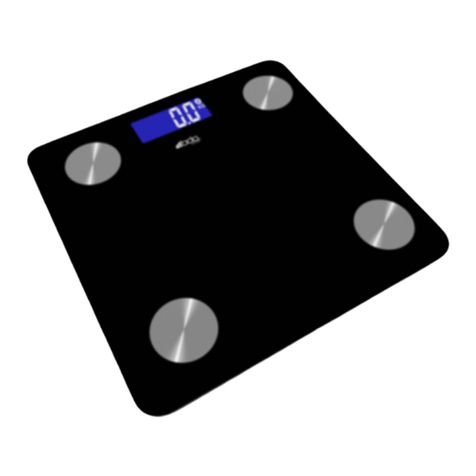
2. Place the calibration weight on the pan; Wait until the flashing weight value
display changes to a steady state (e.g. 500.00 g).
3. Remove the weight of the pan; “0.00” will be displayed and the balance will return
to the weighing mode.
Linearity Calibration
If tolerance (error) after calibration is too high, then it is necessary to make linearity
calibration. For this, proceed as follows:
1. Long press CAL key when the number flashes, and long press CAL again.
2. The necessary weight value will flash, put the according weight on the pan and
wait until the display shows 0.00g.
4. USE OF THE BALANCE
Weighing function
1. Enter the weighing mode
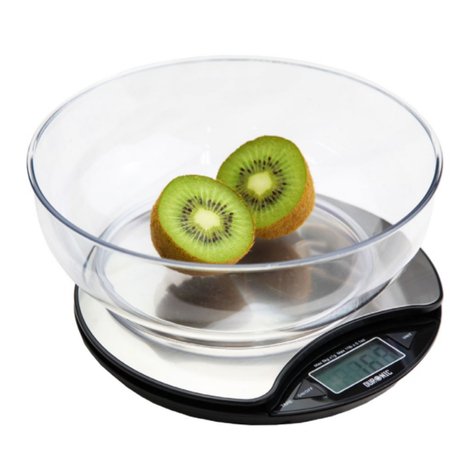
2. Place a container on the pan
3. Once the weight on display has stabilized, press “TARE” key; value on display will
change to 0.00.
4. Place the sample to be weighed in the container.
5. Once the value on display has stabilized, read the display.
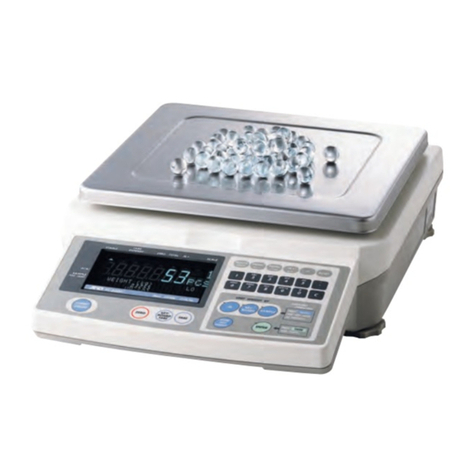
Piece counting function
1. Long Press “UNIT/COU” key to enter in piece counting mode; The display will
show 10-20-50-100 in sequence.
2. Place the corresponding sample of pieces on the pan. (e.g. put 10pcs sample on
the pan, when the display shows 10, press “UNIT/COU”to save the data.) Then it
works.
Note: In counting mode, the weight of the pieces must be even and the weight of
an individual piece should not be less than the readability of the balance.
5. To return to weighing mode, press “UNIT/COU” key.
Weighing unit selection
Balance can perform weighing in different measuring units.
In weighing mode press repeatedly “UNIT” key to consecutively display all available
weighing units and select the desired one.
The weighing unit by default is g.
Overload
The weight of the sample cannot exceed the rated maximum capacity of the balance;
when exceeded, the upper line “----OL-----“ will be displayed. Remove the sample
immediately to avoid damages to the balance.