manuals.online logo
Brands
  1. Home
  2. •
  3. Brands
  4. •
  5. Whirlpool
  6. •
  7. Washer
  8. •
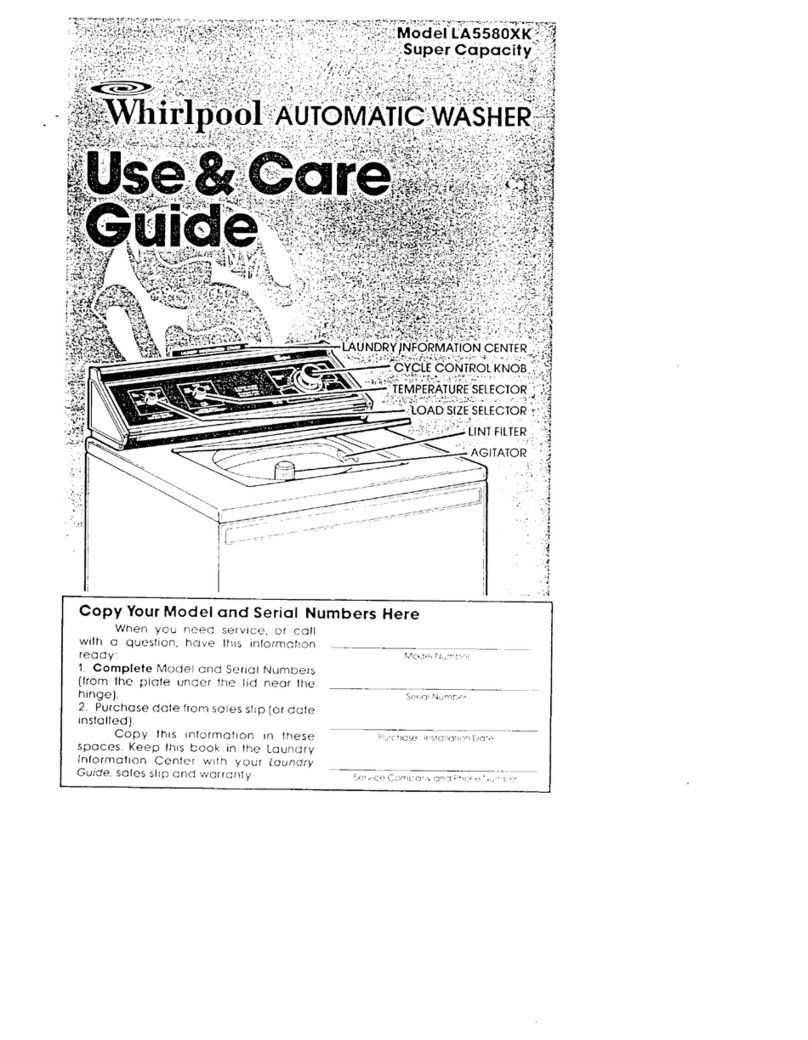
  9. Whirlpool LA5243XY User manual

Whirlpool LA5243XY User manual

Other Whirlpool Washer manuals

Whirlpool WFL98HEBU User manual

Whirlpool

Whirlpool WFL98HEBU User manual

Whirlpool WFW86HEBC0 User manual

Whirlpool

Whirlpool WFW86HEBC0 User manual

Whirlpool Duet Steam User manual

Whirlpool

Whirlpool Duet Steam User manual

Whirlpool LSQ9110KQ0 User manual

Whirlpool

Whirlpool LSQ9110KQ0 User manual

Whirlpool LA9800XK User manual

Whirlpool

Whirlpool LA9800XK User manual

Whirlpool W10298850 Instruction manual

Whirlpool

Whirlpool W10298850 Instruction manual

Whirlpool w10550271a User manual

Whirlpool

Whirlpool w10550271a User manual

Whirlpool CAE2745FQ0 User manual

Whirlpool

Whirlpool CAE2745FQ0 User manual

Whirlpool 4KWTW5600JW User manual

Whirlpool

Whirlpool 4KWTW5600JW User manual

Whirlpool WFW5090JW0 User manual

Whirlpool

Whirlpool WFW5090JW0 User manual

Whirlpool 7LSC9355BN0 User manual

Whirlpool

Whirlpool 7LSC9355BN0 User manual

Whirlpool WTW6600SB0 User manual

Whirlpool

Whirlpool WTW6600SB0 User manual

Whirlpool W10867906B User manual

Whirlpool

Whirlpool W10867906B User manual

Whirlpool LSE9355BQ0 User manual

Whirlpool

Whirlpool LSE9355BQ0 User manual

Whirlpool Cabrio W10240441C - SP User manual

Whirlpool

Whirlpool Cabrio W10240441C - SP User manual

Whirlpool W10338647A User manual

Whirlpool

Whirlpool W10338647A User manual

Whirlpool WFW94HEXW Parts list manual

Whirlpool

Whirlpool WFW94HEXW Parts list manual

Whirlpool ATW4475V User manual

Whirlpool

Whirlpool ATW4475V User manual

Whirlpool Michigan 49022 User manual

Whirlpool

Whirlpool Michigan 49022 User manual

Whirlpool WTW4850XQ Assembly instructions

Whirlpool

Whirlpool WTW4850XQ Assembly instructions

Whirlpool Duet W10254043C User manual

Whirlpool

Whirlpool Duet W10254043C User manual

Whirlpool FFD11469BSVUK User manual

Whirlpool

Whirlpool FFD11469BSVUK User manual

Whirlpool GHW9300P User manual

Whirlpool

Whirlpool GHW9300P User manual

Whirlpool LSC9245BW0 User manual

Whirlpool

Whirlpool LSC9245BW0 User manual

Popular Washer manuals by other brands

Zanussi ZWF 14080 W user manual

Zanussi

Zanussi ZWF 14080 W user manual

Zanussi FV 825 N Instruction booklet

Zanussi

Zanussi FV 825 N Instruction booklet

LG WM8000HVA Specifications

LG

LG WM8000HVA Specifications

Zanussi TJ 1284 H instruction manual

Zanussi

Zanussi TJ 1284 H instruction manual

AEG KO-LAVAMAT 74740 User information

AEG

AEG KO-LAVAMAT 74740 User information

Beko WSRE7512PRA user manual

Beko

Beko WSRE7512PRA user manual

Miele PW 6207 operating instructions

Miele

Miele PW 6207 operating instructions

GE GE Profile WWSE3160AAA Specifications

GE

GE GE Profile WWSE3160AAA Specifications

Bush WMNB712EB instruction manual

Bush

Bush WMNB712EB instruction manual

ALLIANCE UW60AV Information manual

ALLIANCE

ALLIANCE UW60AV Information manual

Bosch WAN280H3 User manual and installation instructions

Bosch

Bosch WAN280H3 User manual and installation instructions

Maytag MAT15MNAW installation instructions

Maytag

Maytag MAT15MNAW installation instructions

LG T2109VSAL owner's manual

LG

LG T2109VSAL owner's manual

Indesit IWC 61481 Instructions for use

Indesit

Indesit IWC 61481 Instructions for use

Electrolux EWF12843 user manual

Electrolux

Electrolux EWF12843 user manual

Indesit WIN 70 Instructions for use

Indesit

Indesit WIN 70 Instructions for use

Bosch WGB25400BY User manual and installation instructions

Bosch

Bosch WGB25400BY User manual and installation instructions

Coltene SciCan HYDRIM C61W G4 Operator's manual

Coltene

Coltene SciCan HYDRIM C61W G4 Operator's manual

manuals.online logo
manuals.online logoBrands
  • About & Mission
  • Contact us
  • Privacy Policy
  • Terms and Conditions

Copyright 2025 Manuals.Online. All Rights Reserved.

-.
ANoteToYou 2
pg2;“fdq 3
PartsAndFeatures 4
Operating
lnstmctions 5
Other Features 8
Laundry Guide 10
Wgfcl Assistance
20
Warranty 24
1-800-253-1301
Call us with questions or comments.
TWO SPEED AUTOMATIC WASHER
MODEL LA5243XY
ANue ToYou
Thank you for buying a Whirlpool appliance.
You have purchased a quality, world-class home appliance. Years of engineering experience have gone
into its manufacturing. To ensure many years of trouble-free operation, we have developed this Use and
Care Guide. It is full of valuable information on how to operate and maintain your appliance property and
safely. Please read it carefully. Also, please complete and mail the Ownership Registration Card
provided with your appliance. This will help us notify you about any new information on your appliance.
Your safety is important to us.
This guide contains safety symbols and statements. Please pay special attention to these symbols and
follow any instructions given. Here is a brief explanation of the use of each symbol.
This symbol will help alert you to such dangers as
personal injury, burns, fire and electrical shock. This symbol will help you avoid actions which
could cause product damage (scratches, dents,
etc.) and damage to your personal property.
Our Consumer Assistance number, l-800-253-1301, is
toll-free 24 hours a day.
If you have a question concerning your appliance’s operation, or if you need service, first see ‘If You
Need Assistance Or Se&e” on pages 20 and 21. ff you need further help, feel free to call us. When
calling, you will need to know your appliance’s complete model number and serial number. You can find
this information on the model and serial number plate (see diagram on page 4). For your convenience,
we have included a handy place below for you to record these numbers, the purchase date from the
sales slip and your dealer’s name and telephone number. Keep this book and the sales slip together in a
safe place for future reference.
Model Number
Serial‘Number
Purchase Date
Dealer Name
Dealer
Phone
Important Safety Instructions
l Read all Instructions before using the
washer.
l NEVER
wash items cleaned, washed,
soaked in or spotted with wax, paint,
gasoline, or flammable fluids in the washer.
The fumes can create a FIRE HAZARD or
EXPLOSION. ALWAYS hand launder and
air dry fabrics containing these materials.
l NEVER
allow children to operate, play with,
or crawl inside the washer. Close super-
vision of children is necessary when the
washer is used near children.
l
When discarding an old washer, ALWAYS
remove the lid to prevent accidental
entrapment.
l
DCI NOT reach into the washer basket
while it is filling with water, while agitator is
moving or while basket is spinning. ff the lid
is opened while the basket is spinning, the
basket will automatically stop in a few
seconds.
l
DO NOT tamper with controls.
l
NEVER use or store flammable fluids (dry-
cleaning solvents, kerosene) in or near
your washer. DC NOT add flammable fluids
to the wash water. These substances give
off vapors that can create a FIRE HAZARD
or EXPLOSION.
l
tf hot water has not been used recently
(usually 2 weeks or longer), hydrogen
gases may build up in the water heater and
the hot water pipes. HYDROGEN GAS IS
EXPLOSIVE. To prevent injury or damage,
before using your washer, turn on all hot
water faucets and allow water to run for
several minutes. This will allow gases to
escape. DC NOT smoke or use any open
flame near the faucet while it is open.
l You are responsible for making sure
that your washer:
-is installed, repaired, and has parts
replaced by a qualffied person.
-is property installed and leveled on a floor
that can support the weight.’
-is connected to the correct 3-prong outlet,
electric supply, water supply and drain.*
is property grounded.*
is property maintained.
-is protected from the weather and kept
where the temperature will not fall below
freezing.
‘See the Installation Instructions.
- SAVE THESE INSTRUCTIONS -
Additional safety instrktions and your responsibilities
l
ALWAYS store detergent, laundry aids and
other materials in a cool, dry place where
children can’t reach them-in a locked
cabinet if possible.
l
ALWAYS read and follow instructions on
packages of detergents and laundry aids
-especially warnings and precautions.
l
DC NOT wash or dry items that are soiled
with vegetable or cooking oil. These items
may contain some oil after laundering. Due
to the remaining oil, the fabric may smoke
or catch fire by itself.
l
HAZARDOUS FUMES can form if chlorine
bleach is used in the same wash as ammo-
nia or acids such as vinegar or rust remover.
l
ALWAYS unplug the power supply cord before
attempting to service the washer.
l
DC NOT machine wash glass fiber materials.
Small particles can stick to fabrics washed in
following loads and cause skin irritation.
l You are responsible for
making sure that
your
washer:
- is used only for jobs normally expected of
home automatic washers.
- is not run by children or anyone unable to
operate it properly.

PartsAnd Features
The parts and features of your washer are illustrated in this section. Become familiar with all parts and
features before using your washer.
Load size
(under lid)
Bleach dispenser
-
Fabric softener
dispenser
Control panel
1 Agitator
Manual clean
lint filter
(inside agitator)
Hang tags/temporary labels
Remove all hang tags and temporary labels before the washer is used. If label glue remains,
rub briskly with thumb or soak area with hand dishwashing detergent.
Do not use sharp instruments, rubbing alcohol, flammable fluids or abrasive cleaners to remove
labels. These can damage the finish. See “Important Safety Instructions” on page 3.
4
Operating Instructions
I
In This Section
Page
Starting your washer .......................................... 5 Select a cycle and wash time ......................... 6
Select a load size ................................................ 5 Starting/stopping the washer ......................... 6
Select a water temperature ................................ 5 What happens in each cycle .......................... .6
Your Whirlpool washer is designed for ease of operation and maximum washing efficiency. The
following will help you quickly learn to operate your machine.
Before starting your washer
Add measured detergent. Then place a sorted
load in the washer before starting. See page 10
for additional “Before you wash” information.
Select a load size
Turn the knob to point at a setting that describes
the size of load you want to wash. Set the knob
*-on SMALL (a few small items), MEDIUM or
LARGE (a full load).
NOTE: For best washing results, items should
move freely in the washer. Do not overload the
washer or choose a water level that is too low for
your wash load.
For best results with permanent press clothes,
use the LARGE water level.
Reduce wash time when using the SMALL
water level setting. Loads with only a few small
items need less wash time for best results.
Select a water temperature
Match the water temperature to the type of fabric
and soils being washed. The top temperature is
the was6 selection and the bottom temperature is
the rinse selection.
Water temperature tips:
l
Use warm wash water with the Permanent
Press or Knits Gentle cycles.
l
For heavily soiled permanent press or knit
clothes, pre-wash or pre-soak before washing
in warm water.
l
Always use cold rinse water for permanent
press fabrics.
See the “Water temperature guide” on page 14
for more information.
Starting/stopping the washer
l
Start the washer by pulling out the Cycle
Control Knob. The washer will fill to the
selected water level with the selected wash
water temperature. The washer will begin
agitating immediatefy after filling. Agitation can
occur with the washer lid up or down.
l
To stop the washer at any time, push in the
.Cycle Control Knob. To restart the washer, pull
out the Cycle Control Knob.
What happens in each cycle
Each cycle is designed for different kinds of
fabrics.
When the Cycle Control Knob is set to a
number and pulled out, the washer fills before
agitation and timing starts. After agitation starts,
the knob turns clockwise until it points to OFF
and the cycle ends.
The washer pauses briefly throughout each
cycle. These pauses are normal for washer
operation.
6
Permanent Press cycle
l-l-.-,,,,r
“----‘k’---nal-cleans moderately to
!nt press and some
l-elllldllelll l-,e55/IY”IIl
heavily soiled permane
synthetic fabrics.
Wash time: 10 minutes
Permanent Press/Light-cleans lightly soiled
permanent press and some synthetic fabrics.
Wash time: 6 minutes
The Permanent Press cycle uses a cool-down
. . . . . . . .I#..~
rinse ana pulse0 splnmng 10reauce wnnKcllng.
Other Features
In This Section
Page
Rinse and spin ...........*....-....................-.........*....8
Drain and spin ............................................-........8
Manual clean lint filter ..................._....................9
Page
Liquid bleach dispenser ..................................9
Liquid fabric softner dispenser ......................9
Understanding the use of the following features will help you use your washer efficiently.
Rinse and spin
When using extra detergent for heavily soiled
clothes or washing special-care items, you may
want an extra rinse and spin.
1. Push the Cycle Control Knob in.
2. Turn knob clockwise to one of the dots on the
dial, as illustrated.
3. Pull Cycle Control Knob out. The washer will
fill to selected level, agitate, drain and spin.
Drain and spin
A drain and spin may help shorten drying times
for some heavy fabrics or special-care items by
removing excess water.
1. Push Cycle Control Knob in.
2. Turn knob clockwise until indicator points to
any bar just before an OFF area on the dial,
as illustrated.
3. Pull Cycle Control Knob out. The washer will
drain and spin.
Manual clean lint filter
Clean lint filter after every load.
1.
2.
3.
4.
5.
To remove, grasp the top of the agitator with
both hands. Pull upward to remove agitator
cap. Lint filter is attached to the end of the
shaft.
Detach lint filter by pinching forked ends of
shaft together. Slide lint filter off shaft.
Wash or wipe the lint filter clean.
Slide filter back into place on shaft (open end
up). Snap into place.
Push lint filter and agitator cap firmly back into
agitator.
Fabric softener
Liquid bleach dispenser
Always measure bleach. Do not guess. Never
use more than 1 cup (250 mL) for a full load. Use
less with lower water level setting. Follow
directions on bottle for safe use. Use a cup with a
pouring spout to avoid spilling.
1. Load the washer.
._2. Pour measured bleach carefully into dis-
penser. Do not let bleach splash, drip or run
down into washer basket. Undiluted bleach
will damage any fabric it touches.
3. Start the washer. Bleach will be diluted
automatically during the wash part of the
cycle.
Liquid fabric softener dispenser
1. Add detergent and load to the basket.
2. Add liquid fabric softener to the dispenser
using the amount recommended on the
package.
3. Avoid dripping or spilling any fabric softener
on the load.
4. Dilute fabric soflener with warm water. Add
enough water to fill dispenser to the opening.
5. Start the washer. Diluted fabric softener will be
added to the load during the final rinse.
NOTE: Do not stop the washer during this
time. If you do, the fabric softener will mix with
the remaining soapy wash water. This will
cause stains. Do not put detergent in the liquid
fabric softener dispenser.
6. If the dispenser needs cleaning, flush with hot
water. To remove, see “Manual clean lint filter”
above.
NOTE: Do not wash clothes with dispenser
removed.
Laundry Guide
I
In This Section
PawI
Before you wash ... .“...“.“...........“.....“.......” .. 10
Removing stains . ..... .. .I ..-------. 11
WBtm, - -.-....-... ... - I.. ...
------.14
LPundty alds ““..“......---.--“.-..~....--“. 15
Washing apeclalcare items .....
. ............--. 16
Laundering problemr ...““-......................I .. 16
Caring for your washer _-....-.--... 1-,.lQ
Energy saving tipa S----1.-....-..-.- 19
Mnterizing “..........“..--““-“..........“.”....m.. 19
This section reviews proper laundering techniques, gives you additional washing information and
discusses solutions to common laundering problems.
Before you wash
Preparing clothes for washing
l
Empty pockets and turn them inside out.
l
Turn down cuffs and brush away lint and dirt.
l
Turn synthetic knits inside out to avoid pilling.
l
Close zippers, snaps and hooks to avoid
-- snagging other items. Remove pins, buckles
and other hard objects to avoid scratching the
washer interior.
l
Remove unwashable trim and ornaments.
l
Tie strings and sashes so they will not tangle.
l
Mend tears, loose hems and seams.
l
Treat spots and stains. (See page 11 for
pretreatment and stain removal information.)
l
Stained or wet garments should be washed
promptly for best resufts.
Sorting
l
Separate dark from light colors, colorfast from
non-colorfast.
l
Sort by fabric and construction (sturdy cottons,
knits, delicate items).
l
Separate heavily soiled items from lightfy soiled
ones even it they would normalfy be washed
together.
l
Separate lint givers (towels, chenille) from lint
takers (corduroy, synthetics, permanent press).
When possible, turn lint givers inside out.
Loading
l
Load washer properly. Overloading or packing
can:
-cause poor cleaning.
-increase wrfnkfing.
-create excessive lint.
-wear out items faster (because of pilling).
l
Load by the amount of space items take up, not
by their weight.
l
Drop items into washer loosely. Fill to the top of
the basket, but do not pack around the agitator.
l
items should move easily through wash water
for best cleaning and wrinkle-free results.
Watch for rollover. lterns should sink and
reappear later.
l
Mix large and small items in each load. Load
evenly to maintain washer balance. An off-
balance load can make the machine vibrate
during spin.
l
To reduce wrinkling, permanent press and
synthetic knits should have more room to move
in the water than heavy items (towels, jeans).
10