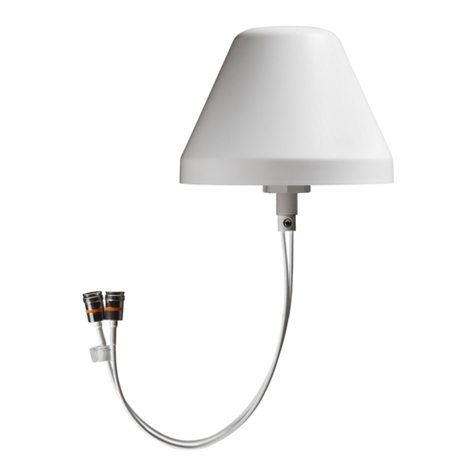
Xirrus 2x2 Omni Antenna User manual

EXTERNAL ANTENNA GUIDE
REFERENCE GUIDE

Overview
To optimize the overall performance of a Xirrus
WLAN in an outdoor deployment it is important
to understand how to maximize coverage
with the appropriate antenna selection and
placement. This document is meant to serve as
a guideline for anyone who wishes to use Xirrus’
antennas and related accessories with Xirrus’
newest outdoor wireless products (XR-520H
and XR-2425H). The document is organized
according to the following sub-sections:
• Basic Technical Background
• Types of available Xirrus Antennas and
Accessories
• Reference Test Data
• Design Considerations and Reference
UseCases
Technical Background
ISM bands:
The U.S. Federal Communications Commission (FCC) authorizes
commercial wireless network products to operate in the Industrial,
Scientic and Medical (ISM) bands using spread spectrum
modulation. The ISM bands are located at three different
frequencies ranges – 900MHz, 2.4GHz and 5GHz. This document
covers products that operate in the 2.4 and 5GHz bands.
ISM bands allow manufacturers and users to operate wireless
products in the U.S. without requiring specic licenses.
This requirement may vary in other countries. The products
themselves must meet certain requirements in order to be
certied for sale such as maximum Transmit Power (Tx Power)
and Effective Isotropic Radiated Power (EIRP) ratings.
Each of the ISM bands has different characteristics. The lower
frequency bands exhibit better range but with limited bandwidth
and hence lower data rates. Higher frequency bands have less
range and are subject to greater attenuation from solid objects.
Antenna Properties, Ratings
and Representation
At the most fundamental level an Antenna provides a wireless
communication system three main attributes that are inter-
related to each other and ultimately inuence the overall
radiation pattern produced by the antenna:
• Gain
• Directivity
• Polarization
Gain of an Antenna is a measure of the increase in power that
the antenna provides. Antenna gain is measured in decibels
(dB) — a logarithmic unit used to express the ratio between two
values of a given physical quantity. In the general case, the gain
in dB is a factor of the ratio of output power (or radiated power)
to the input power of the antenna (that ratio is also called the
“efciency” of the antenna). In practice, the gain of a given
antenna is commonly expressed by comparing it to the gain
of an isotropic antenna. An isotropic antenna is a “theoretical
antenna” with a perfectly uniform three-dimensional radiation
pattern. When expressed relative to an isotropic antenna, the
gain of a given antenna is represented in dBi (i for isotropic).
By that measure, a truly isotropic antenna would have a power
rating of 0 dB. The U.S. FCC uses dBi in its calculations.
Directivity is the factor that was referred to in the previous
discussion about antenna gain and its relation to efciency.
Mathematically, the gain of an antenna is its directivity times
itsefciency. And like its gain, the directivity of a given
antenna is also expressed relative to an isotropic antenna. The
directivity measures the power density that an antenna radiates
in the direction of its strongest emission, relative to the power
densityradiated by an ideal isotropic antenna (which emits
uniformly in all directions), when they are both radiating the
same total power.
Polarization of an antenna is the orientation of the electric
eld of the radio wave that it produces relative to the earth’s
surface. The polarization of an antenna is determined by the
physical structure of the antenna and by its orientation. A
simple straight wire antenna will have one polarization when
mounted vertically and a different polarization when mounted
horizontally. A linear polarized antenna radiates wholly in one
plain containing the direction of propagation of the radio wave
while, in a circular polarized antenna, the plane of polarization
rotates in a circle making one complete revolution during one
Xirrus External Antennas Guide

period of the wave. A linear polarized antenna may be either
Horizontally Polarized (if the direction of propagation is parallel
to the earth’s surface) or Vertically Polarized (if the direction
of propagation is perpendicular to the earth’s surface). A
circular polarized antenna may be either Right-Hand-Circular
(RHC) or Left-Hand-Circular (LHC) depending on whether the
direction of rotation of the plane of propagation is clockwise
or counterclockwise respectively. Polarization is an important
design consideration, particularly in Line of Sight (LOS) or
Point-to-Point type deployments because maximum signal
strength between sending and receiving antennas occurs when
both are using identical polarization.
Radiation Pattern of an antenna is a plot of the relative strength
of the electromagnetic eld of the radio waves emitted by the
antenna at different angles. Radiation patterns are typically
represented by either a three-dimensional graph or by a set of
two separate two-dimensional polar plots of the horizontal and
vertical cross sections. The radiation pattern of the theoretical
isotropic antenna, which radiates equally in all directions, would
look like a sphere.
Impedance Matching is an important consideration in the
design of the overall wireless communication system. This is
because an electromagnetic wave traveling through various
parts of a communication system (radio, cable, connectors, air)
may encounter differences in impedance. At each interface,
depending on the impedance mismatch, some fraction of
the propagating radio wave’s energy will reect back into the
source. This reecting wave is called a standing wave and the
ratio of maximum power to minimum power in the standing
wave is called the Voltage Standing Wave Ratio (VSWR). A VSWR
of 1:1 is ideal.
Types of Xirrus Antennas
The tables starting on the next page detail the specications
of the different antennas Xirrus offers for use with its Arrays
and Access Points, in both 2.4GHz and 5GHz. Each type of
antenna will offer certain coverage capabilities suited for specic
applications (as discussed in the later section of this document).
The radiation patterns listed below also provide some guidance
on the coverage to be expected from a given antenna. As a
general rule of thumb as the gain of an antenna increases, there
is some tradeoff to its coverage area. High gain antennas will
typically offer longer coverage distance but smaller (and more
directed) coverage area.

Directional Antennas
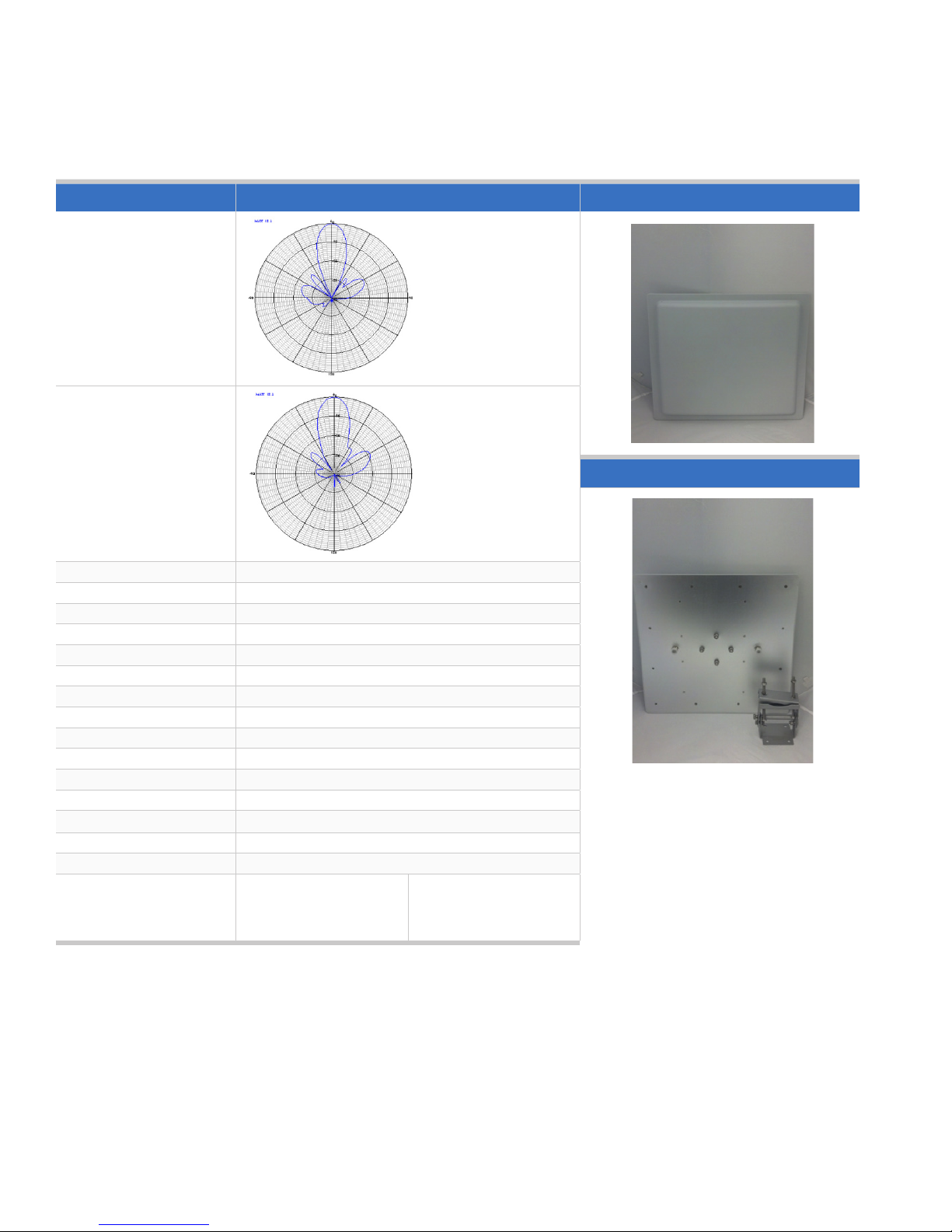
15° Antenna for 2.4 GHz band (ANT-DIR15-2x2-2.4G-01)
DESCRIPTION PANEL 15° ANTENNA FOR INDOOR AND OUTDOOR USE FRONT
Vertical Gain Pattern
Horizontal Gain Pattern
BACK AND CONNECTORS
Frequency Range (GHz) 2.4– 2.5
Impedance 50 ohms
VSWR (50 ohms) ≤2.0:1
Peak Gain, dBi (2.4 and 5GHz) 17+/- 1
Polarization +/– 45
3dB Beamwidth Az (H) 16° typ.
3dB Beamwidth El (V) 16° typ.
Maximum Power 10 W CW
Connector N-female x 2
Dimensions 17.7IN X 17.7IN X 1.6 IN
Weight 8.7lb
Operating Temp -40 C to +55C
Mounting Options Pole Mount included
Cable SKU ANT-CAB-195-10-MM
Cable Specs LMR-195, male RP-TNC to male N connectors and 10’ length
What to order For use with one XR-520H:
• 1 ANT-DIR15-2x2-2.4G-01
• 2 ANT-CAB-195-10-MM
( per 2.4GHz radio )
For use with one XR-2425H:
• 1 ANT-DIR15-2x2-2.4G-01
• 2 ANT-CAB-195-10-MM
( per 2.4GHz radio )

15° Antenna for 5 GHz band (ANT-DIR15-2x2-5.0G-01)
DESCRIPTION PANEL 15° ANTENNA FOR INDOOR AND OUTDOOR USE FRONT
Vertical Gain Pattern
Horizontal Gain Pattern
BACK
Frequency Range (GHz) 5.15 – 5.850
Impedance 50 ohms
VSWR (50 ohms) ≤2.0:1
Peak Gain, dBi (2.4 and 5GHz) 17+/- 1
Polarization V/H
3dB Beamwidth Az (H) 17°
3dB Beamwidth El (V) 17°
Maximum Power 10 W CW
Connector N-female x 2
Dimensions 10.3IN X 10.3IN X 1.4IN
Weight 2.53lb
CONNECTORS CLOSEUP
Operating Temp -40 C to +55C
Mounting Options Pole Mount included
Cable SKU ANT-CAB-195-10-MM
Cable Specs LMR-195, male RP-TNC to male N connectors and 10’ length
What to order For use with one XR-520H:
• 1 ANT-DIR15-2x2-5.0G-01
• 2 ANT-CAB-195-10-MM
( per 5GHz radio )
For use with one XR-2425H:
• 1 ANT-DIR15-2x2-5.0G-01
• 2 ANT-CAB-195-10-MM
( per 5GHz radio )

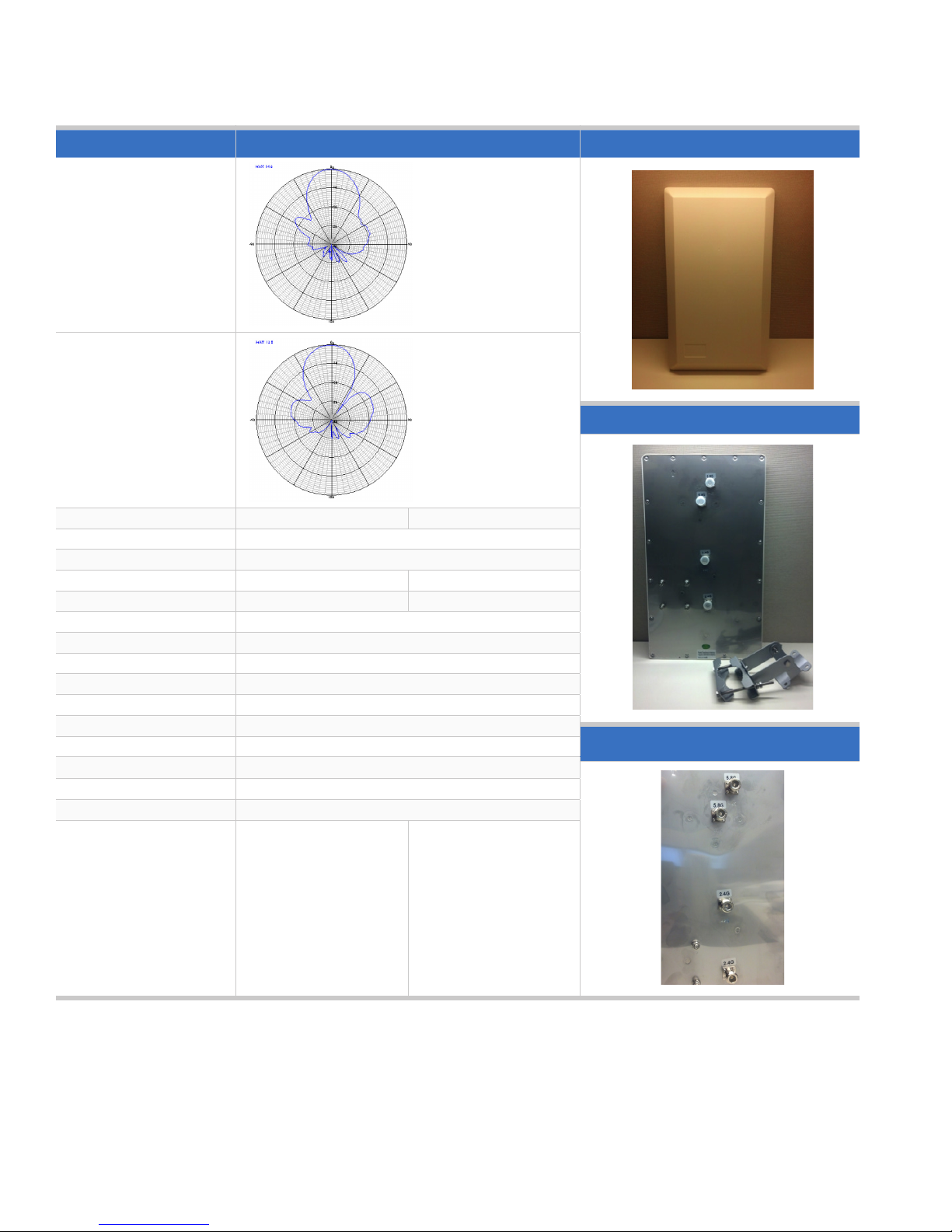
30° Antenna (ANT-DIR30-2x2-01)
DESCRIPTION PANEL 30° ANTENNA FRONT
Vertical Gain Pattern
Horizontal Gain Pattern
BACK
Frequency Range (GHz) 2.4– 2.5 5.15 – 5.825
Impedance 50 ohms
VSWR (50 ohms) 2.0: 1 max. typ.
Peak Gain, dBi (2.4 and 5GHz) 11.7 – 13.5 12.5 – 14.0
Polarization 2 x +/– 45 2 x +/– 45
3dB Beamwidth Az (H) 35° +/- 5
3dB Beamwidth El (V) 35° +/- 5
Maximum Power 10 W max.
Connector N-female x 4
Dimensions 16.5in x 9.4in x 1.4 in
Weight 3.75lb
CONNECTORS CLOSEUP
Operating Temp -40 C to +55C
Mounting Options Pole Mount included
Cable SKU ANT-CAB-195-10-MM
Cable Specs LMR-195, male RP-TNC to male N connectors and 10’ length
What to order For use with one XR-520H:
• 1 ANT-DIR30-2x2-01
• 4 ANT-CAB-195-10-MM
For use with one XR-2425H:
• 2 ANT-DIR30-2x2-01
• 8 ANT-CAB-195-10-MM

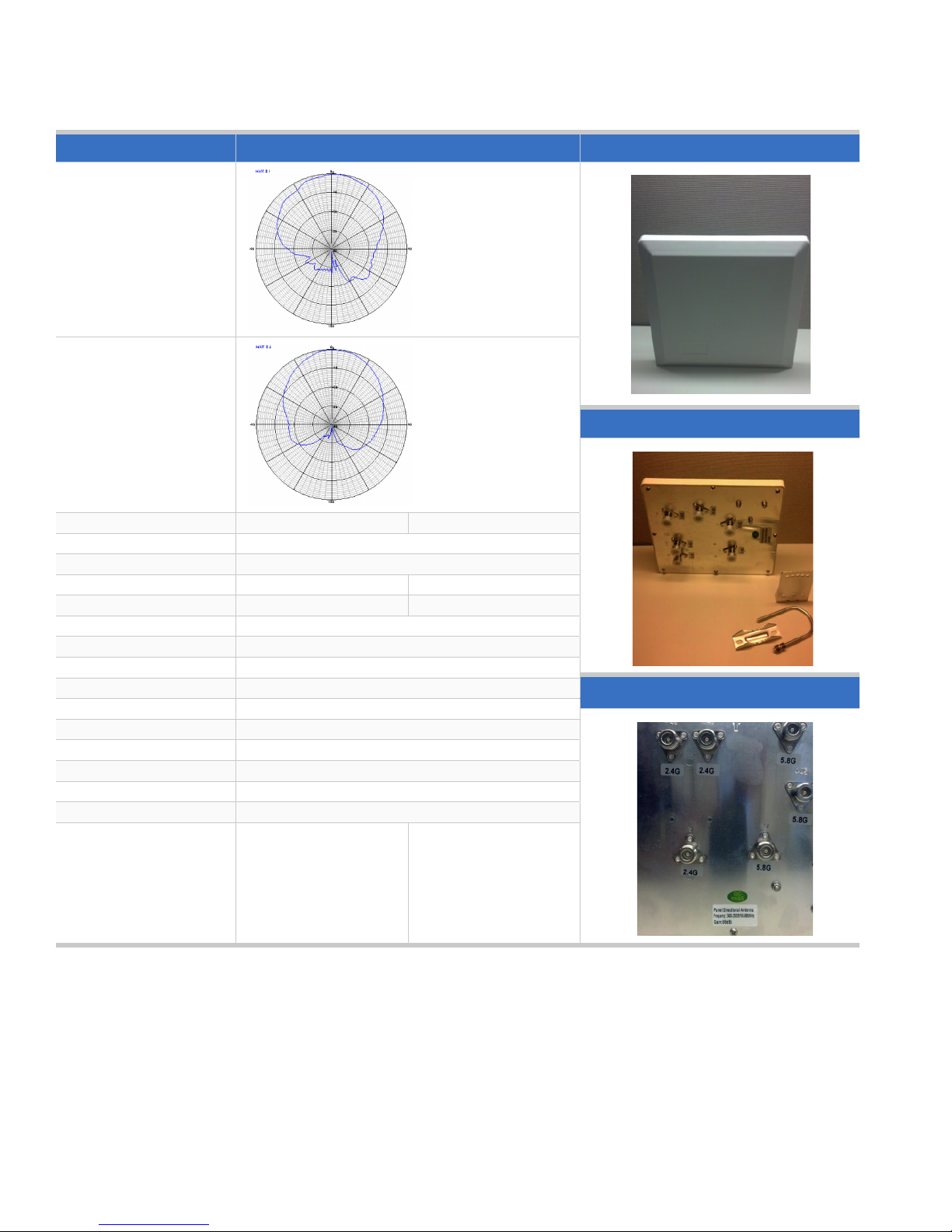
60° Antenna (ANT-DIR60-2x2-01)
DESCRIPTION PANEL 60° ANTENNA FRONT
Vertical Gain Pattern
Horizontal Gain Pattern
BACK
Frequency Range (GHz) 2.4 – 2.48 5.15 – 5.850
Impedance 50 ohms
VSWR (50 ohms) 2.0: 1 max. typ.
Peak Gain, dBi (2.4 and 5GHz) 7 – 10 8.5 – 9.5
Polarization 2 x +/– 45, V 2 X +/– 45, V
3dB Beamwidth Az (H) 65° +/- 5
3dB Beamwidth El (V) 65° +/- 5
Maximum Power 10 W max.
CONNECTORS CLOSEUP
Connector N-female x 6
Dimensions 8.6in x 8.6in x 1.18in
Weight 1.49lb
Operating Temp -40 C to +55C
Mounting Options Pole Mount included
Cable SKU ANT-CAB-195-10-MM
Cable Specs LMR-195, male RP-TNC to male N connectors and 10’ length
What to order For use with one XR-520H:
• 1 ANT-DIR60-2x2-01
• 4 ANT-CAB-195-10-MM
For use with one XR-2425H:
• 2 ANT-DIR60-2X2-01
• 8 ANT-CAB-195-10-MM

90° Antenna (ANT-DIR90-2x2-01)
DESCRIPTION PANEL 90° ANTENNA FRONT
Vertical Gain Pattern
Horizontal Gain Pattern
BACK
Frequency Range (GHz) 2.4 – 2.5 5.15 – 5.85
Impedance 50 ohms
VSWR (50 ohms) 2.0: 1 max. typ.
Peak Gain, dBi (2.4 and 5GHz) 4.0 6.5 – 9.5
Polarization Vertical
3dB Beamwidth Az (H) 90° typ.
3dB Beamwidth El (V) 90° typ.
Maximum Power 10 W max.
Connector 2*N connectors
CONNECTORS CLOSEUP
Cable SKU ANT-CAB-195-10-MM
Cable Specs LMR-195, male RP-TNC to male N connectors and 10’ length
What to order For use with one XR-520H:
• 2 ANT-DIR90-2x2-01
For use with one XR-2425H:
• 4 ANT-DIR90-2X2-01

Omni-Directional Antennas:
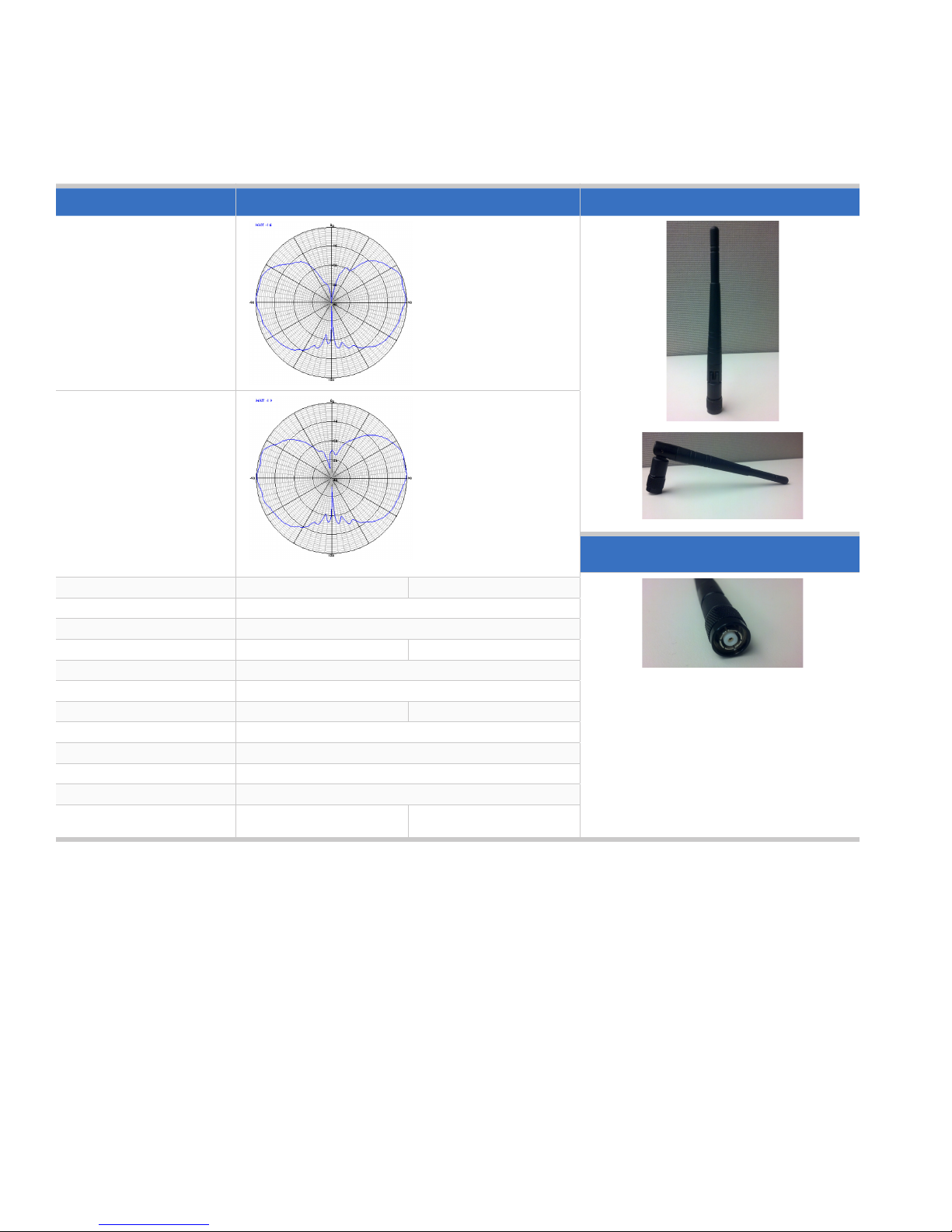
“Rubber Duck” Antenna (ANT-OMNI-1x1-02)
DESCRIPTION 360° (OMNIDIRECTIONAL) ANTENNA ANTENNA
Vertical Gain Pattern
Horizontal Gain Pattern
CONNECTOR CLOSEUP
Frequency Range (GHz) 2.4 – 2.5 5.15 – 5.825
Impedance 50 ohms
VSWR (50 ohms) 2.0: 1 max. typ.
Peak Gain, dBi (2.4 and 5GHz) -1.54 – 0 0 – 1.7
Polarization 4 X Vertical
3dB Beamwidth Az (H) 360°
3dB Beamwidth El (V) 90° 60°
Maximum Power 10 W max.
Connector 1 X RP-TNC male
Cable SKU ANT-CAB-195-10-MM
Cable Specs LMR-195, male RP-TNC to male N connectors and 10’ length
What to order For use with one XR-520H:
• 4 ANT-OMNI-1x1-02
For use with one XR-2425H:
• 8 ANT-OMNI-1X1-01

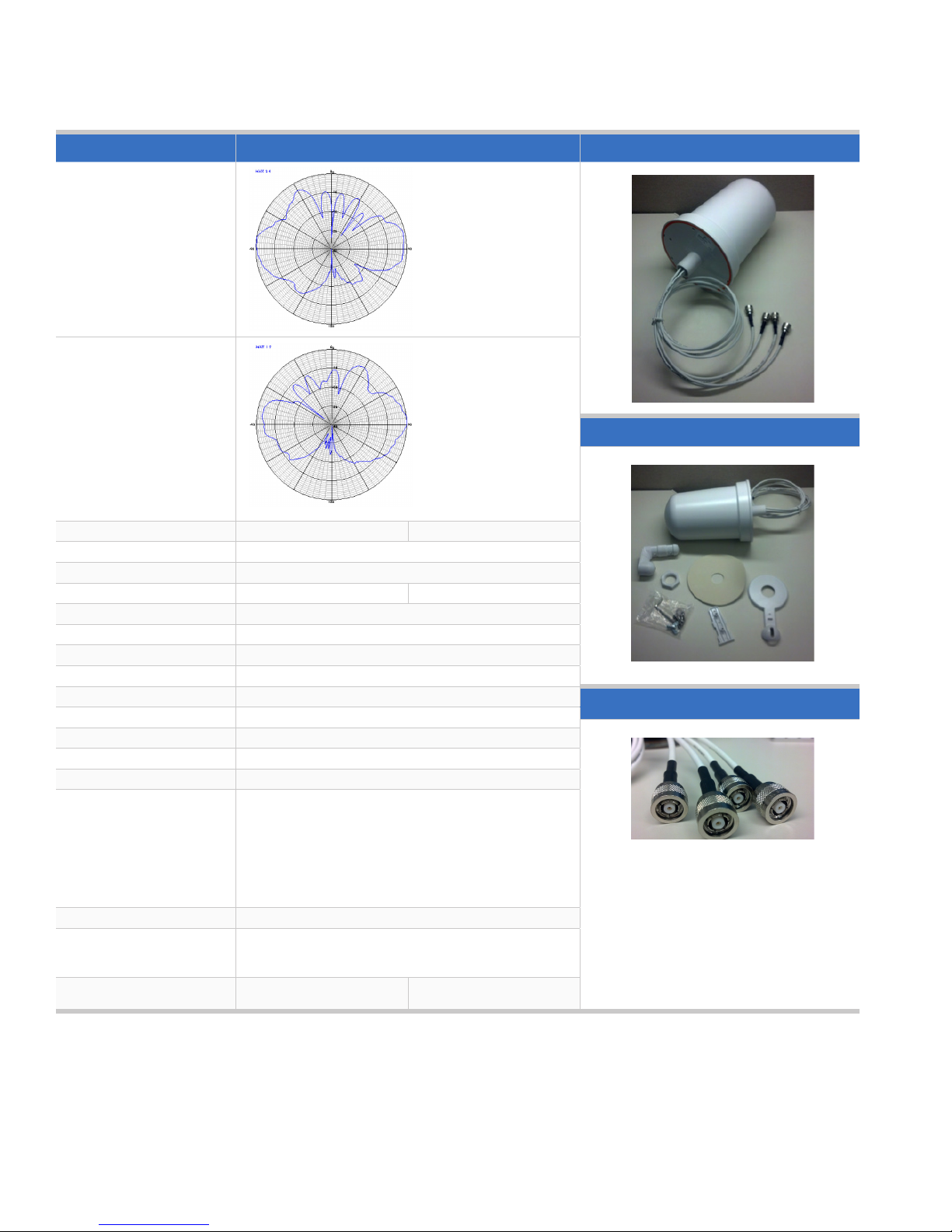
2x2 Omni Antenna (ANT-OMNI-2x2-02)
DESCRIPTION 360° (OMNIDIRECTIONAL) ANTENNA ANTENNA
Vertical Gain Pattern
Horizontal Gain Pattern
MOUNTS
Frequency Range (GHz) 2.4 – 2.5 5.15 – 5.825
Impedance 50 ohms
VSWR (50 ohms) 2.0: 1 max. typ.
Peak Gain, dBi (2.4 and 5GHz) 2.3 3 – 6.5
Polarization 4 x V (Linear, Vertical)
3dB Beamwidth Az (H) 360°
3dB Beamwidth El (V) 60°
Maximum Power 10 W.
Connector RP-TNC male CONNECTOR CLOSEUP
Dimensions 8.6 H x 6.3 OD inches
Operating Temp -30° C to + 70° C
Storage Temp -40° C to + 85° C
Ingress Protection IP-54
Mounting Options 1.5” stud mount
Universal wall and mast mountable with included articulating
mount. All tools and hardware included. Mounts to mast up to
1-1/2” in diameter.
Ceiling mountable to 1” thick ceiling tile with jam nut. Also includes
rubber washer for mounting to smooth surfaces such as NEMA
enclosures.
Cable Specs LMR-195, male RP-TNC to male N connectors and 10’ length
Connector Three Reverse Polarity TNC (male)
ANSI 7/16-28 UNEF
2B threads
What to order For use with one XR-520H:
• 1 ANT-OMNI-2x2-02
For use with one XR-2425H:
• 2 ANT-OMNI-2X2-02
This manual suits for next models
5
Table of contents
Other Xirrus Antenna manuals
Popular Antenna manuals by other brands

DAVIS
DAVIS Windex AV 3160 installation instructions

Belden
Belden Hirschmann BAT-ANT-N-14G-IP23 Mounting instruction

Vtronix
Vtronix YHK Fitting instructions

KVH Industries
KVH Industries TracVision 6 Technical manual

Leica Geosystems
Leica Geosystems GS10 user manual

Sirio Antenne
Sirio Antenne Gain-Master manual

Feig Electronic
Feig Electronic ID ISC.ANTH200/200 Series manual

TERK Technologies
TERK Technologies TV44 owner's manual

TERK Technologies
TERK Technologies SIR3 owner's manual

Directive Systems & Engineering
Directive Systems & Engineering DSE2324LYRMK quick start guide

HP
HP J8999A instructions

MobilSat
MobilSat MSP-S Mounting instructions