manuals.online logo
Brands
  1. Home
  2. •
  3. Brands
  4. •
  5. ZANKER
  6. •
  7. Refrigerator
  8. •
  9. ZANKER KSU 370 B User manual

ZANKER KSU 370 B User manual

This manual suits for next models

1

Other ZANKER Refrigerator manuals

ZANKER ZKR 250 B User manual

ZANKER

ZANKER ZKR 250 B User manual

ZANKER KEAK88FS User manual

ZANKER

ZANKER KEAK88FS User manual

ZANKER KNLK14FS User manual

ZANKER

ZANKER KNLK14FS User manual

ZANKER ZKK8423 User manual

ZANKER

ZANKER ZKK8423 User manual

ZANKER ZKK 8416 K User manual

ZANKER

ZANKER ZKK 8416 K User manual

ZANKER TT 162 C User manual

ZANKER

ZANKER TT 162 C User manual

ZANKER KBA23001SB User manual

ZANKER

ZANKER KBA23001SB User manual

ZANKER KBB24011SK User manual

ZANKER

ZANKER KBB24011SK User manual

ZANKER KBA22411SB User manual

ZANKER

ZANKER KBA22411SB User manual

ZANKER TT 160 ICE User manual

ZANKER

ZANKER TT 160 ICE User manual

ZANKER KBB29001SK User manual

ZANKER

ZANKER KBB29001SK User manual

ZANKER CT 235 User manual

ZANKER

ZANKER CT 235 User manual

ZANKER ZKK8421 User manual

ZANKER

ZANKER ZKK8421 User manual

ZANKER KEAK82FR User manual

ZANKER

ZANKER KEAK82FR User manual

ZANKER ZKR 250 B User manual

ZANKER

ZANKER ZKR 250 B User manual

ZANKER KBA23022SK User manual

ZANKER

ZANKER KBA23022SK User manual

ZANKER ZBT 6234 User manual

ZANKER

ZANKER ZBT 6234 User manual

ZANKER DD241 User manual

ZANKER

ZANKER DD241 User manual

ZANKER ZKK8008 User manual

ZANKER

ZANKER ZKK8008 User manual

ZANKER ZKK9008 User manual

ZANKER

ZANKER ZKK9008 User manual

ZANKER ZKR 244 A User manual

ZANKER

ZANKER ZKR 244 A User manual

ZANKER ZKR 200 A User manual

ZANKER

ZANKER ZKR 200 A User manual

ZANKER TT160A User manual

ZANKER

ZANKER TT160A User manual

ZANKER KBU14001DK User manual

ZANKER

ZANKER KBU14001DK User manual

Popular Refrigerator manuals by other brands

Frigidaire FRS26TS7DW2 Use & care manual

Frigidaire

Frigidaire FRS26TS7DW2 Use & care manual

Fisher Scientific 10ECEEFSA manual

Fisher Scientific

Fisher Scientific 10ECEEFSA manual

Summit FF22BDRSS user manual

Summit

Summit FF22BDRSS user manual

Frigidaire FFRU17B2QWE use & care

Frigidaire

Frigidaire FFRU17B2QWE use & care

Hotpoint ENBGH 19xxx FW operating instructions

Hotpoint

Hotpoint ENBGH 19xxx FW operating instructions

Hitachi R-SG28KPH instruction manual

Hitachi

Hitachi R-SG28KPH instruction manual

Dometic RMH 7390 L operating instructions

Dometic

Dometic RMH 7390 L operating instructions

AEG S71700TSW0 user manual

AEG

AEG S71700TSW0 user manual

Electrolux ENB3669 Instruction book

Electrolux

Electrolux ENB3669 Instruction book

Electrolux ERN 2930 Instruction book

Electrolux

Electrolux ERN 2930 Instruction book

Beko GNE 60520 X user manual

Beko

Beko GNE 60520 X user manual

Jenn-Air JUR248LBES00 Use & care guide

Jenn-Air

Jenn-Air JUR248LBES00 Use & care guide

Dometic RGE 4000 Installation and operating manual

Dometic

Dometic RGE 4000 Installation and operating manual

Dometic L-0191B Brochure & specs

Dometic

Dometic L-0191B Brochure & specs

LG LRBP1031W - 10 Cu. Ft. Cabinet Depth Bottom Freezer... owner's guide

LG

LG LRBP1031W - 10 Cu. Ft. Cabinet Depth Bottom Freezer... owner's guide

Daewoo RN-33 Series user manual

Daewoo

Daewoo RN-33 Series user manual

Haier RF-8888-174 Service manual

Haier

Haier RF-8888-174 Service manual

Blaupunkt 5CK2 Series user manual

Blaupunkt

Blaupunkt 5CK2 Series user manual

manuals.online logo
manuals.online logoBrands
  • About & Mission
  • Contact us
  • Privacy Policy
  • Terms and Conditions

Copyright 2025 Manuals.Online. All Rights Reserved.

H/Z/12-2. (02)1372731
GEBRUIKSAANWIJZING
MODE D`EMPLOI
GEBRAUCHSANLEITUNG
INSTRUCTION BOOK
KOEL/VRIESCOMBINATIE
RÉFRIGÉRATEUR CONGÉLATEUR
KÜHL - GEFRIERKOMBINATION
REFRIGERATOR- FREEZER COMBINATION
KSU 370 B (ZLKI 351)
NL
FR
DE
GB
56
Before installing and using the appliance read this user's instruction book carefully. It contains safety
precautions, hints, information and ideas. If the refrigerator is used in compliance with the
instructions written, it will operate properly and provide you with greatest satisfaction.
The symbols below help you to find things more easily:
Safety precautions
Warnings and information at this symbol serve safety for you and your appliance.
Hints, useful information
Environmental information
Symbol for ideas
At this symbol ideas can be found according to food and its storing.
GB
57
Cont
Contents
ents
GB
Important safety information ..................................................................................................58
General safety precautions....................................................................................................58
Precautions for child safety....................................................................................................58
Safety precautions for installation ...........................................................................................58
Safety precautions for isobutane ............................................................................................58
Instructions for the User.........................................................................................................59
General information..............................................................................................................59
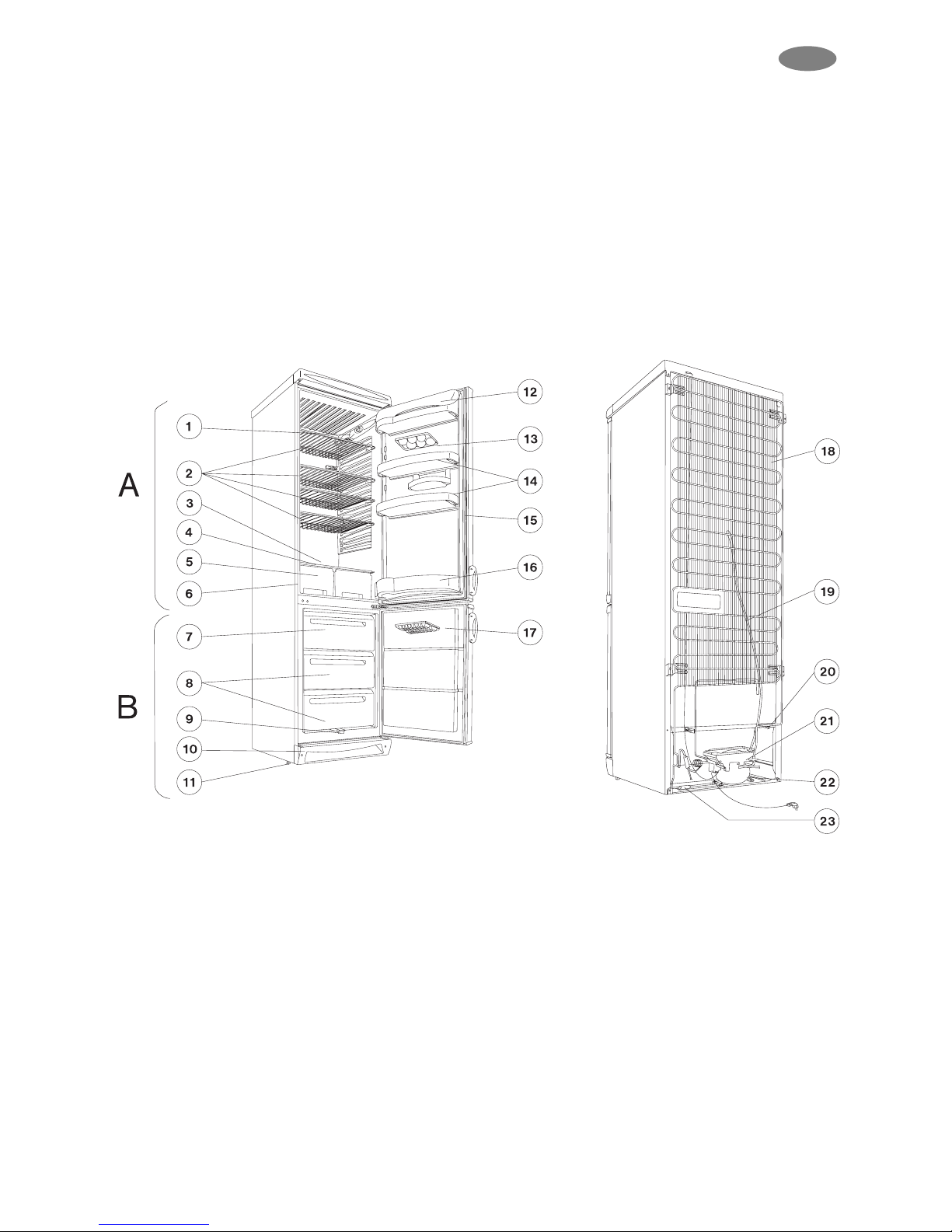
Description of the appliance, main parts..................................................................................59
Handling the appliance .........................................................................................................60
Putting it into use.............................................................................................................60
Controlling the temperature, setting....................................................................................60
How to use the refrigerator................................................................................................60
Storing in the refrigerator ..................................................................................................61
Storage time and temperature of foods....................................................................................61
How to use the freezer..........................................................................................................61
Freezing.........................................................................................................................61
Storing in the freezer........................................................................................................62
How to make ice cubes ....................................................................................................62
Some useful information and advice........................................................................................62
Hints and ideas ...................................................................................................................62
How to save energy .........................................................................................................62
The appliance and environment .........................................................................................62
Maintenance .......................................................................................................................63
Defrosting ......................................................................................................................63
Regular cleaning .............................................................................................................64
When the refrigerator is not in use......................................................................................64
Trouble shooting..................................................................................................................64
How to change the bulb ...................................................................................................64
If something does not work ...............................................................................................65
Instructions for the Installer....................................................................................................66
Technical data .....................................................................................................................66
Installing the appliance .........................................................................................................66
Transportation, unpacking.................................................................................................66
Cleaning ........................................................................................................................66
Placement ......................................................................................................................67
Change of door opening direction ......................................................................................67
Electrical connection........................................................................................................68
Storage time chart (1) ...........................................................................................................69
Storage time chart (2) ...........................................................................................................70
Warranty and service .............................................................................................................70
Guarantee conditions ...........................................................................................................70
Service and spare parts....................................................................................................70
Declaration of guarantee terms .............................................................................................71
58
Im
Impor
port
tant saf
ant safe
et
ty inf
y infor
ormation
mation
General safety precautions
Keep these instructions and they should remain at
the appliance when moving away or changing
owner.
This appliance is designed for storing food,
domestic use according to these instructions only.
Specialised companies that are qualified to do
so by the manufacturer must carry out service
and repairs including repairing and changing
the power cord. Accessory parts supplied by
them should be used only for repairing. Otherwise
the appliance can be damaged or can cause other
damage or injury.
The appliance is out of circuit only in that case if the
plug is removed from the socket. Before cleaning
and maintenance always unplug it (do not get it by
the cable). If the socket is difficult to reach, switch
off the appliance by cutting off the current.
Power cord must not be lengthened.
Without the lamp cover of interior lighting you must
not operate the appliance.
When cleaning, defrosting, taking out frozen food
or ice tray do not use sharp, pointed or hard
devices, as they can cause damage to the
appliance.
Be careful not to allow liquids to the temperature
control and lighting box.
Ice and ice-cream can cause hurt if they are eaten
immediately after removal from the frozen food
compartment.
After dissolving frozen food must not be refrozen, it
must be used up as soon as possible.
Store pre-packed frozen food in accordance with
the frozen food manufacturer's instructions.
You must not make defrosting faster with any
electric heating appliance or chemicals.
Do not put hot pot to the plastic parts.
Do not store flammable gas and liquid in the
appliance, because they may explode.
Do not store carbonated drinks, bottled drinks and
bottled fruits in the frozen food compartment.
Check and clean the outlet of melting water coming
during defrosting regularly - a label inside the
appliance warns you for this. If it is clogged the
melting water gathered can cause earlier failure.
Adults must handle the appliance. Do not allow
children to play with it or its controlling parts.
If you are discarding the appliance pull the plug
out of the socket, cut the connection cable (as
close to the appliance as you can) and remove
the door to prevent playing children to suffer
electric shock or to close themselves into it.
Precautions for child safety
Do not allow children to play with the packaging of
the appliance. Plastic foil can cause suffocation.
Safety precautions for
installation
Put the appliance to the wall to avoid touching or
catching warm parts (compressor, condenser)
to prevent possible burn.
When moving the appliance take care of the plug
not to be in the socket.
When placing the appliance take care not to
stand it on the power cord.
Adequate air circulation should be around the
appliance, lacking this leads to overheating. To
achieve sufficient ventilation follow the
instructions relevant to installation.
For the safety of life and property keep
the precautions of these user's
instructions as the manufacturer is not
responsible for damages caused by omission.
Safety precautions for
isobutane
Warning
The refrigerant of the appliance is isobutane
(R 600a) that is inflammable and explosive to a
greater extent.
Keep ventilation openings, in the appliance
enclosure or in the built-in structure, clear of
obstruction.
Do not use mechanical devices or other means
to accelerate the defrosting process, other than
those recommended by the manufacturer.
Do not damage the refrigerant circuit.
Do not use electrical appliances inside the food
storage compartments of the appliance, unless
they are of the type recommended by the
manufacturer.
GB

59
Ins
Instr
tructions f
uctions for the User
or the User
General information
The official designation of the appliance is
refrigerator-freezer combination with one motor
compressor and freezer placed in the lower part. The
appliance has -besides the general services- a freezer
with its own door and is completely separated from the
other unit.
According to this the appliance is suitable for storing
frozen and deep-frozen food, freezing products in
quantity given in the user's instructions at home
and making ice.
The appliance can meet the requirements of
standards between different temperature limits
according to the climate class.
The letter symbol for climate class can be found on
the data label.
Description of the appliance, main parts
12. Butter compartment
13. Egg tray
14. Door shelf
15. Door gasket
16. Bottle shelf
17. Ice tray
18. Condenser
19. Defrost water outlet tube
20. Spacer
21. Evaporative tray
22. Compressor
23. Rollers
A - Refrigerator
B - Freezer
1. Lighting box
2. Wire shelf
3. Defrost water collector
4. Glass shelf
5. Vegetable boxes
6. Data label
7. Freezing compartment
8. Storing compartments
9. Defrost water outlet
10. Bottom cover grid
11. Adjustable feet
GB
60
Putting it into use
Place the accessories into the appliance then plug to
the mains socket.
To start cooling turn the thermostatic control knob on
the right-hand side of the compartment from 0
clockwise. In 0 position the appliance is out of
operation.
The next paragraph will give instructions for setting.
Handling the appliance
Controlling the temperature, setting
The thermostatic controller interrupts the operation of
the appliance automatically for more or less time
depending on the setting then restarts it assuring the
required temperature.
Turning the control button towards the bigger numbers
cooling becomes more and more intensive.
Operate the appliance in the 5 thermostatic knob
position for 4-5 hours after the installing so that the
temperatures reach the +5 °C in the fridge and -18 °C
in the freezer. After reset the thermostatic knob to the
3 position and place the foodstuffs to be made cold
and to be frozen into the adequate compartment. The
3 position generally meets the requirements of
everyday cooling.
We recommend you to keep the above mentioned in
case of defrosting and cleaning as well as placing of
fairly big quantity foodstuffs too.
The temperature coming about in the refrigerator is
effected by not only the position of the thermostatic
control but the ambient temperature, frequency of
door openings and the quantity of food put into it
newly, etc.
In the maximum i.e. 5 position - in case of
increased demand e.g. during heatwaves -
without disconnecting continuous operation can
occur. This does not cause damages to the appliance.
How to use the refrigerator
For adequate cooling developing interior air
circulation is necessary. For this reason you are
asked not to cover the whole surface of the wire
shelves with paper, trays, etc.
Do not put hot food into the refrigerator.
Allow it to reach room temperature naturally.
In this way the unnecessary frost building up can
be avoided.
Foods can take over odours from each
other. So it is essential to put foods in closed
dishes or wrap them in cellophane, aluminium
foil, grease-proof paper or cling film before
placing them into the refrigerator. This way foods
will keep their moisture e.g. vegetables will not
dry out after some days.
GB
61
Storing in the refrigerator
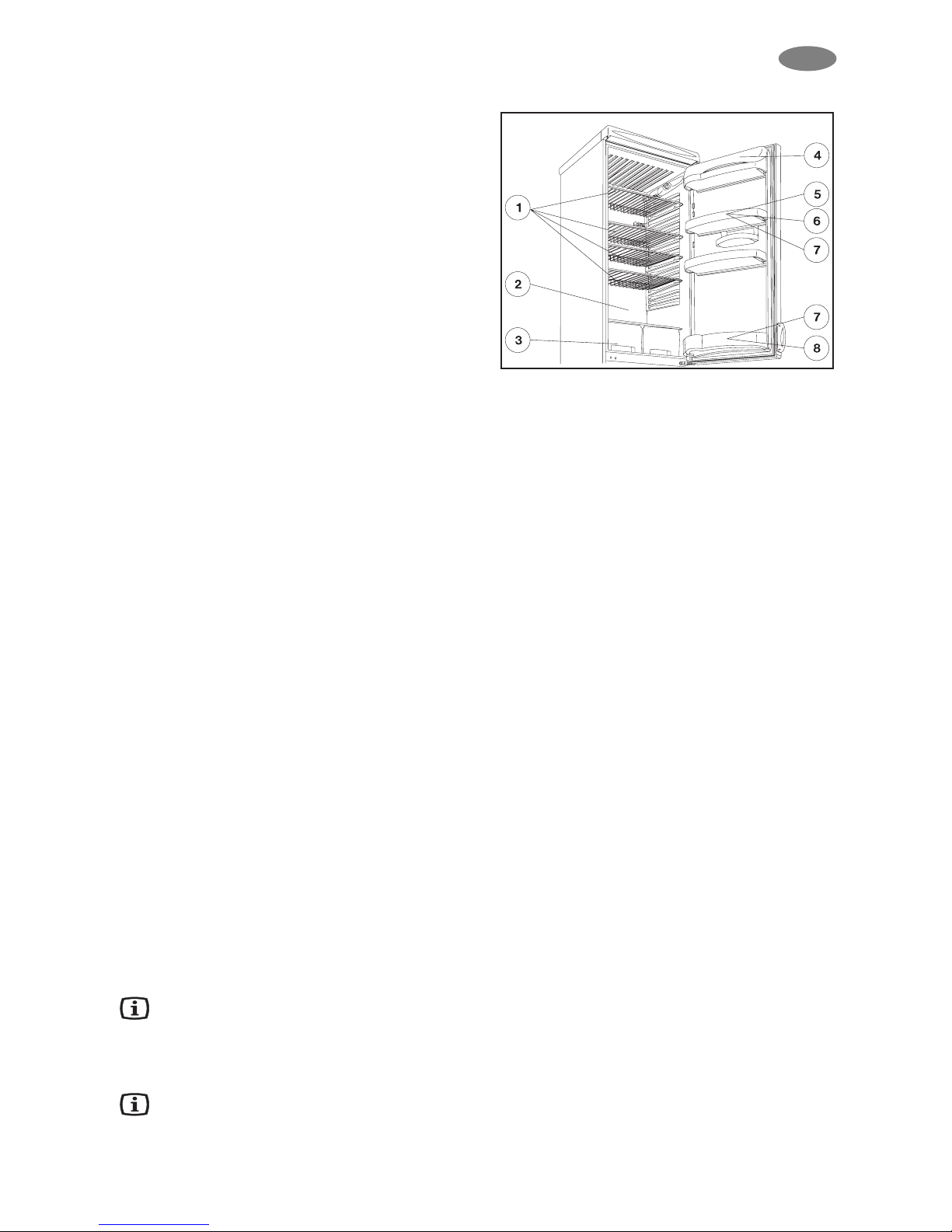
When placing the different kinds of food take into
consideration the sketch below in figure:
1. Confectionery, ready-cooked foods, foods in
dishes, fresh meat, cold cuts, drinks
2. Milk, dairy products, foods in dishes
3. Fruits, vegetables, salads
4. Cheese, butter
5. Eggs
6. Yoghurt, sour cream
7. Small bottles, soft drinks
8. Big bottles, drinks
Storage time and temperature of
foods
The storage time chart at the end of the instruction
book gives information about storage time.
The storage time can not be determined exactly in
advance, as it depends on the freshness and handling
of the cooled food. That is why the storage time made
known is only informative.
If you do not want to use up deep-frozen foods bought
immediately they can be stored for about 1 day (until
dissolving) in the refrigerator.
How to use the freezer
GB
Freezing
Freezing different products should always be done in
the freezing compartment after proper preparing.
The quantity of food to be frozen should be 4 or 6 kg
depending on type.The quantity can be read on the
data label, which is on the left at the bottom of the
fresh food compartment.
Set the thermostat knob to Max. position.
Operate the appliance in this position for 2 hours.
After 2 hours reset the thermostatic knob to a position
adequate for you or Medium position. Put the
quantity to be frozen into the freezing compartment
(max. 4 or 6 kg).
After 24 hours replace the frozen products into the
wire basket (or baskets).
Never freeze food in bigger quantity than
given in the Technical data at the same
time, otherwise freezing will not be thorough and
after dissolving various deterioration may take
place (losing taste and aroma, lysing, etc.).
Do not make ice during freezing preferably,
because making ice reduces freezing capacity.
62
Storing in the freezer
It is practical to replace frozen products into the wire
basket(s) after freezing has finished. Doing this you
could make room in the freezing compartment for
another freezing. Intermediate freezing does not
deteriorate foods already stored.
Do not forget to keep to the storage time given
on the packaging of frozen products if you buy
them frozen. To store home-frozen products see the
storing instructions placed in the door of the freezer.
Symbols signify the various foods, numbers mean
maximum storing time given in months.
It is safe to store quick-frozen, frozen foods only
if they have not dissolved even for a short time
until placing them into the freezer. If the deep-frozen
food has already dissolved, refreezing is not
recommended, it has to be used up as soon as
possible.
How to make ice cubes
To make ice cubes fill the enclosed ice cube tray with
water and put it to the frozen food compartment.
Setting thermostatic control knob to maximum
position can shorten preparing time. After finishing do
not forget to reset the thermostatic control to the
suitable position.
Ready ice cubes can be taken out of the tray under
running water then twist or hit it. If the ice tray freezes
to the compartment, avoid using metal tools or knife to
take it out as the cooling system can be damaged.
Some useful information and
advice
The variable shelves are worth paying attention to,
which increases the usability of the fresh food
compartment considerably. Rearranging the
shelves is also possible when the door is open at an
angle of 90°.
After opening and closing the door of freezer
vacuum will rise inside the appliance because of
the low temperature. So wait 2-3 minutes after
closing the door - if you want to open it again - while
inner pressure equalises.
Take care of operating the freezer at a position of
thermostatic control so that the inside temperature
can never go above -18 °C, since temperature
higher than this storing time of frozen foods can
decrease.
It is practical to make sure of faultless operation of
the appliance daily so as to notice possible failure
in time and prevent deterioration of frozen foods.
How to save energy
Avoid putting the appliance in a sunny place and
near anything that gives off heat.
Be sure that the condenser and the compressor
are well ventilated. Do not cover the sections
where ventilation is.
Wrap products in tightly closing dishes or cling
film to avoid building up unnecessary frost.
Do not leave the door open longer than
necessary and avoid unnecessary openings.
Put warm foods into the appliance only when
they are at room temperature.
Keep the condenser clean.
The appliance and environment
This appliance does not contain gasses which
could damage the ozone layer, in either its
refrigerant circuit or insulation materials. The
appliance shall not be discarded together with the
urban refuse and rubbish. Avoid damaging the
cooling unit, especially at the rear near the heat
exchanger. Information on your local disposal sites
may be obtained from your municipal authorities.
The materials used on this appliance marked with
the sympol are recyclable.
Hints and ideas
In this chapter practical hints and ideas are given
about how to use the appliance to reach maximum
energy saving and there is environmental
information about the appliance as well.
GB
63
Maintenance
Defrosting
Bleeding part of the moisture of cooling chambers in form
of frost and ice goes with the operation of the appliance.
Thick frost and ice has an insulating effect, so it reduces
cooling efficiency as the temperature increases in the
cooling chambers, they need more energy, at a certain
thickness it does not allow the door of the freezing
compartment to open.
At this type of appliance defrosting the cooling plate of the
refrigerator is automatic without any external
intervention.The thermostatic control interrupts the
operation of compressor at regular intervals for more or
less time - during this cooling is interrupted - the
temperature of the cooling plate goes above 0 °C due to
interior heating load of the compartment, so defrosting
occurs. When the surface temperature of the cooling
plate has reached +3 - +4 °C the thermostatic control
restarts operation of the system.
Melting water flows through defrost water outlet leaded
through the back into the evaporative tray maintained on
the top of compressor and evaporates due to its warmth.
Check and clean the outlet of melting water
coming during defrosting regularly - a label
inside the appliance warns you for this. If it is clogged
the melting water gathered can cause earlier failure
as it can go to the insulating of the appliance.
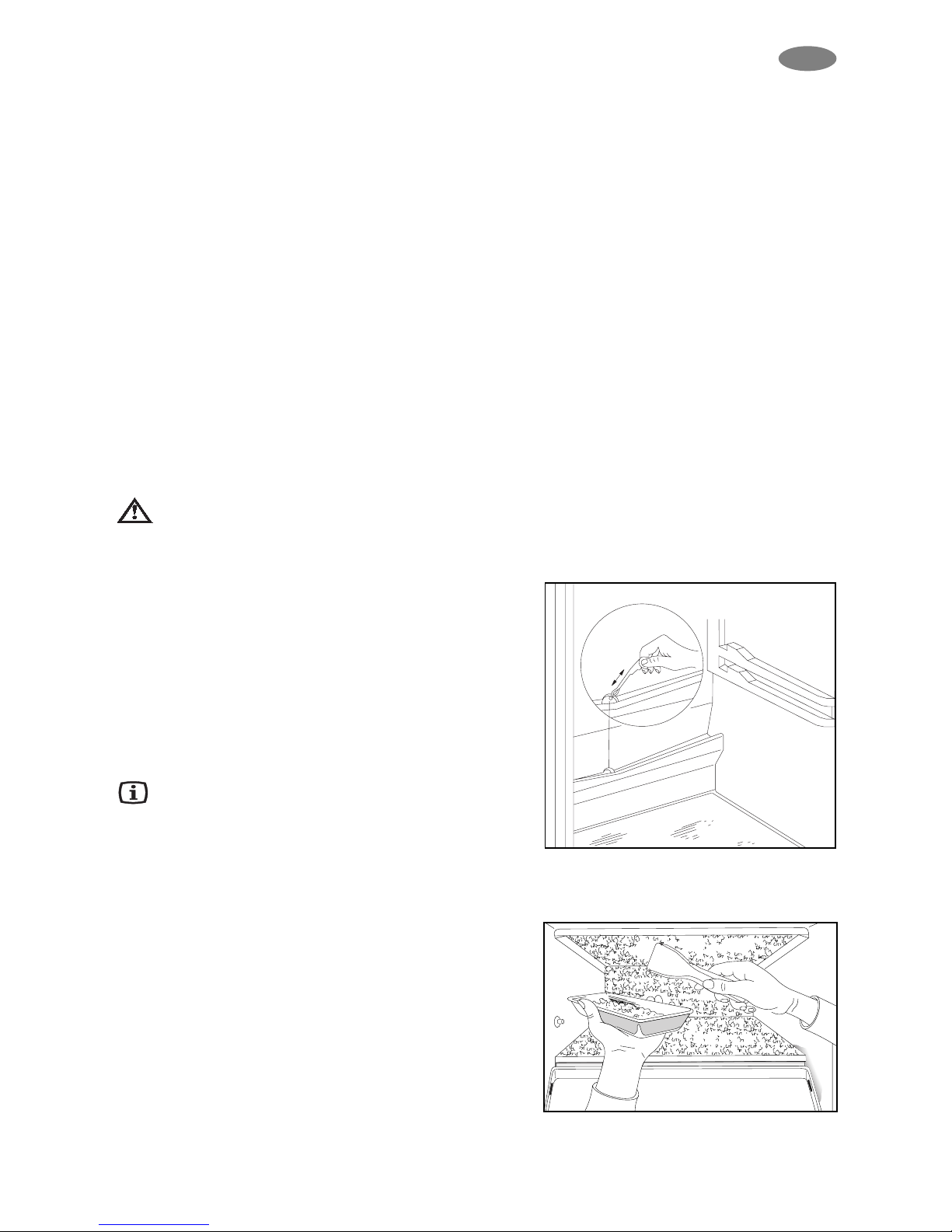
Clean the melting water outlet with the supplied pipe
scraper that can be seen in the figure. The pipe scraper
has to be stored in the outlet.
The most typical case of clogging up in the melting water
outlet when you put food wrapped in some paper into the
appliance and this paper contacts back plate of the
refrigerator and freezes to it. If you remove the food right at
this moment the paper will tear and it can cause clogging
up in the outlet by getting into it. So you are asked to be
careful - because of the above - when placing foods
wrapped in paper into the appliance.
In case of increased demand e.g. during
heatwaves, the refrigerator temporarily happens to
operate constantly - during this the automatic defrosting is
ineffective.
Remaining small ice and frost stains on back plate of the
refrigerator after defrosting period is not abnormal.
The freezer can not be equipped with automatic defrosting
set since the deep-frozen and frozen foods do not endure
melting temperature.
When small frost and ice occurs scrape off and remove
frost and ice coating with the supplied plastic scraper.
The tray in figure is not a piece of accessories to the
appliance!
When ice coating is so thick that it cannot be removed with
the plastic scraper, the cooling plates have to be
defrosted. Frequency of defrosting depends on usage
(generally 2-3 times a year).
Take the frozen foods out of the appliance, and put them
into a basket lined with paper or cloth. Store them in a
possibly cool place or replace them into another
refrigerator.
GB
64
Pull out the mains plug from the mains socket, so both
parts of the appliance are out of operation.
Open the doors of both parts of the appliance and clean
the refrigerator according to 'Regular cleaning'. Maintain
and clean the freezer as following:
Sweep off the melting water with a cloth or sponge in
direction of sides of the cooling plates. The melting water
swept down gathers in the outlet channel practically
formed in the bottom of the appliance and can be
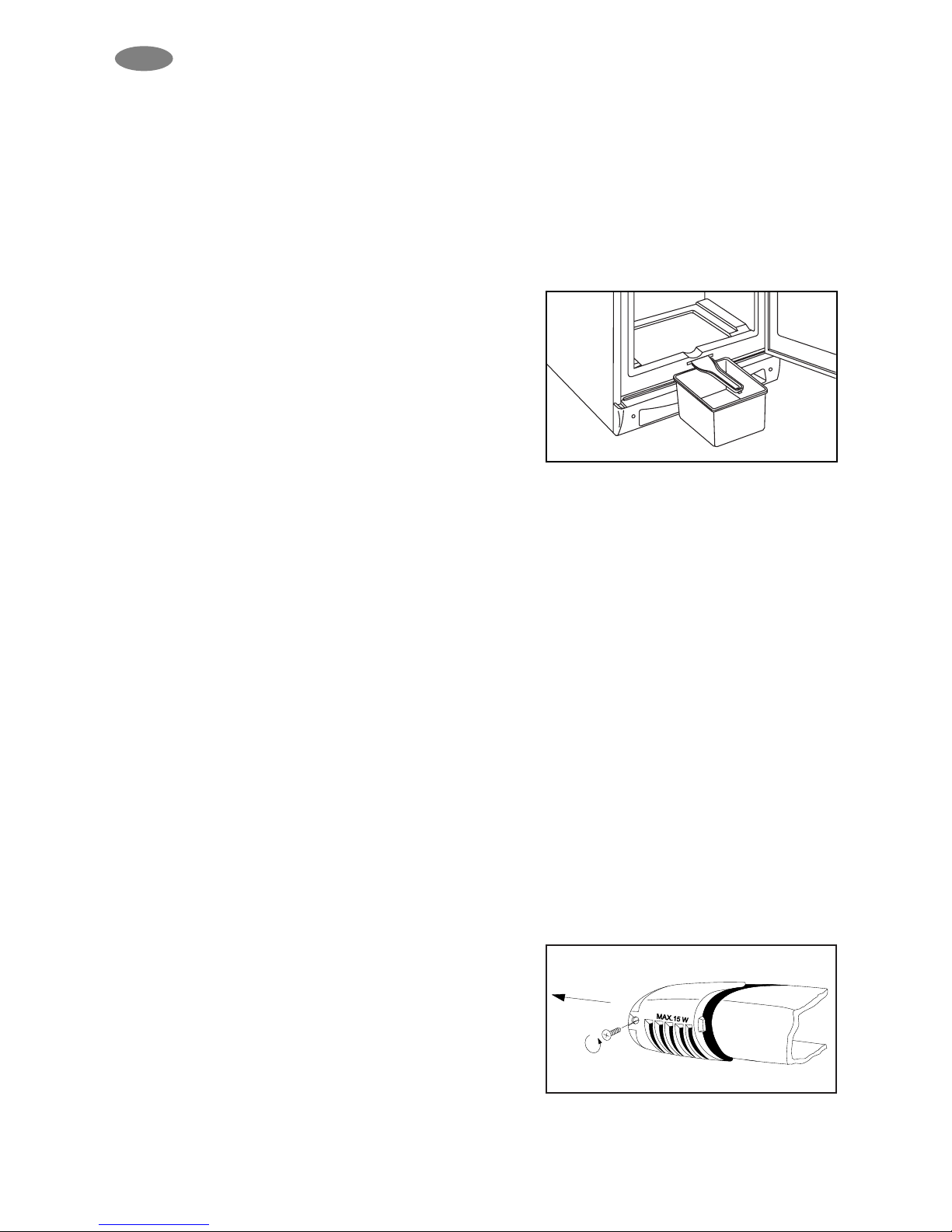
removed according to figure.
Put an adequately high bowl or dish under the outlet.
The bowl in figure is not a piece of accessories to the
appliance!
Wipe the surfaces after defrosting and leading the water
out.
Put the mains plug into the mains socket and put foods
taken out back to their places.
It is recommended to operate the appliance at the highest
position of the thermostatic control for some hours so that
it can reach the sufficient storing temperature as soon as
possible.
Regular cleaning
It is recommended to wash the inside of the
refrigerator in 3-4 weeks time using lukewarm water
then wipe it (it is practical to clean the inside of the
freezer and defrost it at a time).
Household cleaner or soap must not be used.
After breaking the circuit wash the appliance with
lukewarm water then wipe it. Clean the door gasket with
clean water. After cleaning apply voltage to the appliance.
It is recommended to remove the dust and dirt collected
on the back of the refrigerator and the condenser and to
clean the evaporative tray on top of the compressor once
or twice a year.
When the refrigerator
is not in use
In case the appliance will not be used for a long time
follow these steps:
Break the circuit of the appliance.
Remove foods from the refrigerator.
Defrost and clean it as written before.
Leave the door open to avoid a build up of air inside.
Trouble shooting
How to change the bulb
Should the light fail to work you can change it as below:
Break the circuit of the appliance.
Unscrew the plate screw fixing the lamp cover, then
take the lamp cover off in the direction of arrow and the
bulb can be changed. (Type of the bulb: Mignon 322,
230 V, 15 W, E 14 thread)
After changing bulb replace the lamp cover, screw the
plate screw and apply voltage to the appliance.
The lack of light does not influence the development of
the adequate temperatures.
GB