logo
Brands
  1. Home
  2. •
  3. Brands
  4. •
  5. Zanussi
  6. •
  7. Cooker
  8. •
  9. Zanussi Mixed Fuel Cookers User manual

Zanussi Mixed Fuel Cookers User manual

This manual suits for next models

1

Other Zanussi Cooker manuals

Zanussi ZCV46330BA User manual

Zanussi

Zanussi ZCV46330BA User manual

Zanussi ZCV55001WA User manual

Zanussi

Zanussi ZCV55001WA User manual

Zanussi EC19 User manual

Zanussi

Zanussi EC19 User manual

Zanussi ZCG91246 User manual

Zanussi

Zanussi ZCG91246 User manual

Zanussi ZCV554MN User manual

Zanussi

Zanussi ZCV554MN User manual

Zanussi GC 18 B Assembly instructions

Zanussi

Zanussi GC 18 B Assembly instructions

Zanussi ZCG92246 User manual

Zanussi

Zanussi ZCG92246 User manual

Zanussi ZKC6020W User manual

Zanussi

Zanussi ZKC6020W User manual

Zanussi ZITN641K User manual

Zanussi

Zanussi ZITN641K User manual

Zanussi ZCM 5000 Assembly instructions

Zanussi

Zanussi ZCM 5000 Assembly instructions

Zanussi ZCM 630 User manual

Zanussi

Zanussi ZCM 630 User manual

Zanussi ZE 942 User manual

Zanussi

Zanussi ZE 942 User manual

Zanussi ZCM 700 User manual

Zanussi

Zanussi ZCM 700 User manual

Zanussi ZCG563 User manual

Zanussi

Zanussi ZCG563 User manual

Zanussi ZCG551GNC User manual

Zanussi

Zanussi ZCG551GNC User manual

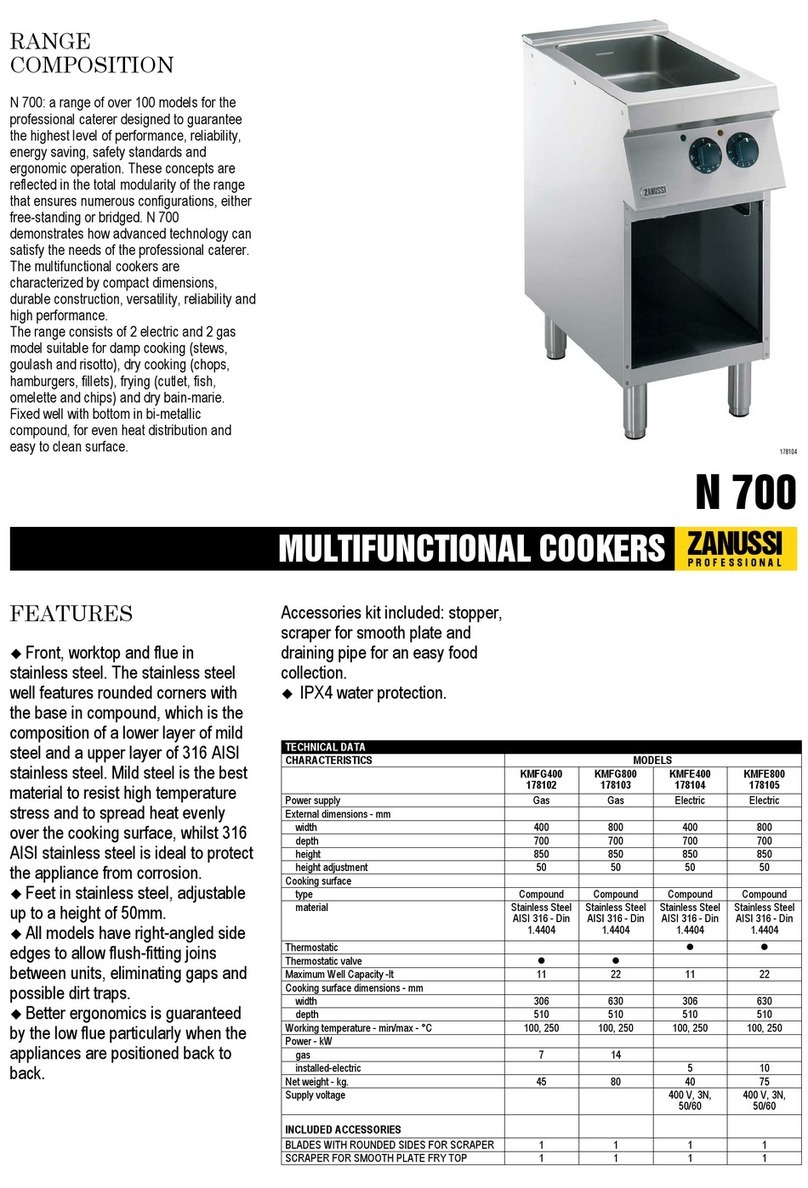
Zanussi 178102 User manual

Zanussi

Zanussi 178102 User manual

Zanussi ZCS6604 User manual

Zanussi

Zanussi ZCS6604 User manual

Zanussi ZCV680TCBA User manual

Zanussi

Zanussi ZCV680TCBA User manual

Zanussi ZCI660EBC User manual

Zanussi

Zanussi ZCI660EBC User manual

Zanussi Z 9060 XOS Quick setup guide

Zanussi

Zanussi Z 9060 XOS Quick setup guide

Zanussi ZCM 611 User manual

Zanussi

Zanussi ZCM 611 User manual

Zanussi ZCG560N User manual

Zanussi

Zanussi ZCG560N User manual

Zanussi ZSX 6 AMT User manual

Zanussi

Zanussi ZSX 6 AMT User manual

Zanussi HC9617 Assembly instructions

Zanussi

Zanussi HC9617 Assembly instructions

Popular Cooker manuals by other brands

Modena FC 7645 SGM User manual book

Modena

Modena FC 7645 SGM User manual book

Electrolux Insight EKG6049 user manual

Electrolux

Electrolux Insight EKG6049 user manual

Stanley Donard 60 Installation and operating instructions

Stanley

Stanley Donard 60 Installation and operating instructions

Bartscher 201TC manual

Bartscher

Bartscher 201TC manual

Parkinson Cowan 50 GR/BU installation instructions

Parkinson Cowan

Parkinson Cowan 50 GR/BU installation instructions

Siemens HK9P00020U instruction manual

Siemens

Siemens HK9P00020U instruction manual

Creda S150E Installation and user instructions

Creda

Creda S150E Installation and user instructions

Creda HB48309 instructions

Creda

Creda HB48309 instructions

Bosch HCE743220F instruction manual

Bosch

Bosch HCE743220F instruction manual

Tricity Bendix SE545P manual

Tricity Bendix

Tricity Bendix SE545P manual

NEFF E1461A2/01 Instructions for use

NEFF

NEFF E1461A2/01 Instructions for use

Smeg SNL61MA9 user manual

Smeg

Smeg SNL61MA9 user manual

RiverGrille TF2002501-RG Assembly instruction

RiverGrille

RiverGrille TF2002501-RG Assembly instruction

Vollrath 69504F Operator's manual

Vollrath

Vollrath 69504F Operator's manual

Tricity Bendix CSIE500 Operating and installation instructions

Tricity Bendix

Tricity Bendix CSIE500 Operating and installation instructions

AEG Competence 5731 V Instruction book

AEG

AEG Competence 5731 V Instruction book

Euromaid ES60 Installation and operation manual

Euromaid

Euromaid ES60 Installation and operation manual

Hotpoint HUI 62 TP Instructions for installation and use

Hotpoint

Hotpoint HUI 62 TP Instructions for installation and use

https://manuals.online logo
https://manuals.online logoBrands
  • About & Mission
  • Contact us
  • Privacy Policy
  • Terms and Conditions

Copyright 2026 Manuals.Online. All Rights Reserved.

MIXED FUEL
COOKERS
60 CM
INSTRUCTION BOOKLET
IL
3
ENGLISH
This warnings has been given for the safety of you and others. We therefore ask you to carefully read the
procedures of installing and using this cooker.
Important safety information
Installation
 The work of installation must be carried out by
competent and qualified installers according to the
regulations in force.
 Any modifications to the domestic electrical mains
which may be necessary for the installation of the
appliance should be carried out only by competent
personnel.
 Ensure that air can circulate around the gas
appliance. Poor ventilation can produce a lack of
oxygen.
 WARNING The use of a gas cooking appliance
produces heat and humidity in the room in
which it is installed. Ensure good ventilation of
the room keeping natural ventilation openings
clear or installing an extractor hood with a
discharge tube. In case of doubt ask installer for
advice.
 Avoid installation of the cooker near inflammable
material e.g. curtains, tea towels, etc.).
 Supply the appliance with the type of gas stamped
on the relevant adhesive label situated in the imme-
diate vicinity of the gas connection tube.
Child Safety
 This appliance has been designed for use by adults.
Take care, therefore, that children do not attempt to
play with it.
 The appliance remains hot for a long time after being
switched off. Supervise children at all times, paying
attention that they do not touch surfaces or remain
in the vicinity of the appliance when in use or when
not completely cooled.
During Operation
 This product is intended for the cooking of food and
must not be used for other purposes.
 It is dangerous to modify, or attempt to modify, the
characteristics of this appliance.
 Unstable or deformed pans should not be placed on
the burners or plates in order to avoid accidents
caused by upsetting or boiling over.
 Particular care should be taken when cooking with
oil or fat.
 If the appliance is fitted with a cover, its function is to
protect the surface from dust when closed and to ac-
cumulate splashes of grease when open. Do not use
for other purposes.
 Always clean the cover before closing.
 Leave the burners and/or plates to cool before
closing.
 All the covers, in plate glass or enamel, are
removable to facilitate cleaning.
 Always ensure that the knobs are in the « »
(Stop) position when the appliance is not in use.
 Always insert the dripping pan when using the grill
or when cooking meat on the grid. Pour a little water
into the dripping pan to avoid grease burning and
creating unpleasant smells.
It is very important that this instruction book
should be kept safely for future consultation. If
the appliance should be sold or given to
another person, please ensure that the booklet
goes together with it, so that the new owner
can know of the functions of the machine and
also be aware of the warnings.
 Always use oven gloves to remove dishes from the
oven.
 The accessories grid and dripping pan) should be
washed before using for the first time.
 Take care when using cleaning products in spray
form: never direct the spray onto the resistance or the
thermostat bulb.
 If, when placing food in the oven, or when removing
it, a large quantity of oil, juice, etc. spills onto the
bottom of the oven, re-clean before starting to cook
to avoid unpleasant smoke and also the possibility
of these substances catching fire.
 For reasons of hygiene and safety this appliance
must always be kept clean. A build up of grease or
other food can cause fires.
 The gas oven becomes hot with the movement of air.
The holes on the bottom of the oven must never be
obstructed. Do not cover the sides of the oven with
aluminium foil, in particular the lower part of the
opening.
 The appliance is heavy, move it carefully.
 Before maintenance and cleaning disconnect the
appliance and allow to cool.
 To facilitate ignition, light the burners before
placing pans on the grid. After having lit the
burners check that the flame is regular.
 Always lower the flame or turn it off before removing
the pan.
 Ensure that the oven grids are inserted correctly see
instructions).
 If there are self-cleaning panels they should only be
cleaned with soap and water see cleaning
instructions).
 Only heat-resistant plates may be placed in the
drawer situated under the oven.Do not put
combustible materials there.
Technical assistance
 In case of repairs, do not attempt to correct yourself.
Repairs carried out by unqualified persons can cau-
se damage. Contact an authorized Technical
Assistance Centre and insist an original spareparts.
Environmental Information
 After installation, please dispose of the packaging with
due regard to safety and the environment.
 When disposing of an old appliance, make it unusable,
by cutting off the cable.

4
Description of the appliance
These instructions are only for the countries
stated by the symbol printed on the front cover
of this instruction book.
MANUFACTURER: ELECTROLUX ZANUSSI S.p.A.
Viale Bologna 298
47100 FORLÌ Italy)
Contents
For the user For the installer
The following symbols will be found in the text to guide
you throughout the Instructions:
Safety Instructions
Step by step instructions for an operation
Hints and Tips
Environmental information
F
Guide to Use the instructions
Important safety information 3
Description of the appliance 4
Using the gas hob 5
Hints and tips 5
Using the electric oven 6
Before the First Use of the Oven
Minute minder
Suggestions for gas burners 8
Suggestions for using the oven 8
Cooking table 10
Cleaning and maintenance 11
Something not working 13
Technical data 14
Instructions for the installer 14
Gas connection 15
Electrical connections 16
Wiring diagramm 1
1
2
3
10
11
12
4 5 678
91. Cooker lid
2. Cooker hob
3. Control panel
4. Ignition switch
5. Hob control knobs
6. Oven function control knob
7. Thermostat control knob
8. Minute minder
9. Oven Thermostat control light
10. Oven handle
11. Oven door
12. Adjustable feet
5
Burner min diam max diam
Rapid large) ø 160 mm ø 260 mm
Semi-rapid medium) ø 120 mm ø 220 mm
Auxiliary small) ø 80 mm ø 160 mm
Table of minimum and maximum diameters of
recipients to be placed on burners
Fig. 3
Ho Control kno s (Fig. 1)
The knobs for using the gas hob are found on the control
panel. The knobs are marked with the following symbols:
lNo gas supply
Maximum gas supply
Minimum gas supply
All models are equipped with a safety-valve. In case of
extinction of the flame, this device will operate, stopping
gas supply ex.: overflowing, draughts).
Ignition of ho urners
To ignite a burner, before positioning the saucepan:
- press the ignition switch marked by a small spark ),
- push the corresponding knob in completely and turn
in an anticlockwise direction to the maximum position;
- keep the knob pushed for about 5 seconds: this will
allow the "thermocouple" Fig. 2 - D) to be heated
and the safety devise to be switched off, otherwise
the gas supply would be interrupted
- upon ignition regulate the flame as required.
If after a few attempts the burner does not ignite, check
that the baffle and its cap are correctly positioned.
To interrupt the supply of gas, turn the knob in a
clockwise direction to the position " ".
During cooking, when using fats or oils, take
particular care as they can, when over-
heated, self-ignite.
Fig. 1 FO 2063
Fig. 2 FO 0204
A - Burner cap
B - Burner crown
C - Ignition candle
D - Thermocouple
Using the gas hob
F
Hints and tips
Pottery
Remember that a wide-bottomed pan allows a faster
cooking than a narrow one.
Always use pots which properly fit what you have to
cook.
Particularly make sure that the pans are not too small
for liquids, since these could easily overflow.
Moreover, the pans should not be too large for a faster
cooking. In fact, grease and juices may spread on the
bottom and burn easily.
It is better to use non-openable moulds for baking cakes.
In fact, an openable mould lets juices and sugar leak
through, falling on the bottom of the oven and
consequently burning on the bottom of the baking tray,
making cleaning difficult.
Avoid putting plastic-handled pans in the oven as they
are not heat-proof.
You should use pans with the right diameter to fit the
burner, in order to make the most out of it, thus reducing
gas consumption as in Fig. 3.
It is also advisable to cover any boiling casserole and,
as soon as the liquid starts boiling, lower the flame
enough to keep the boiling point.
6
Oven function control kno (Fig.
4) and thermostat control kno
(Fig. 5).
The oven function control knob allows to set the oven on
the required cooking function. By turning the thermostat
knob, you can then adjust the oven temperature to the
required level.
Meaning of symbols
Top and bottom heating elements
Traditional cooking)
Grill element
Bottom heating element only
Fan cooking
Defrosting
Traditional cooking
Turn the oven control knob to and the thermostat
control knob to the required temperature.
Grilling
Turn the oven control knob to and the thermostat
control knob to the required temperature.
While the grill is in function, leave the door
half-open and to put the protective screen to
the knob (fig. 6-a,b).
Cooking with the ottom element
Turn the oven control knob to and the thermostat
control knob to the required temperature.
Fan cooking
Turn the oven control knob to and the thermostat
control knob to the required temperature.
Defrosting
Turn the oven control knob to and the thermostat
control knob to the OFF position l).
When selecting this function, the oven fan will circulate
air at room temperature inside the oven, assisting in
thawing frozen food.
When cooking with the oven or with the grill,
the lid must be kept open to avoid over-
heating.
Using the electric oven
Fig. 4
Fig. 5
0
0
5
0
10
5
10
0
20
FO 1114
FO 2580
Fig. 6-a FO 2124
FO 0375
Fig. 6-b
7
Fig. 7
Oven accessories
The oven is supplied with oven grid for grilled and
baked dishes and dripping pan, to collect juices
dripping from meat placed on the grid. When using
the appliance for the first time, wash the oven
accessories.
Oven thermostat pilot light
From time to time, the thermostat pilot light will cycle on
and off, depending on the operation of the thermostat.
Fig. 8
35
0
5
01
51
0
3
04
0
5
0
2
45
35
FO 2562
The minute minder may be set for a maximum time of
one hour. The regulation knob fig.8) must be first turned
until the 60-minute position is reached and then back to
the required time.
Once the pre-set time has elapsed, a signal will be heard
which automatically cuts out. The oven, however, will
remain on.
Minute minder
Before the First Use of the Oven
Remove all packaging, before using the
appliance
Before first use, the oven should be heated without food.
During this time, an unpleasant odour may be emitted.
This is quite normal.
1. Switch the oven function control knob to conventional
cooking .
2. Set the thermostat control knob to MAX.
3. Open a window for ventilation.
4. Allow the oven to run empty for approximately 45
minutes.
This procedure should be repeated with the fan cooking
and grill function for approximately 5-10 minutes.
FO 0918
8
Advice for use of the oven
Traditional cooking
Heat derives from the top and the bottom, it is therefore
preferable to use the central guides. If cooking requires
more heat from the bottom or the top, use the upper or
lower guides.
Fan cooking
Heat is transmitted to food through pre-heated air and is
forcibly circulated inside the oven by a fan positioned on
the back of the oven itself. In this way heat quickly and
uniformly reaches all parts of the oven thus cooking various
foods placed on more than one shelf fig. 9).
With this type of cooking the elimination of humidity from
the air and a drier environment prevent the transmission and
mixture of smells and tastes.
The possibility of cooking on more than one shelf allows
many various dishes to be prepared at the same time, and
up to three trays of biscuits or mini-pizzas to be consumed
immediately or to be frozen. The oven can, however, be
used for cooking on only one shelf. In such case use the
lower guides in order to observe cooking better.
Furthermore, this oven is especially convenient for quick
defreezing, sterilizing preserves, homemade fruit in syrup
and finally to dry mushrooms or fruit.
For the cooking of cakes
Pre-heat the oven , unless indicated differently, for at least
10 minutes before use. Do not open the oven door when
cooking dishes which must raise e.g. raised pastries and
soufflés); the jet of cold air would block the raising process.
To check if cakes are cooked, insert a toothpick into the
mixture; if it comes out clean the cake is ready. Wait until
at least 3/4 of the cooking time has passed before doing
this check.
As a general rule remember that:
a dish which is well-cooked on the outside but not
sufficiently cooked inside would have required a lower tem-
perature and longer cooking time. On the contrary, a dry
texture would have required a shorter time and higher
cooking temperature.
For the cooking of meat
Meat to be cooked in the oven should weigh at least 1 kilo
to avoid its becoming too dry. If you want roasts with a
good colour, use very little oil. If the piece is lean, use oil
or butter or a little of both. Butter or oil are on the other hand
unnecessary if the piece has a strip of fat. If the piece has
a strip of fat on one side only, put it in the oven with this
side upwards; when melting the fat will grease the lower
side sufficiently.
Red meat should be removed from the fridge one hour
before cooking otherwise the sudden change of tempera-
ture could cause it to become tough. A roast, especially if
of red meat, must not be salted at the beginning of cooking
as salt causes juices and blood to seep out of the òmeat,
thus preventing the formation of a well-browned crust.
It is advisable to salt the outside of the meat after just over
half the cooking time.
Place the roast in the oven in a dish having a low rim; a
deep dish shields heat. Meat can be placed on an
ovenproof dish or directly on the grill, under which the
dripping pan will be inserted to collect juice. Ingredients
for gravy should only be put in the dish immediately if
cooking time is brief, otherwise they should be added
during the last half hour. Begin cooking rare meat at a high
temperature, reducing the temperature to finish cooking the
inside. The cooking temperature for white meat can be mo-
derate throughout.
The degree of cooking can be checked by pressing the
meat with a fork; if it does not give the meat is cooked.
At the end of cooking it is advisable to wait at least 15
minutes before cutting the meat in order that the juices are
not lost. Before serving plates can be kept warm in the oven
at minimum temperature.
Suggestions for using the oven
Start your cooking with a big flame by turning the knob
to the symbol . Then adjust the flame as necessary.
The outside of the flame is much hotter than its inside
nucleus). Accordingly , the top of the flame should lick
the bottom of the pan. Excessive flames mean a waste
of gas.
In contrast with electric plates, gas burners do not
require flat-bottomed pans: the flames lick the bottom
and spread the heat all over the surface.
No special pans are required for gas burners. However,
thinwalled pans transmit the heat to the food more
quickly than thick-walled ones.
Suggestions for gas burners
Since heat doesn't spread evenly on the pan's bottom,
the food may only be partially heated. Consequently it
is advisable to stir the food many times.
A thick pan bottom prevents partial overheating as it
allows sufficient thermic compensation.
Avoid very small pans. Wide and shallow pans are more
suitable than narrow and deep ones as they allow a
faster heating. Cooking is not quickened by placing
narrow pans on wide burners. The result is just a waste
of gas. For a proper usage, place small pans on small
burners and large pans on large burners.
Remember to cover pans to reduce gas consumption.
9
FO 0061
Fig. 9
For the cooking of fish
Cook small fish from start to finish at a high temperature.
Cook medium-sized fish initially at a high temperature and
then gradually lower the temperature.
Cook large fish at a moderate temperature from start to
finish.
Check that baked fish is cooked by gently lifting one side
of the gut; the meat must be white and opaque throughout,
except in the case of salmon, trout or similar.
Grilling
The following types of meat are suitable for grilling. Mostly
meat or offal cut in slices or pieces of various sizes, but
not usually very thick, poultry cut in half and flattened, fish,
some vegetables e.g. courgettes, aubergines, tomatoes,
etc.), skewers of meat or fish and seafood.
Meat and fish to be grilled should be lightly brushed with
oil and always placed on the grill; meat should be salted
upon completion of cooking; whereas fish should be salted
on the inside before cooking. The grill should be positioned
in the guides nearest or furthest from the grill element
according to the thickness of the meat, in order to avoid
burning the surface and cooking the inside insufficiently.
The formation of smoke caused by drops of juice and fat
can be avoided by pouring l or 2 glasses of water into the
dripping pan.
The grill can also be used to brown, toast bread and grill
certain types of fruit, such as bananas, halved grapefruit,
slices of pineapple, apples, etc. Fruit should not be placed
too near the source of heat.
Cooking times
Cooking times can vary according to the type of food, its
consistency and its volume. It is advisable to watch when
cooking for the first time and check results since when
preparing the same dishes, in the same conditions, similar
results are obtained.
The COOKING TABLE relating to cooking in the oven and
by grill is provided as a guide.
Experience will show possible variations to the values set
out in the table.
Nevertheless carefully follow the indications given in
the receipe you intend to follow.
Attention: do not place any utensils such as dripping pan,
cake tins, casseroles, pyrex dishes, aluminium foil or other
on the base of the oven when the oven is in use. A
stagnation of heat would result which would compromise
the results of cooking and could damage the oven enamel.
4
3
2
1
10
Shelf level
from the bottom
1. Cooking times are intended after pre-heating ythe oven for approximately 15 minutes.
2. When cooking on more than one shelf, the guide indicated is the one which is preferable.
3. Times refer to cooking on only one shelf, for more shelves increase the time by 5-10 minutes.
4. For roasted beef, veal, pork or turkey with bone or rolled increase times by 20 minutes.
Type of cooking Quantity kg Fan Traditional Fan Traditional Time
in
Minutes
Cakes
With beaten mixture, in mould 1 1-3 2 175 200 60
With beaten mixture, in baking tin 1 1-3 2 175 200 50
Shortpastry, cake tin 0,5 1-3 3 175 200 30
Shortpastry with wet filling 1,5 1-3 2 175 200 70
Shortpastry with dry filling 1 1-3 2 175 200 45
With naturally raised mixture 1 1-3 1 175 200 50
Little cakes 0,5 1-3 3 160 175 30
Meat
Veal 1 2 2 180 200 60
Beef 1 2 2 180 200 70
English roastbeef 1 2 2 220 220 50
Pork 1 2 2 180 200 70
Chicken 1 ÷ 1,5 2 2 200 200 70
Casseroles
Beef casserole 1 1 2 175 200 120
Veal casserole 1 1 2 175 200 110
Fish
Filets of cod, hake, sole 1 1-3 2 180 180 30
Mackeral, turbot, salmon 1 1-3 2 180 180 45
Oysters 1-3 2 180 180 20
Flans
Macaroni pie 2 1-3 2 185 200 60
Vegetable flan 2 1-3 2 185 200 50
Sweet or savoury souffles 0,75 1-3 2 180 200 50
Pizzas and calzone 0,5 1-3 2 200 220 30
Defrosting
Prepared dishes 1 2 200 45
Meat 0,5 2 50
Meat 0,75 2 70
Meat 1 2 110
Electric oven
Temperature °C
Food Quantity kg N. of the slide from the bottom Temperature °C Time in
(grill position) Minutes
Chicken 1-1,5 3 Max 30 a side
Toast 0,5 4 Max 5 a side
Sausages 0,5 4 Max 10 a side
Chops 0,5 4 Max 8 a side
Fish 0,5 4 Max 8 a side
Grilling
Coo ing table
11
Before each operation, disconnect the unit.
Cleaning the cooker
Drops of sauce, fruit juice etc., should be removed as
soon as possible with a soft cloth soaked in warm
detergent water. Do not use steel wool or knives to take
off layers of crust. Remove stubborn marks with a well
wetted soap impregnated pad, but care must be taken
not to scratch the enamel. Wash the enamelled grids
with water and detergent; these can also be washed a
dishwasher.
Take off the burner covers and the grids and wash them
carefully with warm water and detergent. Dry them well
before putting them back in position.
Moreover, make sure that these are properly re-placed.
The burner can be rubbed with steel wool or a slightly
abrasive cloth.
Clean the oven door and crystal cover, in models
equipped with these items, only with warm water, and
avoid the use of rough cloths or abrasive substances; in
cookers with an automatic ignition the sparkling bulb
should be cleaned periodically and accurately to avoid
difficulties in lighting; furthermore check that the burner
holes are not obstructed.
Cleaning the oven
Clean carefully the oven cavity after use when it is still
warm. In fact, at this moment it is easy to take off
deposits of fat or other substances such as fruit juice,
sugar particles or fat. You can use warm detergent water
or one of the appropriate spray oven cleaners. Do not
direct the spray at the mat steel parts as this could
damage them and always follow the manufacturer's
instructions. Clean the oven acces-sories grate, grid-
plate etc.) with warm water and detergent.
Remove possible incrustations with a slightly abrasive
powder.
Never line any part of the oven with
aluminium foil. It would result in an
accumulation of heat which might damage
the cooking results and also damage the
enamel.
Controls - Sundries
Periodically check the condition of the flexible pipe of
gas connection and make it replaced by skilled
technicians as soon as it shows abnormalities. Annual
replacement is recommended.
Have the cocks periodically lubricated by skilled
technicians. In case of unusual working have the range
checked by skilled technicians.
In ranges with cylinder holder, do not use this space to
leave a non-connected or an empty cylinder.
Oven lamp replacement (Fig. 10)
Disconnect the appliance. Unscrew the lamp and
substitute it with another fitting for a higher tempera-
ture (300°C) with the folowing characteristics:
Tension: 230 V 50Hz)
Power: 15W
Connection: E14
Cleaning the oven door
For a more complete cleaning of the oven door, it is
advisable to disassemble it in the following way Fig.
11):
- open the door fully, turn the two caps situated on the
arm of the hinge to 180°,
- partially close the door to an angle of 30°,
- lift the door and extract from the front.
Re-mount the door by reversing the operation described
above.
FO 0424
Fig. 10
FO 0967
Fig. 11
Cleaning and maintenance