SAFETY INSTRUCTIONS
Get The AArdwolf AAdvantage
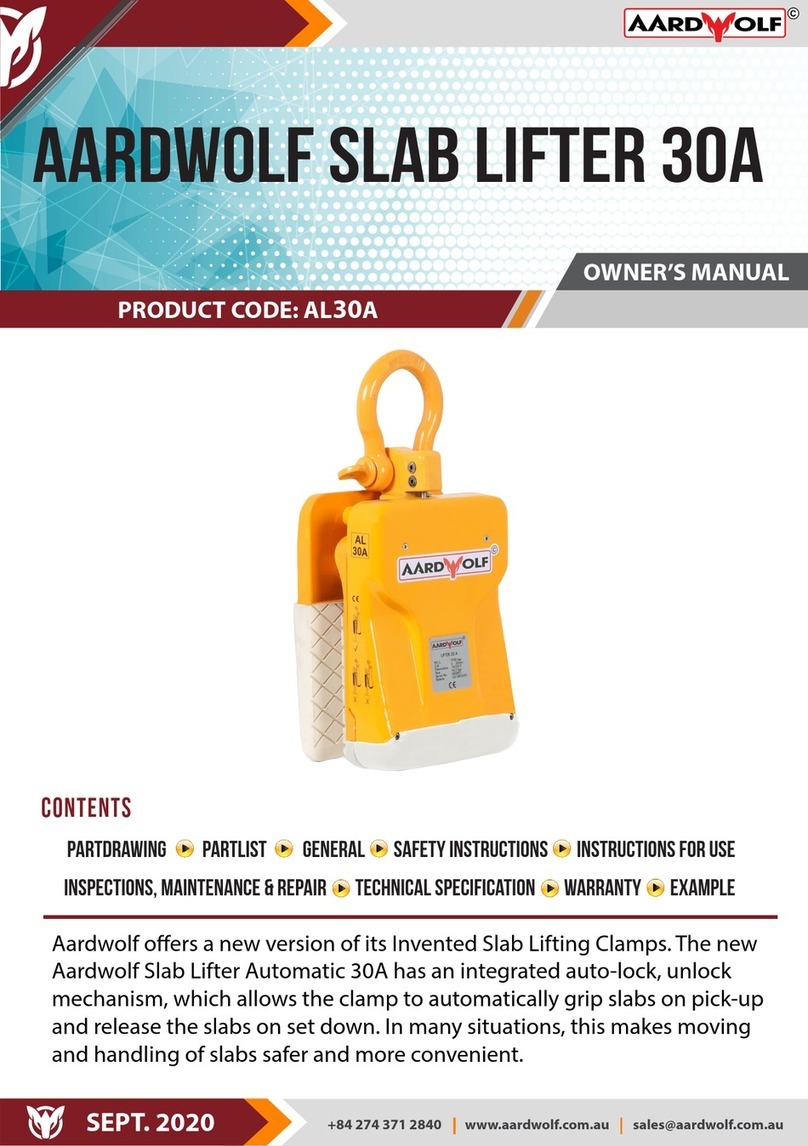
AARDWOLF SLAB LIFTER-AL30AWJ
3. Inspect clamp. If the clamp is worn or damaged, do not use it.
4. Select the proper size clamp for the job. Determine the weight of the slab to be
lifted. Donot exceed the working load limit shown on the clamp. Slab thickness
must be within the grip range specied by the manufacture.
5. Do a risk assessment of the material that is being lifted. The slab must be free of
fractures and other defects that may cause the slab to fall apart while being lifted.
6. All personnel must stand clear of the load while it is being lifted or moved.
7. The grip depends on friction. Check that the rubber pads are free to form dirt,
grease and other substances that may reduce their eectiveness.
8. Do not lift wet slabs. The grip depends on friction. Lifting wet slabs may cause the
rubber pads to lose their grip.
9.
Position the clamp so that it is square with the slab to be lifted, and in the center
of the slab so that the load is balanced.
10. Position the clamp so that it is square with the slab to be lifted, and in the center
of the slab so that the load is balanced.
11. Make sure that the slab is inserted to the full depth into the opening of the clamp.
12. Take up slack slowly. A trial tensioning of the load will usually indicate proper
balance.
13. Do not lower the clamp onto other slabs or material while lowering the slab into
racks, as the clamp will release its load. Important! In order to protect people from
getting injured it is important to follow some general safety directions while
using hoisting accessories.
14. Read the operation manual carefully before you use hoisting accessories.
15. Make sure that the operation manual is always available at the place where the
hoisting accessories are used.
16. Give permission to work with hoisting accessories only to people who are
suitably trained and competent.
17. Wear safety equipment, like the helmet, gloves and safety boots.
18. Never leave a lifted load unsupervised.
19. Lift a load only as much as is really necessary.
20. Do not get underneath the load and do not permit others to do so.
21. Connections or individual parts of hoisting accessories should never be able to
loosen by themselves.
22. Hoisting accessories must be stored in a place where they are protected against
weather conditions and aggressive substances.
23. Defect hoisting accessories are no longer to be used.
24. Repairs and checks are to be made only by qualied people.