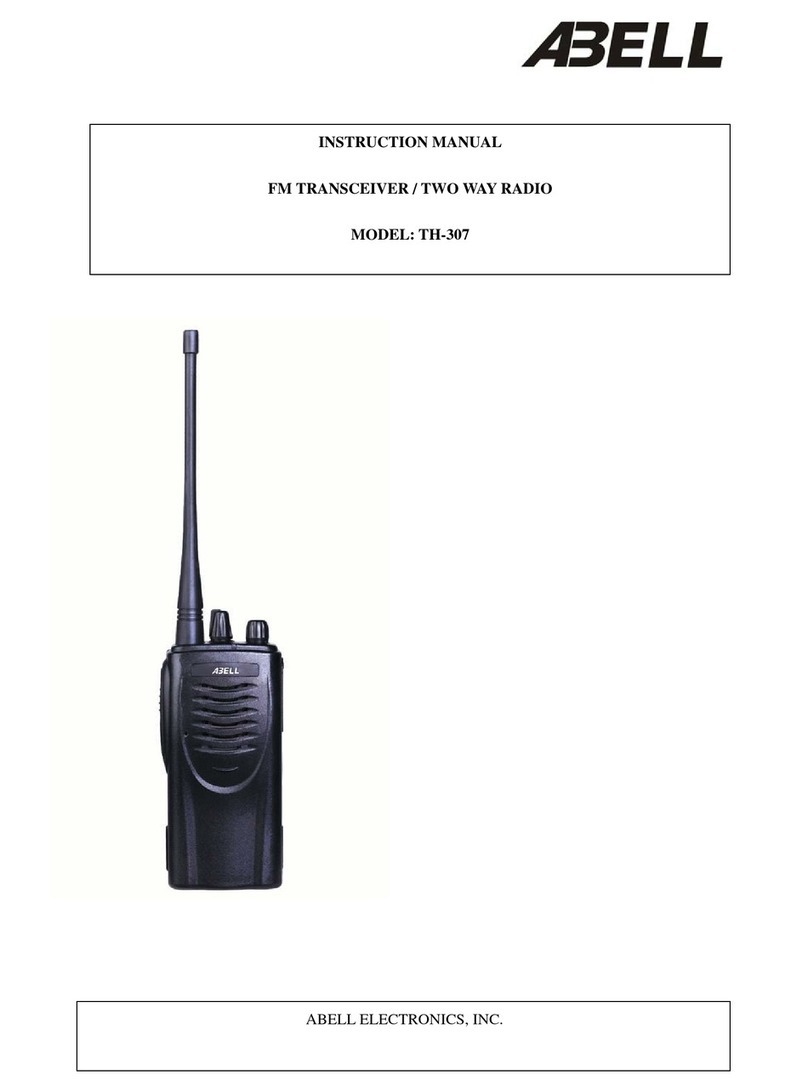
TH-308GB UHF SERVICE MANUAL
- -8
The PLL circuit in the transmitter generates the necessary frequencies.
2.Receiver
The receiver is double conversion superheterodyne, designed to operate in the frequency
range of 450-470MHz, 400-420MHz, 350-370MHz, 370-390MHz.
1)Front-end RF amplifier
An incoming signal from the antenna is applied to an RF amplifier (Q4) after passing through a
transmit/receive switch circuit (D19 off) and a band pass LC filter. After the signal is amplified by
RF amplifier (Q4), the signal is filtered through a band pass filter to eliminate unwanted signals
before it is passed to the first mixer.
The voltage of these diodes are controlled by to track the CPU(IC2) center frequency of the
band pass filter.
2)First Mixer
The signal from the RF amplifier is heterodyned with the first local oscillator signal from
the PLL frequency synthesizer circuit at the first mixer (Q24) to create a 21.70MHz first
intermediate frequency (1st IF) signal. The first If signal is then fed through two monolithic
crystal filters(XF1 and 2) to further remove spurious signals.
3)IF amplifier
The first IF signal is amplified by Q48, and then enters IC10 (FM prcessing IC). The signal is
heterodyned again with a second local oscillator signal witin IC200 to create a 450KHz second
IF signal. The second IF signal is then fed through a 450KHz ceramic filter (CF2) to further
eliminate unwanted signals before it is amplified and FM detected in IC200.
4)AF amplifier
The recovered AF signal obtained from IC200 is amplified by IC300C, filtered by the
high-pass filter IC300B and low-pass filter Q14. And de-emphasized by R43 and C31. The
processed AF signal passes through an AF volume control and is amplified to a sufficient level
to drive a loud speaker by an AF power amplifier(IC11).
5)Squelch
Part of the AF signal from IC17 enters IC17 again, and the noise component is amplified and
rectified by a filter and an amplifier to produce a DC voltage corresponding to the noise level.
The DC signal from the FM IC goes to the analog port of the microprocessor(IC2). IC2
determines whether to output sounds from the speaker by checking whether the input voltage is
higher or lower than the preset value.
To output sounds from the speaker, IC2 sends a high signal to the AFCC lines and turns IC4 on
through Q33, Q39, Q6 and Q5.
6)Receive signaling