4 5
IMPORTANT SAFETY INSTRUCTION (Continued)
WARNING: Risk of child entrapment. Before
you throw away your old refrigerator or freezer:
• Remove doors.
• Leave shelves in place so children may not
easily climb inside.
• Have refrigerant removed by a qualied
service technician.
GENERAL SAFETY AND DAILY USE
• This appliance is intended to be used in
household and similar applications such as:
- sta kitchen areas in shops, oces and other
working environments;
- farm houses and by clients in hotels, motels
and other residential type environments;
- bed and breakfast environments;
- catering and similar non-retail applications.
• Do not store ammable gases or liquids inside
the appliance. There is a risk of an explosion.
• Do not operate any electrical appliances within
the appliance (e.g. electric ice cream makers,
mixers, etc.).
• When unplugging, always pull the plug from the
main outlet. Do not pull on the cord.
• Do not operate the appliance without interior
lighting lamp cover.
• Do not place hot items near the plastic
components of this appliance.
• Do not place food products directly against
the air outlet on the rear wall.
• Frozen food must not be refrozen once it has
been thawed out.
• Store pre-packaged frozen food in accordance
with the frozen food manufacturer’s
instructions.
• The appliance’s manufacturer storage
recommendations should be strictly adhered
to. Refer to the relevant instructions for
storage.
• Do not place carbonated or zzy drinks in the
freezer compartment as it creates pressure on
the container, which may cause it to explode,
resulting in damage to the appliance.
• Ice lollies (popsicles) can cause frost burns
if consumed straight from the freezer
compartment.
• Do not place food directly against the air
outlet inside the refrigerator. Do not place the
appliance in direct sunlight.
• Do not store explosive substances such as
aerosol cans with a ammable propellant in
this appliance.
PROPER DISPOSAL
OF YOUR REFRIGERATOR
RISK OF CHILD ENTRAPMENT
Child entrapment and suocation are not only
problems of the past. Junked or abandoned
refrigerators are still dangerous - even if they are
sitting “for just a few days”. If you are getting rid of
your old refrigerator, please follow the instructions
below to help prevent accidents.
INSTALLATION
STEP 1: LOCATION
Position the appliance away from sources of heat
such as stoves, radiators, direct sunlight etc.
Maximum performance and safety are guaranteed
by maintaining the correct indoor temperature for
the class of unit concerned, as specied on the
rating plate. This appliance performs well from
55 to 110°F (12.8 - 43.3°C). The appliance may not
work properly if it is left for a longer period at
a temperature above or below the indicated range.
IMPORTANT!
There is a need of good ventilation around the
fridge for easy dissipation of heat, high eciency
of refrigeration and low power consumption. For
this purpose, sucient clear space should be
available around the fridge. It is advisable for there
to be 2-2.7 inch (50-70 mm) separating the back of
the fridge to the wall, at least 7.9 inch (200 mm) of
space at its two sides, and a minimum of 11.8 inch
(300 mm) from its top and a clear space up front to
allow the doors to open 160°.
Appliances must not be exposed to rain. Sucient
air must be allowed to circulate in the lower rear
section of appliance, as poor air circulation can
aect performance.
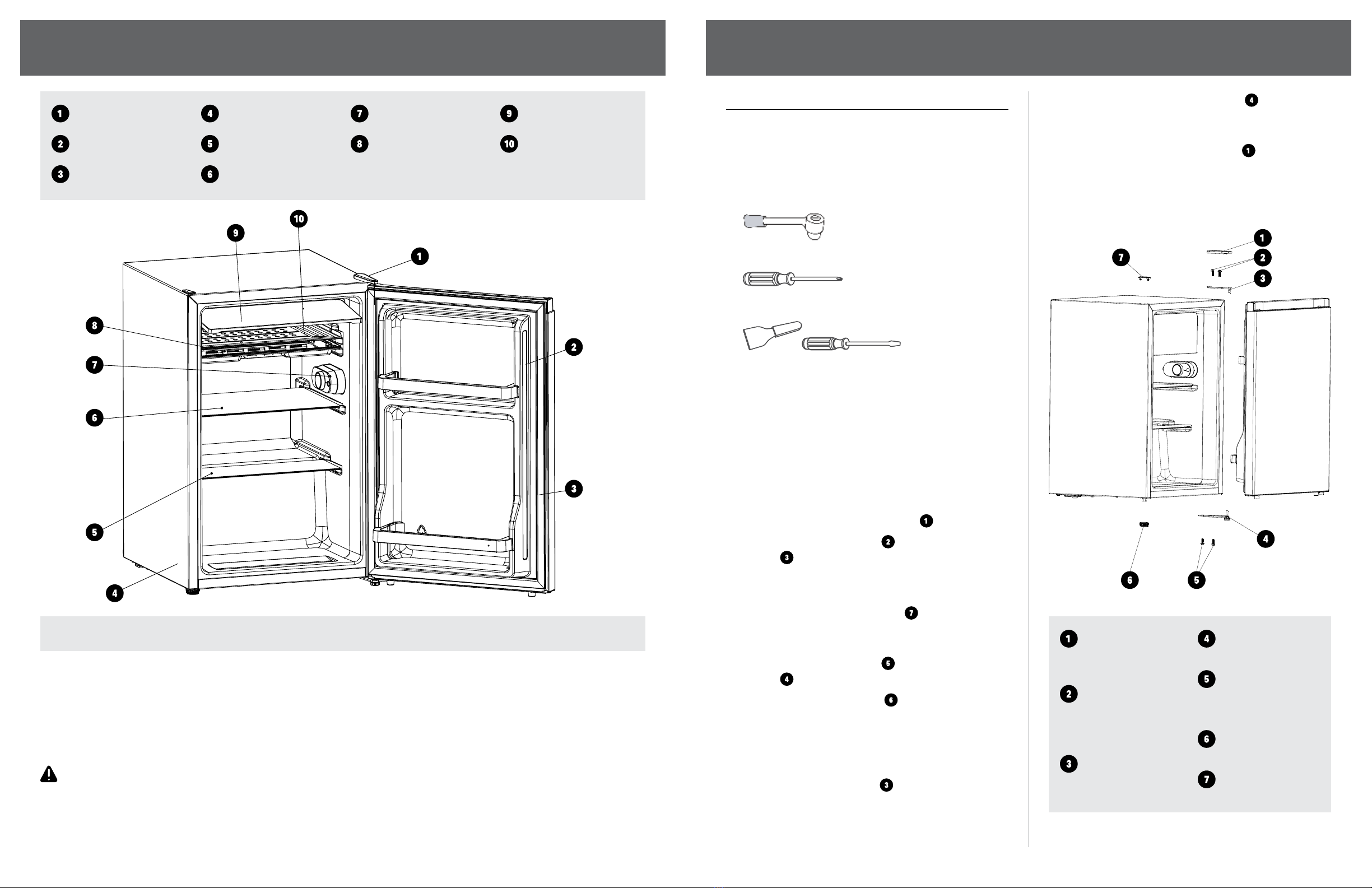
WARNING: Some models may be shipped with a foam pad above the compressor to protect the unit
during transport. Check to see if your unit has one and remove it before use.
Before installing, follow these important rst steps.
WARNING: Keep ventilation openings, in the
appliance enclosure or in the built-in structure,
clear of obstruction.
WARNING: Do not use mechanical devices
or other means to accelerate the defrosting
process, other than those recommended by
the manufacturer.
WARNING: Do not damage the refrigerant
circuit.
WARNING: Do not use electrical appliances
inside the food storage compartments of
the appliance, unless they are of the type
recommended by the manufacturer.
WARNING: The foam pad above the
compressor is only suitable for transport
and must be removed before use.
STEP 2: CLEANING
Wash any removable parts of the refrigerator
interior, and exterior with mild detergent and
warm water. Wipe dry. Do not use harsh cleaners
on these surfaces.
Do not use razor blades or other sharp
instruments, which can scratch the appliance
surface when removing adhesive labels. Any glue
left from the tape can be removed with a mixture
of warm water and mild detergent, or touch
the residue with the sticky side of tape already
removed. Do not remove the serial plate.
CAUTION: Flammable refrigerant used! When
handing, moving and use of the refrigerator, make
sure to avoid either damaging the refrigerant
tubing, or increasing the risk of a leak.