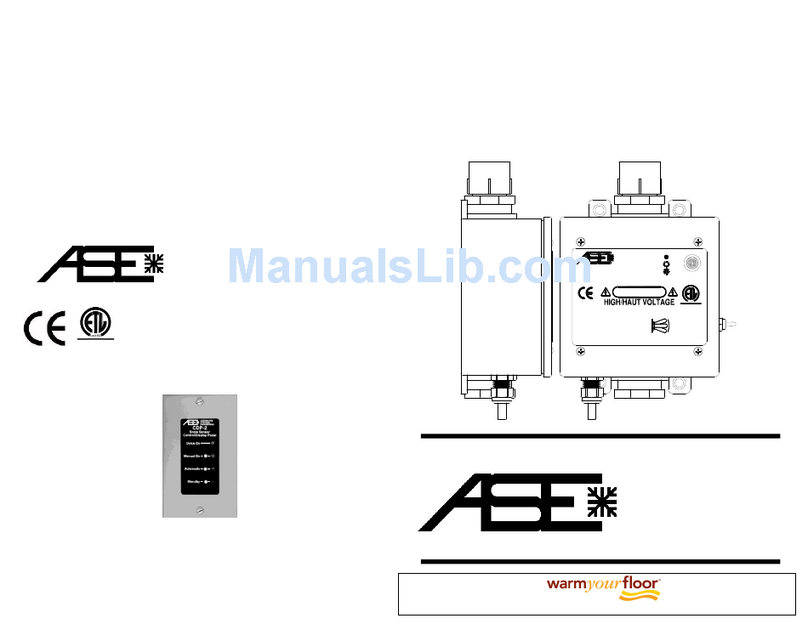
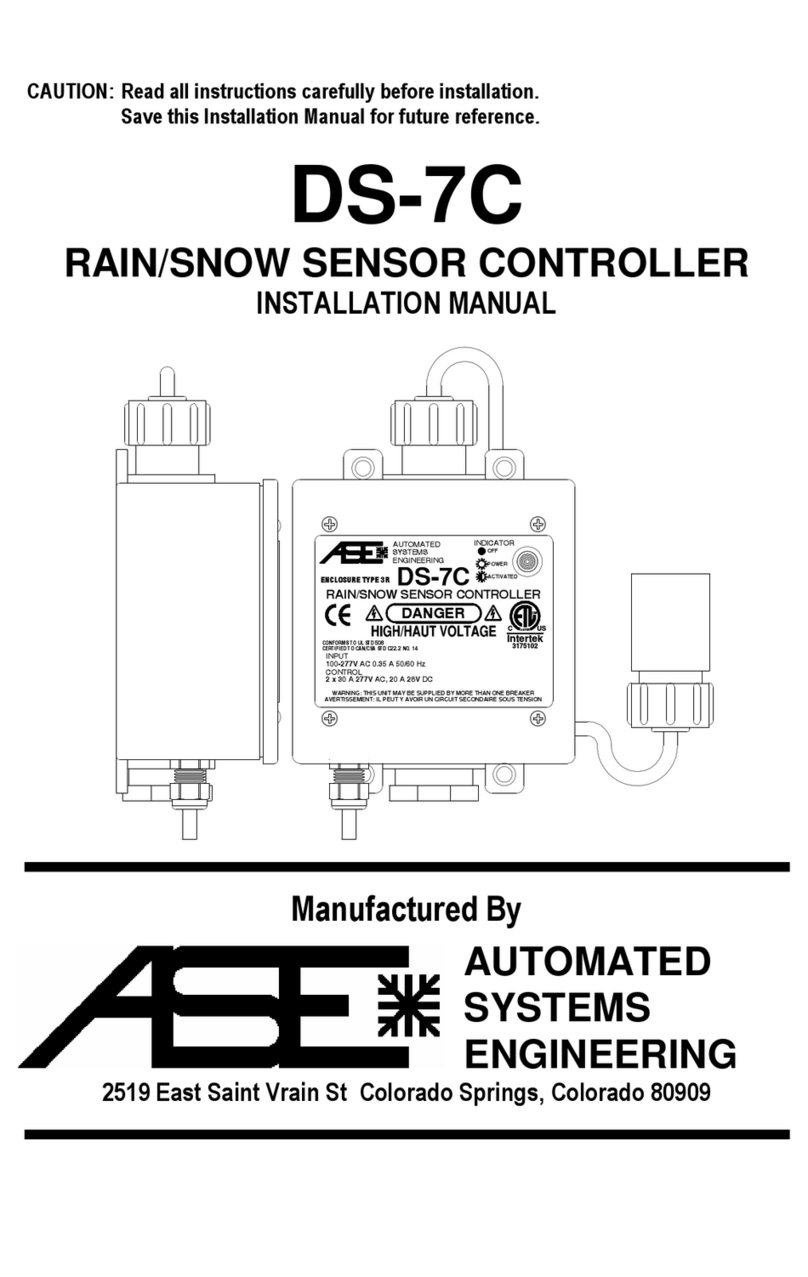
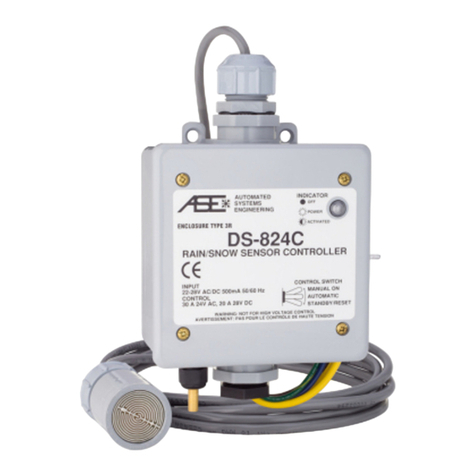
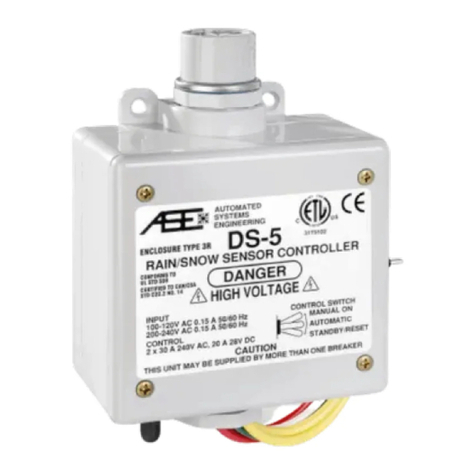
External Control/Monitor Operation
The DS-4C provides external control and monitor
capability. Order the optional CS-3 “Control Cable” and
CS-4 “Monitor Cable” to access these points. External
Control allows the user to externally activate (Manual On)
or disable and clear the delay (Standby/Reset) for the DS-
4C relays. Connecting the White lead to a control lead will
activate the function listed in the Profile Table. This can be
achieved using a switch or dry contact. A “Standby/Reset”
function will always override a companion “Manual On”
function.
The external monitor points provide low power dry contact
closures that mimic the operation of the load relays. These
relays, rated at 24 VAC/VDC @ 400 mA, 10W maximum,
will close with their respective load relays and can be used
to externally monitor activation of the sensor.
Typical Load Wiring
The main relays are dry contacts and do not supply power directly to your load
The Yellow load leads and Red load leads connect to main relays 1 & 2 respectively. Both relays in the
DS-4C activate according to the selected profile. These relays act as normally open switches and are fully
isolated from each other. Each relay is intended to switch a separate circuit. Switching capacity of the DS-
4C is 30A per circuit, 2 separate circuits. While not as convenient as directly supplying power for the load,
dry contacts allow you to operate the DS-4C from one voltage while controlling loads of a different voltage
without adding an external relay or contactor. For example, the DS-4C can be powered from 120VAC but
can directly control a 240VAC heater and a 120VAC feed blower or two separate 277VAC heat cables.
The following diagrams show some possible wiring schemes for connecting the DS-4C to your load. Your
load may be a direct connection to heat cable, a heater, a contactor coil, or a control voltage. For clarity
the green safety GROU D leads are not shown.
NEUTRAL BUS BAR
CB
BROWN
BLUE
LOAD CENTER RED
YELLOW
BLOWER
CB
POWER SUPPLY
DS−4C
HEATER
120VAC In, 120VAC Deice Heater/Rain Blower for VSAT or Similar
6
Power & Activation Indicator
A green lamp shines through a lens on the cover of the DS-4C to indicate operational status. If this lamp is
OFF the DS-4C is not receiving power. If this lamp is steady O the DS-4C is powered but not triggered.
If this lamp blinks once Relay 1 is closed. If it blinks twice Relay 2 is closed. If it blinks three times both
Relay 1 and Relay 2 are closed. Note that, even though snow or rain may have stopped, the DS-4C
indicator will continue to flash during the Delay-Off drying cycle.
Setting the Configuration Switches and Adjustments
The following paragraphs and table outline the operating modes for the DS-4C and
explain the functions of the adjustments. Trigger temp (TT) is adjustable from
34°F-44°F (1°C-6°C) using the TRIG TEMP control. When ambient air
temperature (AT) is below this setting precipitation is assumed to be snow. When
above this setting, precipitation is assumed to be rain.
The DEL configuration switch activates the Delay-Off drying cycle timer on the DS-
4C. The timer allows the DS-4C to continue to operate and dry the heated surface through evaporation
once precipitation has stopped. The drying cycle reduces the chance of
moisture left behind refreezing into ice. This timer is restarted by each
sensor trigger. Therefore, the DS-4C will continue to operate as long as it is
triggered, then for the Delay-Off period once the trigger clears. The range of
the Delay-Off adjustment is defined in the Profile Table. The adjustment will
have no function if Delay-Off time is shown in the profile as a fixed value.
The DS-4C precipitation sensor is very sensitive and can detect a single snow flake or rain drop. However,
if the DS-4C is mounted in an area susceptible to high winds, overhanging trees, or blowing ground snow,
nuisance triggering may occur. While proper placement is the best remedy,
the SENSITIVITY control can also be used to reduce nuisance triggering.
An internal timer checks the precipitation sensor for moisture and compares
cleared time with triggered time. The highest sensitivity setting (toward
MORE) triggers on first detection. As the control is adjusted clockwise
precipitation must be detected for a longer period to be considered valid.
The lowest sensitivity setting (toward LESS) requires 120 seconds of detection before the unit triggers. If a
trace amount of snow blows onto the grid from a drift or overhang it will likely be melted and evaporated in
less than a minute. Similarly, a very light snowfall may also clear quickly from the grid. If these conditions
should be ignored by the sensor the SENSITIVITY control can be adjusted as required. However, to
prevent non-triggering during a true event, it is recommended that the user start at highest sensitivity
(MORE), then adjust while monitoring operation over time.
Fine Adjustment for Efficient Operation
The DS-4C is shipped with the TRIG TEMP and DELAY OFF adjustments in the center position,
representing 39°F (3.9°C) and mid point of Delay-Off time respectively. It is also set for highest
SENSITIVITY. Depending on local conditions the user may find that fine adjustment of the controls may
provide more satisfactory operation. If the sensor does not trigger during very wet snows the trigger
temperature may need to be adjusted higher. Constant triggers from snow falling from trees or overhangs
may be reduced by adjusting SENSITIVITY. The Delay-Off time can also be adjusted to provide clean
melt-off without excessive running time. Fine adjustment can both save operating expense and provide
more reliable operation. However, to keep reliability high, always make adjustments in small increments.
3
External Control
Pin CS-3 Function
1 Green See Profile Table
2 Black See Profile Table
3 Orange See Profile Table
4 Red See Profile Table
5 White GND/Common
External Monitor
Pin CS-4 Function
1 Black Relay 1 Monitor
2 Red Relay 1 Monitor
3 Green Relay 2 Monitor
4 White Relay 2 Monitor