Aurora IPX series User manual

i
Manual Number: 170408
USERS GUIDE
IPX Series
Network Switch Recommendations & Configuration
10Gbps Network Switch Configurations

i
User Guide
TABLE OF CONTENTS
RECOMMENDED NETWORK SWITCHES ...............................................................................1
1.1 Switch Speed .................................................................................................................................. 1
1.2 Packets Routing.............................................................................................................................. 1
1.3 Ethernet Switch Configuration ........................................................................................................ 2
1.4 Ethernet Switch Models .................................................................................................................. 3
CONFIGURATIONS...................................................................................................................5
Switch Login & Connections ................................................................................................................. 5
Aurora IPX-FSW Series........................................................................................................................ 5
BlackBox ............................................................................................................................................... 6
Netgear ProSAFE XS708E................................................................................................................... 7
Netgear ProSAFE XS712T ................................................................................................................... 8
Netgear ProSAFE XS728T ................................................................................................................. 12
Netgear M7300-24XF XSM7224S ...................................................................................................... 14
Extreme Network Summit X670 Series .............................................................................................. 15
Arista Networks 7050X Series ............................................................................................................ 15
Huawei Cloud Engine Series .............................................................................................................. 17
D-Link DXS-1210-12TC...................................................................................................................... 19
Ubiquiti EdgeSwitch16 XG Model ES-16-XG ..................................................................................... 21
Edge-Core AS5700-54X-EC ............................................................................................................... 22

1
User Guide
RECOMMENDED NETWORK SWITCHES
The IPX will work with most non-blocking, IGMP 10G network switch. Layer 3 will allow
more control, however, Layer 2 will work as well. It is highly recommended to
communicate with the representative of the desired network switch brand to confirm
configuration and capabilities. Below are some models that have been tested with the
IPX Series.
1.1 Switch Speed
The IPX Series requires the switch to be a 10 GbE.
IPX Series technology is used to transmit uncompressed video up to 4K along with
other AV signals such as audio, USB and control signals. For video alone, it means raw
bandwidth of about 4 Gb/sec for HD and 8 Gb/sec for 4K mean a bandwidth of around 6
GB/s, and that just for video. It is therefore easy to understand why the IPX requires 10
GbE network switches.
1.2 Packets Routing
To enable the transmission of a source to multiple destinations, IPX devices make use
of Multicast. The default behavior of layer 2 Ethernet switch is to broadcast those
packets which mean that every packet will be transmitted to all possible destinations.
This is why any network switch used with IPX Series has to support IGMP Snooping.
IPX end points use IGMP protocol to assign the end points into multicast groups and
the router uses IGMP snooping to efficiently route multicast packets only to receivers
that want to receive them.
Many switches have the IGMP Snooping feature disabled by default and manual
configuration is required. Often, a simple check mark near “Enable IGMP Snooping” is
the only thing needed to enable IGMP Snooping.
However, the implementation of IGMP Snooping is vendor specific and additional
configuration is often needed.
An Ethernet switch can be informed that a device wants to leave a multicast channel by
sending it a IGMP LEAVE GROUP packet. Once received, the time it takes for the
switch to apply the new configuration may vary from one switch to the other. Most
switches implement and include FASTLEAVE configuration option. When enabled, it
takes much less time for a particular port to leave a multicast group to assign the port to

2
User Guide
a different multicast group. The end results are a noticeably shorter video switching
time. Aurora recommends to always enable the FASTLEAVE option when available.
With FASTLEAVE option, seamless switching is possible for 4K video sources. Without
FASTLEAVE option, 'seamless' switching is limited to 1080P 60 Hz video signals.
1.3 Ethernet Switch Configuration
The following list includes all network switch configuration options that Aurora
Engineers have come across so far. Look for these or similar options when configuring
your switch.
1. Enable IGMP Snooping
a. Must be enabled
2. Enable IGMP Snooping on VLAN 1
a. Must be enabled when all ports default to VLAN1
3. Filter/Drop unregistered Multicast traffic
a. If not applied, the behavior of the switch will be to broadcast multicast packets
if the switch has no known destination for that packet.
b. Must be enabled if found
4. Unregistered Multicast Flooding
a. Must be disabled if found
5. Filter Unregistered Multicast (different wording than number 4 above)
a. Must be enabled if found
6. Enable IGMP Query
7. Enable IGMP Query on VLAN1
8. Set IGMP Version to IGMP V2
a. Must be set if found
9. Enable FASTLEAVE on port X
a. This is optional. Should be enabled, if found
10. Enable FASTLEAVE for VLAN1
a. This is optional. Should be enabled if found

3
User Guide
1.4 Ethernet Switch Models
The following is a list of 10G Ethernet switch models that have been verified to date.
Check with Aurora to see if any others may have been added at a later time relative to
the manual revision date.
Aurora IPX-FSW Series Fiber 10G
IPX-FSW-8 8 Port Switch Layer 3 with 8 1G RJ-45 ports
IPX-FSW-12 12 Port Switch Layer 3 with 8 1G RJ-45 Ports
IPX-FSW-24 24 Port Switch Layer 3 with 4 1G RJ-45 Ports
Arista Networks
7050SX-72 72 Port SFP+ 10G Fiber Switch
7050SX-96 96 Port SFP+ 10G Fiber Switch
7050SX-128 128 Port SFP+ 10G Fiber Switch
7050TX-64 64 Port 10G Copper Switch
7050TX-72 72 Port 10G Copper Switch
7050TX-96 96 Port 10G Copper Switch
7050TX-128 128 Port 10G Copper Switch
Extreme Networks
X670-48T 48 Port Copper Switch
X670-48X 48 Port SFP+ Fiber Switch
Huawei
CE6851-48S6Q-HI (48*10G Base-X SFP+ Fibber Ports + 6*40G QSFP+ Ports)
CE8860-4C-EI (4 Sub Card Slots)
Sub card for CE8860
CE88-D24S2CQ (24*10G Base-X SFP+ Fiber Ports+ 2*40G/100G QSFP+ Ports)
CE6850-48T6Q-HI (48*10G Base-T Copper Ports+ 6*40G QSFP+ Ports)
CE8860-4C-EI (4 Sub Card Slots)
Sub card for CE8860
CE88-D24T2CQ (24*10G Base-T Copper Ports+ 2*40G/100G QSFP+ Ports)

4
User Guide
Netgear Copper 10G
XS708E 8 Port ProSAFE Plus Switch (Note: This is a layer 2 switch and does not have
fast switching. IPX Seamless switch mode will work however at times you may
see a slight glitch in the image.) One port is a shared 10G SFP+ Fiber Ports.
XS708T 8 Port ProSAFE Smart Managed Switch with 1 shared 10G SFP+ Fiber Ports.
XS712T 12 Port ProSAFE Smart Managed Switch with 2 shared 10G SFP+ Fiber Ports.
XS728T 28 Port ProSAFE Smart Managed Switch 24 Copper and 4 non-shared 10G
SFP+ Fiber Ports
XS748T 48 Port ProSAFE Smart Managed Switch 44 Copper and 4 non-shared 10G
SFP+ Fiber Ports

5
User Guide
CONFIGURATIONS
Switch Login & Connections
Login
You must first log onto the switch with administrator right. Follow the switch manufacturer
manual to do so. It will also give you the default Admin password.
Console Port
Some manufacturers use RS-232 / “Console port” for switch configuration and dedicated
console cable which is different from a standard Cat X (RJ45) cable.
Ethernet
Other manufacturers go through standard 1Gbe compatible port for switch configuration. If this
is the case, the manufacturer will give you the default “IP Address” of the switch. Make sure
your network adaptor has an IP Address in the same network.
Depending on login method above, switch configuration will be done either through a Web
Browser or a Telnet Client.
Aurora IPX-FSW Series
The Aurora IPX-FSW Series is designed to work out of the box as it is pre-configured. To confirm
that the default configuration is correct or if settings have been changed inadvertently, open a
console (RS232 baud rate 38400) and type the following commands at the prompt:
Switch> enable
Switch# show ip igmp snooping mrouter -> expected output: IGMP Snooping Enabled
Switch# show ip igmp snooping fast-leave -> expected output: IGMP Snooping fast-leave is
enabled

6
User Guide
BlackBox
1. Go to the “Configuration” / “IGMP Snooping” / “Basic Configuration” tab as shown in
next screen shot:
2. Make sure “Snooping Enabled” is checked.
3. Make sure “Unregistered IPMCv4 Flooding Enabled” is NOT checked.
4. After the changes are made, go at the bottom of the page and click the “Apply”
button.
5. Next, go to the “VLAN Configuration” tab as showed in next screen shot:
6. Make sure “Snooping Enabled” is checked, and click “Apply”.
7
User Guide
Netgear ProSAFE XS708E
This switch does not support FASTLEAVE option however there is a XS708T available that does.
While it supports 'seamless' switching for 1080P video resolutions it is not capable to support
seamless' switching for 4K30 resolutions and higher.
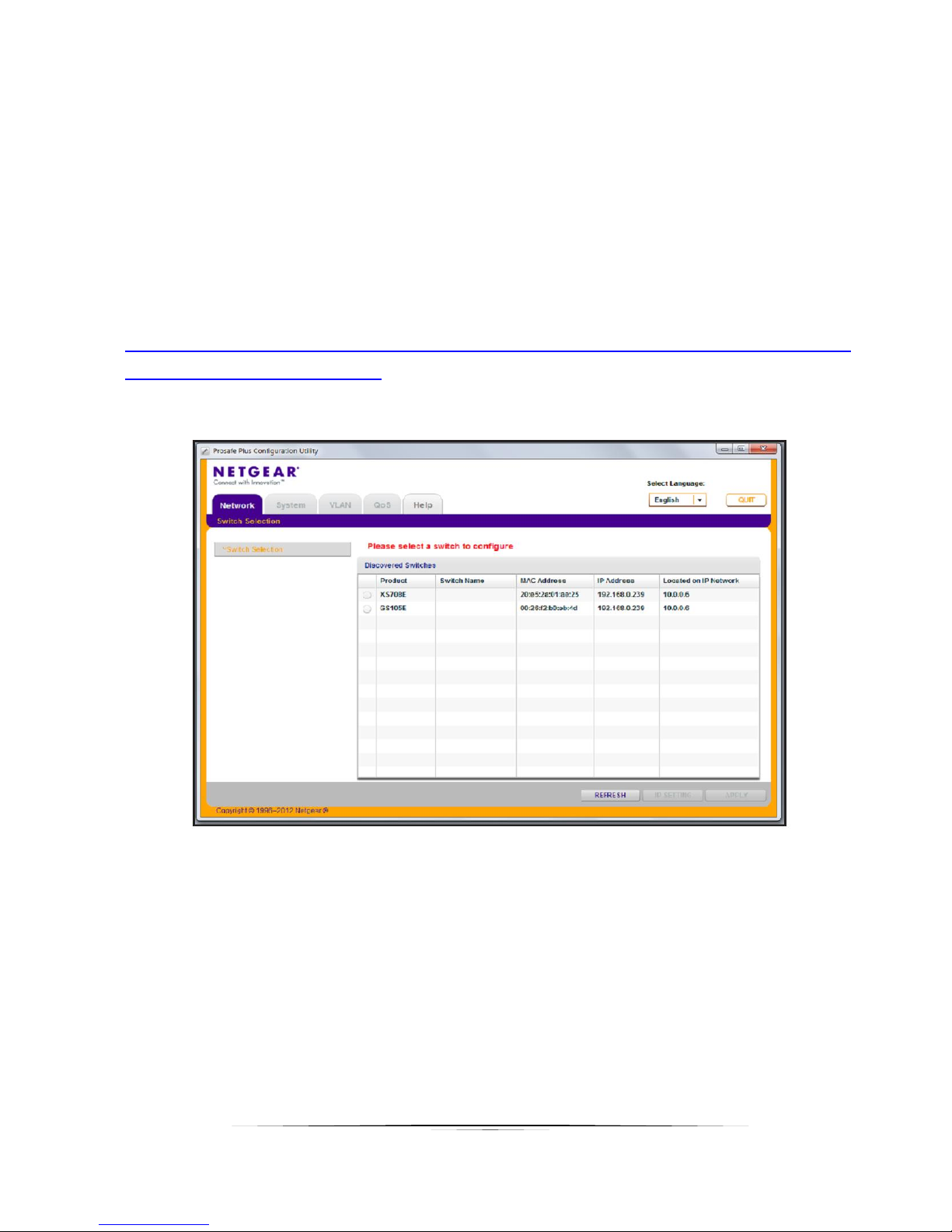
To configure the XS708E, use the ProSAFE Plus Switch Utility that is found on the Resource CD
shipped with ProSAFE PLUS switch. The utility can be installed on any Windows computer on
the same network as the switches to be managed. The user manual for the switch utility can
be found here
http://www.downloads.netgear.com/files/GDC/GS105E/ProSAFE%20Plus%20Switch%20Utility%
20User%20Guide_21Dec2012.pdf
Running the tool will list discovered switches as shown here below
Select the switch you want to configure and a switch from the list and press the Apply button on
the bottom right of the screen.
To enable Multicast:
•Select 'Systems' tab and from there select 'Multicast' sections
•In the IGMP Snooping Status list, select Enable and click Apply
•In the Block Unknown Multicast Address list, select Enable and click Apply
•You can also change the VLAN for which the IGMP snooping is enabled. In the
VLAN ID Enabled for IGMP Snooping field, enter a valid ID and click Apply. This field

8
User Guide
is dimmed if VLAN is not enabled.
To enable VLAN:
•Select VLAN Tab
•Select Port Based and select Enable
•Select Yes if a message appears asking if you want to delete previous VLAN settings
•For each port to be added to the new group, enter the ID of the VLAN group
Netgear ProSAFE XS712T
To configure the XS712T, use the Smart Control Center Utility that is found on the Resource CD
shipped with ProSAFE Smart switch. The utility can also be downloaded directly from here
http://support.netgear.com/product/XS712T. The utility can be installed on any Windows
computer on the same network as the switches to be managed. The product guide and
software manual for the switch utility are also located at
http://support.netgear.com/product/XS712T
If the switch is connected to DHCP server make sure that the computer is also set to DHCP
mode and then run the utility and use the discover button to find the switch.
If you are using a static IP address in your network, configure the switch IP address before
connecting the switch to your network. The default IP address of the switch is 192.168.0.239.
Set up the computer with a static IP address in the 192.168.0.x subnet and connect it to the
switch and run the utility.
To configure the switch to work with IPX Series type devices, follow the instruction below to
setup VLAN and to enable both Multicasting and IGMP snooping.
1. If not available, create VLAN ID #1.
2. Once “VLAN ID” and “VLAN Name” fields are filled as showed, press “Apply” on the
lower right of the screen.
Other manuals for IPX series
1
Table of contents
Other Aurora Switch manuals

Aurora
Aurora DXE-122A-DS User manual
Aurora
Aurora IPX-FSW-8 User manual
Aurora
Aurora VLX Series User manual

Aurora
Aurora AU-A1ZB2WDM User manual

Aurora
Aurora DXP-62K-3 User manual
Aurora
Aurora ASP-S123V User manual
Aurora
Aurora AU-A1BT320 User manual

Aurora
Aurora DXP-62 User manual

Aurora
Aurora DXE-122A User manual
Aurora
Aurora AU-A1BTPLTL User manual