Page 6 “B” Book Guide To Vibration Measurement
Fig 16 - Displacement readings run across the top and
down the right side of the Severity Chart. Acceleration
is shown in lines running diagonally left to right.
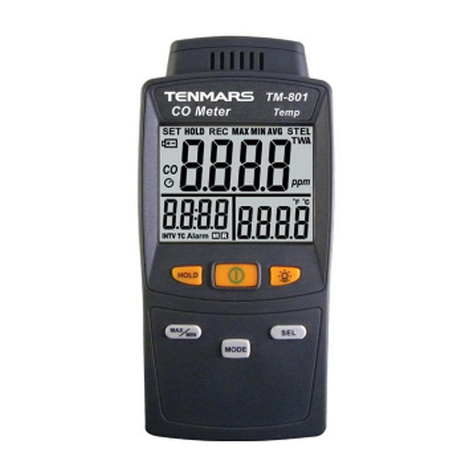
Fig 18 - Over Range
Looking at the left side of the Severity Chart (see Fig
16), the operator would see these numbers
representing Velocity in inches per second.
The operator’s reading of 00.15 would fall exactly half
way between .1 and .2 and the operator could conclude
the vibration level was in the GOOD zone on the chart.
00.15 ips = GOOD
Measuring vibration in Velocity is the easiest method to
learn machine condition. Velocity readings do not
require knowing the RPM of the machine. A reading of
.1 is SMOOTH whether the machine is running at 100
RPMs, or 100,000 RPMs.
Other Examples of readings in Velocity:
0.08 ips = SMOOTH
0.4 ips = ROUGH.
Displacement Measurements (Mils Peak-to-Peak)
Displacement (Mils) readings run across the top and
down the right side of the chart. (See Fig 16) Match
your reading with the same number at the top or right
hand column on the chart.
Next to that number is a diagonal line running right to
left down to the bottom of the chart.
Follow the diagonal line down until it crosses a vertical
line coming up from the bottom that corresponds to
machine RPM. (RPM is at the bottom of the chart.)
Determine if this reading falls in the SMOOTH, GOOD,
FAIR or ROUGH range.
Example: a reading of .5 mils (top right corner of chart)
intersecting at 2000 RPM (middle bottom of chart) is in
the SMOOTH range. A reading of 3 mils (top middle of
chart) at 2000 RPM is ROUGH.
Displacement readings require knowing the machine
running speed (RPM).
Acceleration Measurements (g’s, Peak):
Acceleration readings are represented by diagonal lines
running from the top left to the bottom right of the chart.
Acceleration numbers are found in the middle of these
lines. Like Displacement readings, Acceleration
readings require knowing the machine RPM.
Example: .1 g at 1000 RPM = ROUGH.
0.1 g at 10,000 RPM = SMOOTH.
Over Range
Vibration signal strength to strong for setting. If display
shows a 1. (see photo), select next higher range.