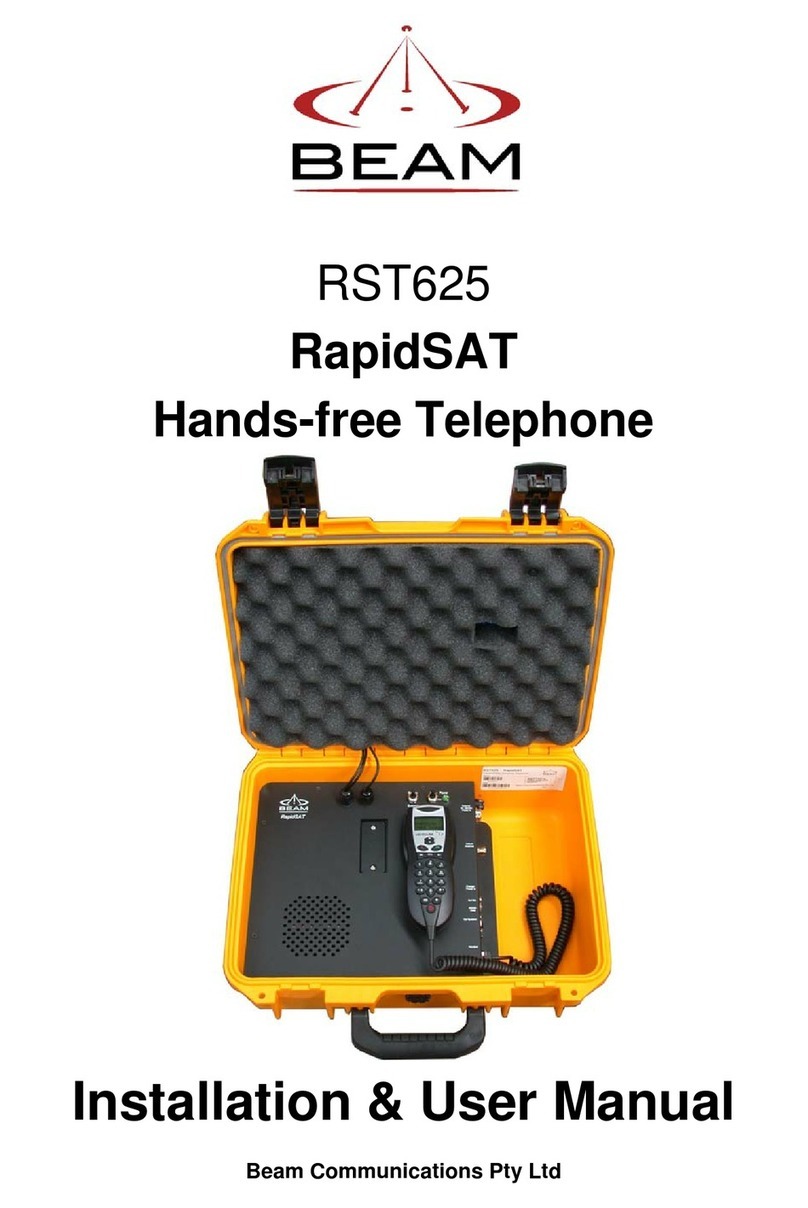
Beam Iridium RapidSAT LBT Instruction Manual

Iridium RapidSAT LBT
Installation & User Manual
Beam Communications Pty Ltd

2
About BeamCommunications
Beam Communications, a wholly owned subsidiary
of World Reach Limited (WRR), listed on the Australian
Stock Exchange, is a world leader in design, manufacture
and distribution of specialized communications
equipment for the Iridium Satellite Network.
Beam’s commitment to be at the forefront has
continued to increase its share of the global satellite
communications market. Its premium distribution
network spans the world.
Recognized as a leading provider of satellite
communication solutions, Beam specializes in Voice,
Data, Tracking and customized solutions. Beam
develops innovative products and services to meet
market demands and niche applications.
Beam’s leading edge products are deployed
in a wide range of vertical markets including
Maritime, Transport, Government, Defense, Mining,
Construction, Forestry, Emergency Services, Relief Aid,
Telemetry and Rural Telephony.
Supported by a dedicated team of professionals, Beam
has developed solid relationships with its peers and
network of distributors worldwide.
BEAM Communications Pty Ltd
5/8 Anzed Court, Mulgrave,
Victoria, 3170, AUSTRALIA
Web: www.beamcommunications.com
Info: info@beamcommunications.com
Support: [email protected]
Tel: +61 3 8588 4500
Fax: +61 3 9560 9055

RapidSAT LBT Installation & User Manual
3
Iridium RapidSAT LBT
Installation and User Manual
Version 1.0
BEAM Communications Pty Ltd
8 Anzed Court, Mulgrave,
Victoria, 3170, AUSTRALIA
Information furnished by BEAM Communications Pty
Ltd (BEAM) is believed to be accurate and reliable.
However, no responsibility is assumed by BEAM for its
use, or for any infringement of patents or other rights of
third parties, which may result from its use. No license is
granted by implication or otherwise under any patent
or patent rights of BEAM. BEAM reserves the right to
change specications at any time without notice.
Copyright © 2010 BEAM Communications Pty Ltd.
All rights reserved.
Product Name RapidSAT LBT
Manual Revision 01
Part Number USRMAN005701
Release Date September 2010

4
Package Contents
Check that your RapidSAT LBT package contains:
1 x Bag Case - RapidSAT Includes integrated
Iridium Tranceiver
1 x Compact Magnetic Mount Antenna
(5m cable)
1 x Auto Accessory DC Power Input Cable
1 x Allen Key Hex Wrench
User Manual
Quick Start Guide
Optional Accessories
9522BRSU UPS Pack Version
The following optional accessories are available for
your RapidSAT 9555.
• RST055 UPS Battery Pack
• UPS Battery Pack Power Output Cable
(length: 150mm)
• RST750 AC/12VDC Adaptor
• USB mini-B to USB-A data cable
See your Service Provider for pricing and availability of
these quality BEAM accessories.
User Information
Please record your serial number here for future
reference:
Model: RapidSAT LBT
Serial no.: _ _ _ _ _ _ _ _
This number can be copied from the white label on the
RapidSAT LBT
Eg. RB200024

RapidSAT LBT Installation & User Manual
5
Operating RapidSAT LBT 18
Cup and Uncup the Intelligent Handset 18
Operation of the RapidSAT LBT 18
Making Calls 18
Data Communications via USB Cable Port 18
Intelligent Handset Overview 19
Intelligent Handset Display Denitions 21
Power-ON Messages 22
Assuring Quality of Iridium Service 24
Obstructions 24
Cabling 24
RF Interference 25
Specication Summary 26
Electrical & Environmental Specications 26
Trouble Shooting 27
Beam Warranty Conditions 30
Contents
About Beam Communications 2
User Information 4
Package Contents 4
Optional Accessories 4
Conventions in this Manual 6
Safety Information 7
Warning: Potentially Explosive Atmospheres 8
Safety - Iridium Transceiver 8
About this Equipment 12
RapidSAT LBT Features 12
Equipment Overview 13
RapidSAT LBT Setup 15
Connecting Power Supply 15
Installing SIM Card 15
Antenna Installation 15
UPS Battery Pack Installation (Optional) 16

6
INTERFERENCE:
All wireless phones may get interference, which could
aect performance.
RECORD:
Write details of the unit for easy reference when required.
Ideal when troubleshooting.
Conventions in this Manual
WARNING / CAUTION:
This symbol and associated text indicate a warning note
providing information to prevent damage to equipment
or personal injury.
NOTE / IMPORTANT / TIP:
This symbol and associated text indicate a note providing
general operating information.

RapidSAT LBT Installation & User Manual
7
WARNING:
DO NOT disassemble equipment. There are no user-
serviceable parts inside.
If a DC power supply is to be used, its output must
comply with the Safety Extra Low Voltage (SELV)
requirements of IEC60950.
All connectors except the Line and Accessory sockets
must only be connected to equipment ports which
comply with the Safety Extra Low Voltage (SELV)
requirements of IEC60950.
DO NOT throw the bag into re or burn when the UPS
Battery Pack is installed. The UPS Battery Pack MUST BE
recycled or disposed properly.
Safety Information
IMPORTANT!
Please read the following information carefully before
installing and using the Beam RapidSAT LBT. Failing
to follow instructions may compromise the safety of
the product and may result in personal injury and/or
equipment damage. Please consult the supplier if you
have any further questions.
Refer to the appropriate section of this RapidSAT LBT
User Manual
for additional safety information.
• Store the system in a cool and dry area.
• Do not submerge the system in water.
• Do not place foreign metal objects or debris in
the system. If debris fall into the system, please
return to factory for service.

8
Safety – Iridium Transceiver
• The 9522B is a low power transceiver. When it is
ON, it receives radio frequency (RF) signals.
• The Iridium 9522B transceiver which is designed
to be used with an external antenna. This
antenna transmits RF energy. The Iridium
antenna (tted via an extension coaxial cable
must be located more than > 0.3 meters (1 foot)
from human body (person) when in operation.
• International agencies have set standards and
recommendations for the protection of public
exposure to RF electromagnetic energy.
» International Commission on Non-Ionizing
Radiation Protection (ICNIRP) 1996
» Verband Deutscher Elektrotechniker
(VDE) DIN-0848
» United States Federal Commission, Radio
Frequency Exposure Guidelines (1996)
» National Radiological Protection Board of
the United Kingdom, GS 11, 1988
» American National Standards Institute
(ANSI) IEEE. C95. 1-1992
These standards are based on extensive scientic
review. For example, over 120 scientists, engineers,
and physicians from universities, government health
agencies, and industry reviewed the available body of
research to develop the updated ANSI standard.
WARNING: POTENTIALLY EXPLOSIVE ATMOSPHERES:
1. Turn the phone OFF and DO NOT remove the UPS
battery pack when you are in any area with a
potentially explosive atmosphere.
2. Obey all signs and instructions.
3. Sparks from plugging in the UPS Battery Pack cables
could cause an explosion or re resulting in bodily
injury or even death.
4. Areas with a potentially explosive atmosphere are
often but not always clearly marked. They include,
but are not limited to:
• fuelling areas such as gasoline stations
• below deck on boats;
• fuel or chemical transfer or storage facilities;
• areas where fuel odours are present (for
example, if a gas/propane leak occurs in a
car or home);
• areas where the air contains chemicals or
particles, such as grain, dust, or metal powders;
• any other area where you normally would be
advised to turn o the vehicle engine.

RapidSAT LBT Installation & User Manual
9
IMPORTANT:
Cellular & Satellite terminals or mobiles operate using
radio signals and communication networks. Because of
this, connection cannot be guaranteed at all times under
all conditions. Therefore, you should never rely solely upon
any wireless device for essential communications, for
example emergency calls.
Antenna Care
Use only the supplied or an approved replacement
antenna. Unauthorized antennas, modications, or
attachments could damage the phone and may violate
local agency regulations. Please refer to the Service
Provider for further information.
Electronic Devices
Most modern electronic equipment is shielded from
RF signals. However, certain equipment may not be
shielded against the RF signals from the wireless phone.
• Do not operate the satellite telephone when a
person is within 1 foot (30 centimeters) of the
antenna. A person or object within 1 foot (30
centimeters) of the antenna could impair call
quality and may cause the phone to operate at
a higher power level than necessary and expose
that person to RF energy in excess of that
established by the FCC RF Exposure Guidelines.
• As a precaution, please maintain maximum body
distance as possible from the antenna during
call transmission.
WARNING:
Before making a call with a hand-held terminal or mobile,
park the vehicle stationary. Please obey local road laws
for handsfree speakerphone operation. Speakerphones
(handsfree) must be installed by qualied personnel. Faulty
installation or operation can constitute a safety hazard.

10
Vehicles
RF signals may aect improperly installed or
inadequately shielded electronic systems in motor
vehicles. Check with the manufacturer or its
representative regarding the vehicle. You should also
consult the manufacturer of any equipment that has
been added to the vehicle.
Performance of electronically controlled brake and/or
guidance systems can, under certain unique conditions,
be subject to interference by mobile radio operation.
Although the transceiver exceeds all requirements
regarding radio frequency emissions, you should mount
the transceiver as far as possible from the guidance
system and/or braking modulator box (usually located in
the trunk) to minimize any interference.
Posted Facilities
Turn the phone OFF in any facility where posted notices
require such as hospitals and onboard aircraft.
Aircraft
Airline regulations prohibit using the phone while in the
air. Consult the local Aviation Authority for guidelines on
use of the equipment on board an aircraft.
Pacemakers
The Health Industry Manufacturers Association
recommends that a minimum separation of six inches
(6”) be maintained between a wireless phone’s antenna
and a pacemaker to avoid potential interference with the
pacemaker. These recommendations are consistent with
the independent research by and recommendations of
Wireless Technology Research.
Persons with pacemakers:
• Should ALWAYS keep the phone more than six
inches from their pacemaker when phone is
turned ON
• Should turn the phone OFF immediately if
you have any reason to suspect interference is
taking place
Other Medical Devices
If you use any other personal medical device, consult
the manufacturer of the device to determine if it is
adequately shielded from external RF energy. The
physician may be able to assist you in obtaining this
information.
Turn the phone OFF in health care facilities when any
regulations posted in these areas instruct you to do
so. Hospitals or health care facilities may be using
equipment that could be sensitive to external RF energy.
Table of contents
Other Beam Telephone manuals