ERECTION
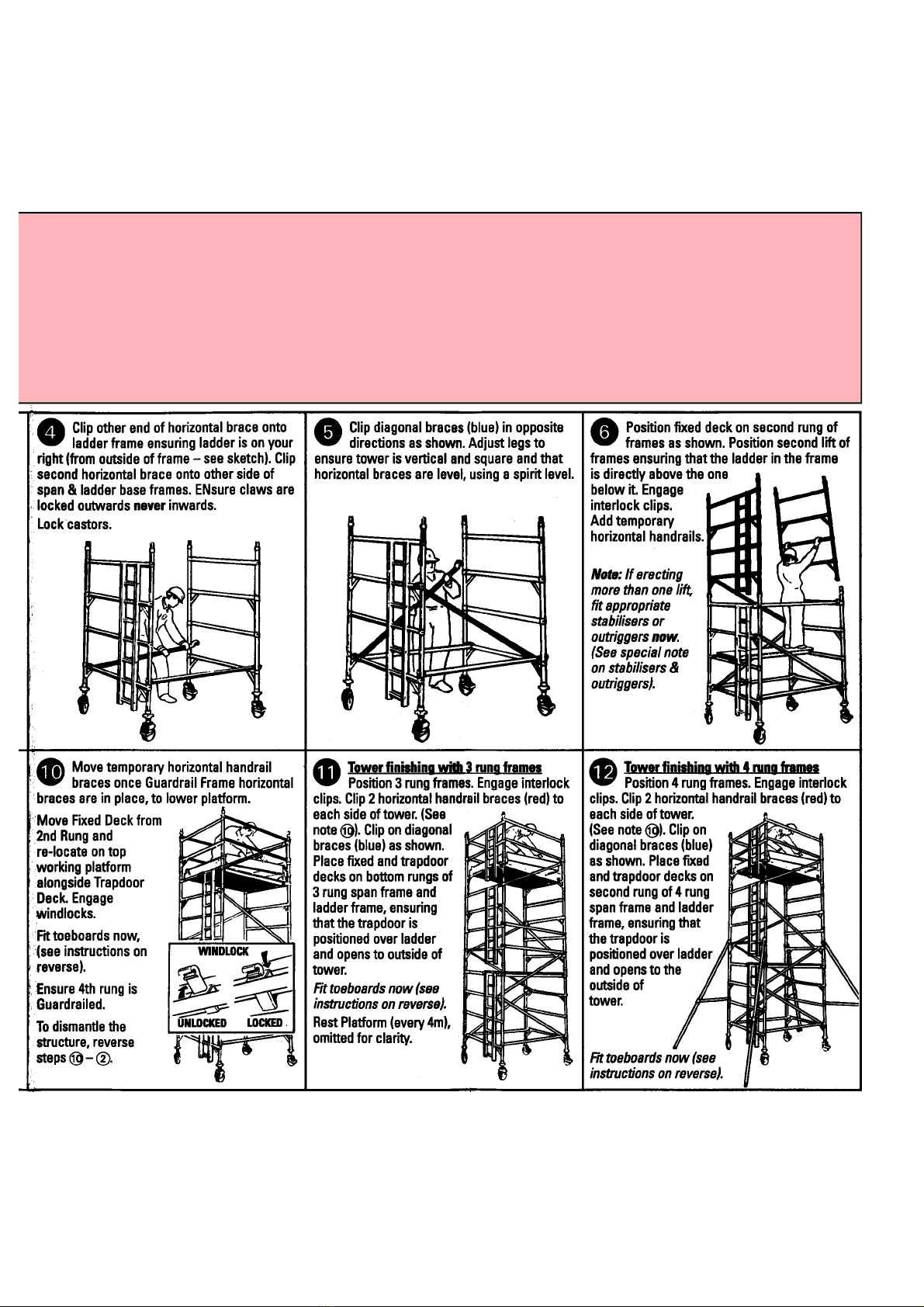
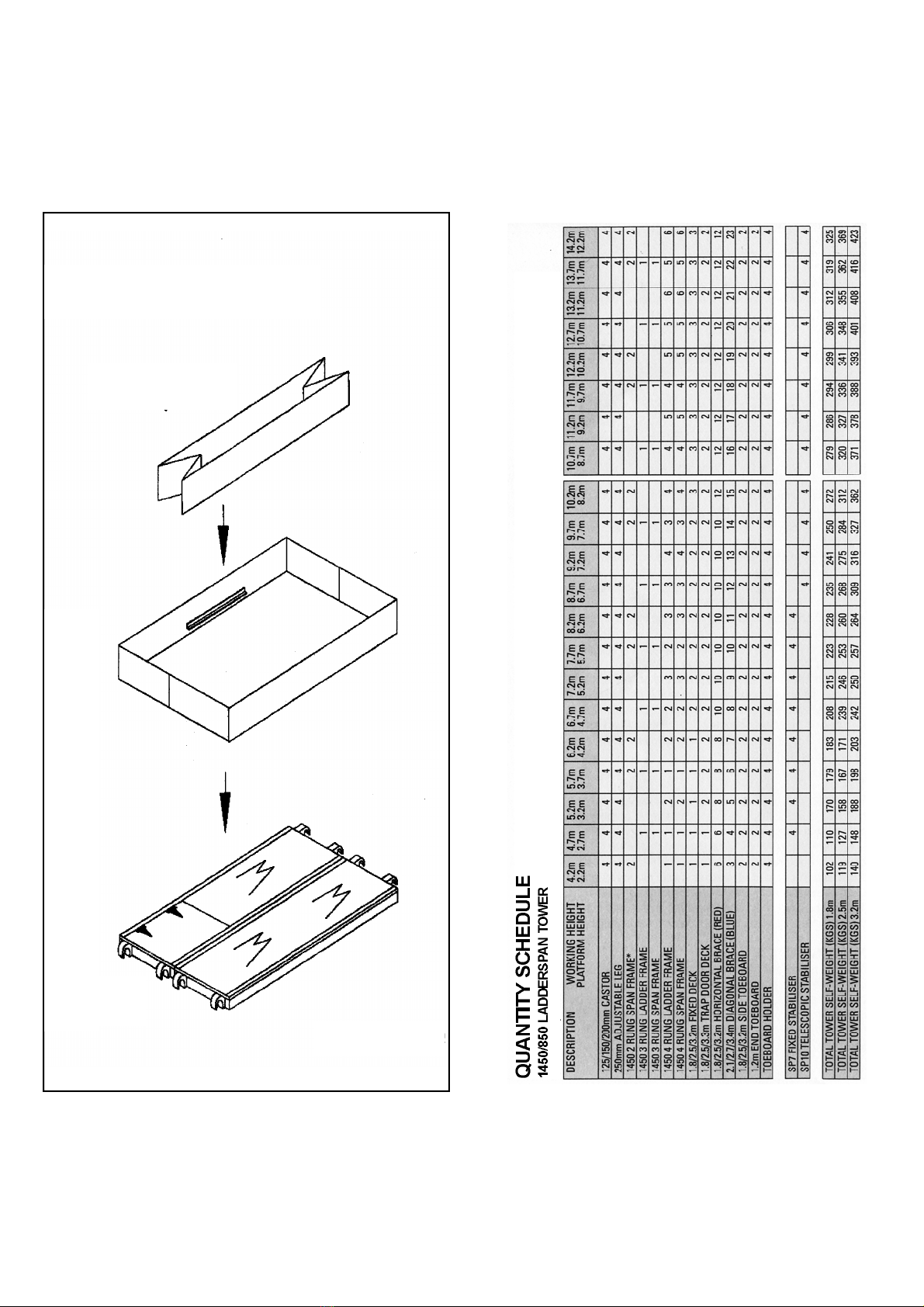
Check that all components are on site and they are
functioning correctly - See Quantity Schedule
Check if the ground on which the mobile access tower is to be
erected and moved, is capable of supporting the tower.
During the erection of the tower it is recommended that a
temporary guardrail brace be employed.
The safe working load is 275 kgs (606 lbs) uniformly distributed -
maximum concentrated load 150 kgs (330 lbs) per deck up to a
maximum of 950 kgs (2100 lbs) per tower (including self weight).
This must not be exceeded
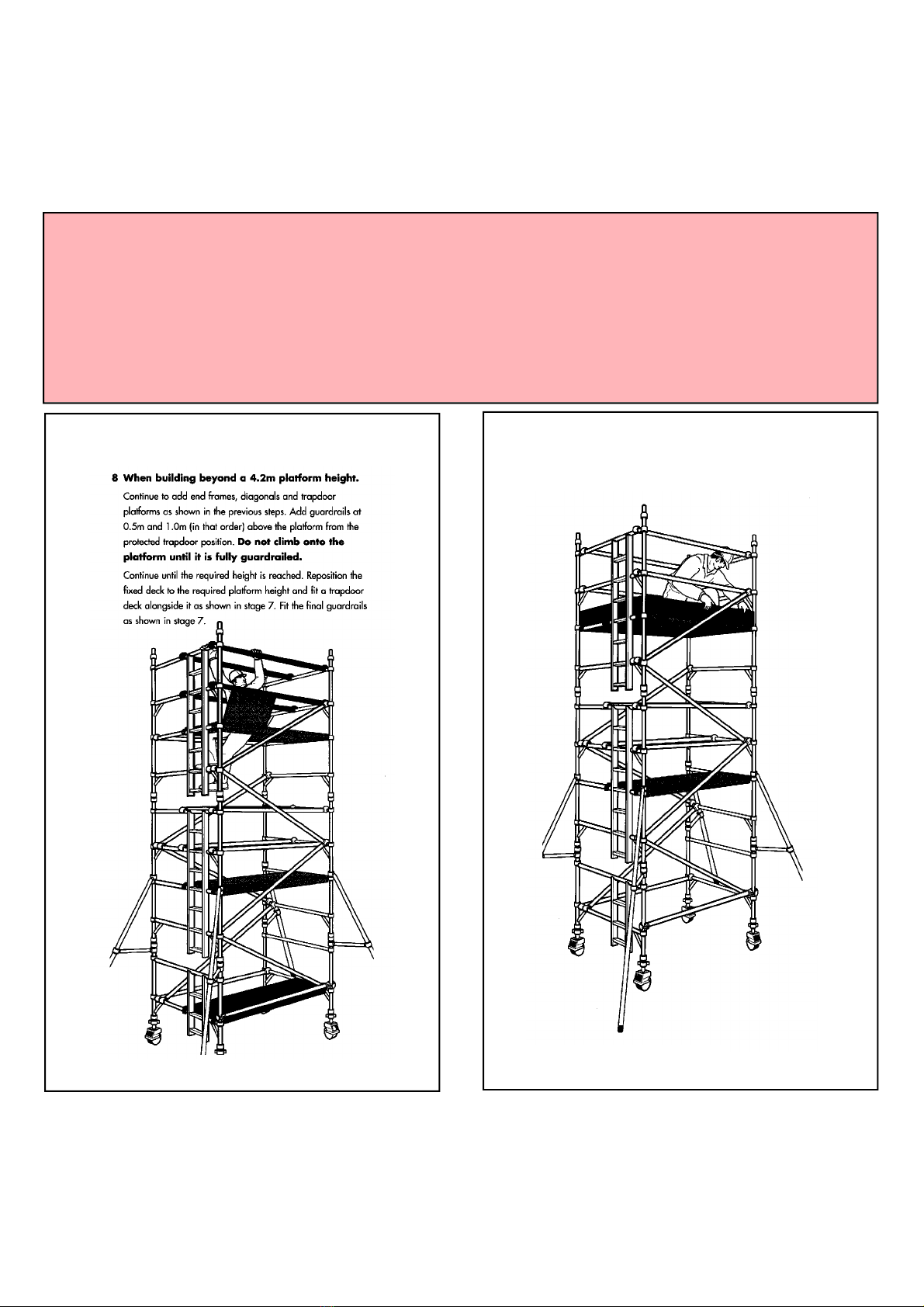
Towers must always be climbed from the inside during assembly
and using the built-in ladder provided during use.
Do not use boxes or step ladders on the platform to gain
additional height.
LIFTING OF EQUIPMENT
Tower components should be
firmly secured by a reliable lifting
material (eg rope), employing a
reliable knot (eg clove hitch), to
ensure safe fatening
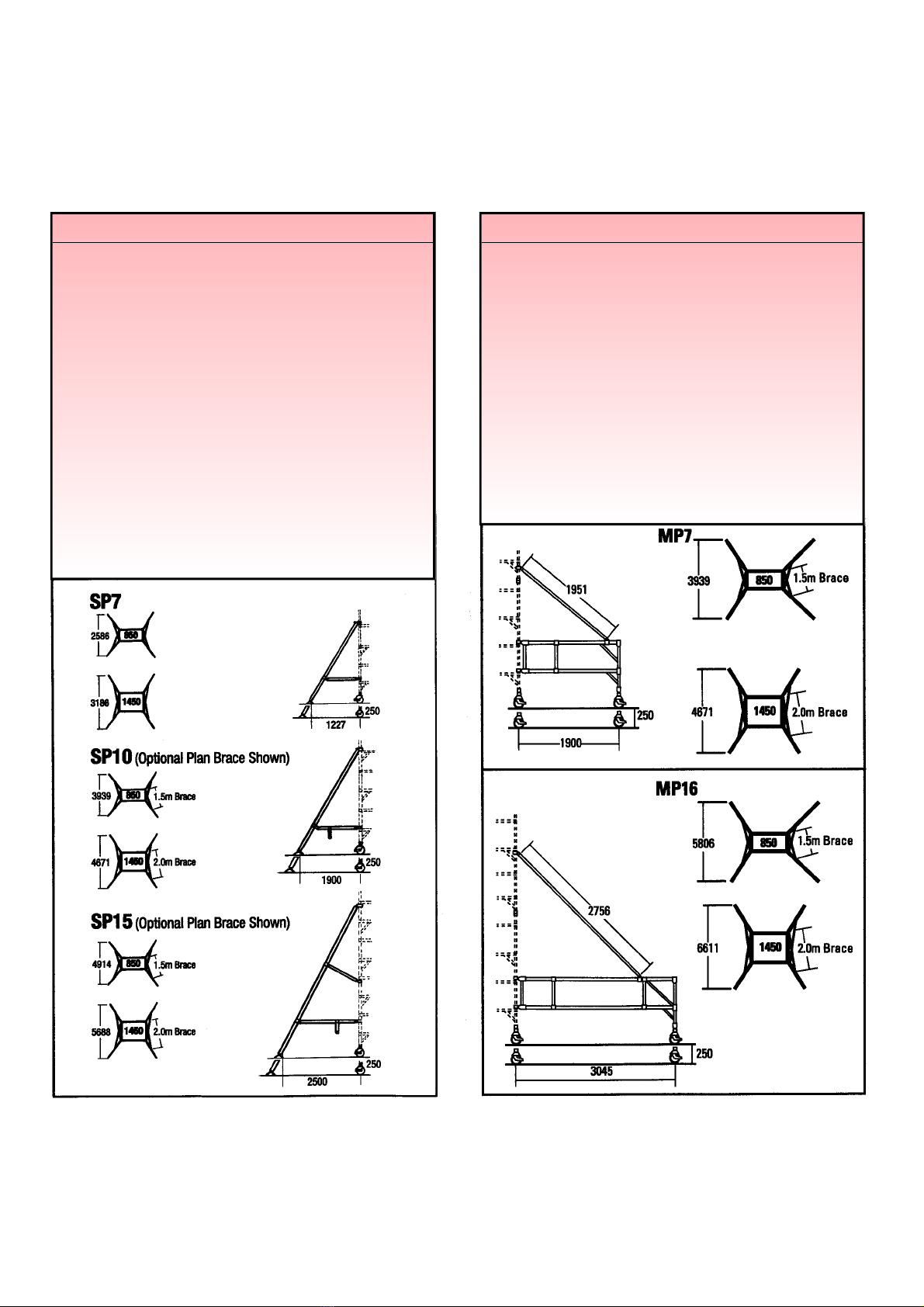
STABILISERS/BALLAST
Stabilisers or outriggers and ballast weights shall always be
fitted when specified.
Ballast is used at the base to stabilise towers against
overturning. The QUANTITY SCHEDULE shows the recommended
stabilisation. In circumstances where there is restricted ground
clearance for stabilisers/outriggers, contact your supplier for
advice.
It must be of solid materials (i.e. not water or loose sand) and
should not be positioned to overload individual legs. Ballast
should be secured agains accidental removal, and be
supported on the lowest rung of the bottom frame.
MOVEMENT
The tower should only be moved by manual effort, and only
from the base.
When moving the tower, beware of live electical apparatus,
particularly overhead, plus wires or moving parts of machinery.
No personnel or materials should be on the tower during
movement.
Caution should be exercised when wheeling a tower over
rough, uneven or sloping ground, taking cars to unlock and lock
castors. If stabilisers are fitted, they should be lifted
sufficiently above the ground to clear ground obstructions. The
height of the tower, when being moved, should not exceed
2.5 times the minimum base dimensions, or 6 metres overall
height.
DURING USE
Beware of high winds in exposed, gusty or medium breeze
conditions. We recommend that in wind speeds over 7.7 metres
per second (17 m.p.h.), cease working on tower. If the wind
becomes a strong breeze, expected to reach 11.3 metres per
second (25 m.p.h.), tie the tower to a rigid structure. If the wind
is likely to reach gale force, over 18 metres per second (40m.p.h.)
the tower should be dismantled.
Beware of open ended buildings which can cause funnelling effect.
Do not abuse the equipment, damaged or incorrect components
should never be used.
Raising and lowering components, tools, and/or materials by rope
should be conducted wtihin the tower base. Ensure that the safe
working load of the supporting decks and the tower structure is
not exceeded.
The assembled tower is a working platform and should not be
used as a means of access to other structures.
Beware of horizontal forces (eg power tools) which could
generate instability. Maximum horizontal force 20 kg.
The Stairway towers featuring an inclined staircase access are
for use with personnel frequently carrying tools an/or materials.
mobile towers are nor designed to be suspended - please refer
to your supplier.
TIES
Ties should be used when the tower goes beyond its safe height
beyond the limits of the stabilisers/outriggers or there is a danger
of instability.They should be rigid, two way ties fastened to both
uprights of the frame with load-bearing right angled or swivel
couplers. Only couplers suitable for the 50.8mm dia. tube of the
tower should be used. Ideally ties should secure to either face of
a solid structure or by means of anchorages.
The tie frquency may vary depending on the application, but
they should, at a minimum, be at every 4 metres height.
MAINTENANCE
All components and their parts should be regularly inspected to
identify damage, particularly to welds. Lost or broken parts should
be replaced, and any tubing with indentations greater than 5mm
should be put to one side for manufacture repair.Adjustable leg
threads should be cleaned and lightly lubricated to keep them
free running.
Wind Beaufort Beaufort Speed in Speed in
Description Scale No. m.p.h. m/sec.
Medium Breeze Raises dust and loose 4 8-12 4-6
paper, twigs snap off.
Strong Breeze Large branches in motion, 6 25-31 11-14
telegraph wires whistle.
Gale Force Walking is difficult 8 39-46 17-21
•
•
•
•
•
•
•
•
••
•
•
•
•
•
•
•
•
•
•
•
•
USAGE ADVICE FOR ALL TOWER VARIATIONS