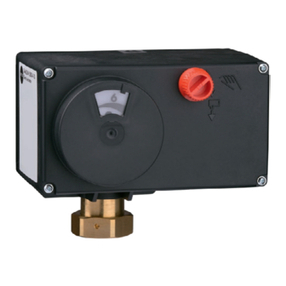
Cameron CLIF MOCK CD-20SFA User manual

CLIF MOCK™
CD-20SFA Sample Probe Controller
User Manual
Manual No. 2350754-01, Rev. 02
Class I Groups C and D
Hazardous Locations

Important Safety Information
Symbols and Terms Used in this Manual
!WARNING: This symbol identies information about practices or circumstances that can lead to per-
sonal injury or death, property damage, or economic loss.
CAUTION: Indicates actions or procedures which if not performed correctly may lead to personal
injury or incorrect function of the instrument or connected equipment.
Important: Indicates actions or procedures which may affect instrument operation or may lead to an
instrument response which is not planned.
This product must be operated within the parameters stated in this manual and in conjunction with
the ratings printed on the product serial tag.
Technical Support Contact Information
Cameron
Measurement Systems Division
14450 John F. Kennedy Blvd.
Houston, TX 77032
Phone: 1-800-654-3760; 281-582-9500
Fax: 281-582-9599
Clif Mock is a trademark of Cameron International Corporation (“Cameron”).
© 2013 Cameron International Corporation (“Cameron”). All information contained in this publication is
condential and proprietary property of Cameron. Any reproduction or use of these instructions, drawings, or
photographs without the express written permission of an ofcer of Cameron is forbidden.
All Rights Reserved.
Printed in the United States of America.
Manual No. 2350754-01, Rev. 02
September 2013

iii
CD-20SFA Sample Probe Controller Table of Contents
Contents
Important Safety Information ...............................................................................................................................ii
Section 1—Overview .......................................................................................................................................... 5
How It Works ................................................................................................................................................ 6
Hazardous Location Safety Compliance ...................................................................................................... 6
Table 1.1—CD-20SFA Specications ........................................................................................................... 7
Section 2—Installation and Wiring...................................................................................................................... 7
Section 3—Maintenance .................................................................................................................................... 8
Operational Test ........................................................................................................................................... 8
Basic CD-20SFA Check-Out ........................................................................................................................ 9
Sample Probe and CD-20SFA Check-Out ................................................................................................... 9
Motor Control Assembly ............................................................................................................................... 9
Table 3.1—Troubleshooting Tips ............................................................................................................... 10
Factory Repairs ...........................................................................................................................................11

iv
Table of Contents CD-20SFA Sample Probe Controller
WARRANTY - LIMITATION OF LIABILITY: Seller warrants only title to the products, software, supplies and
materials and that, except as to software, the same are free from defects in workmanship and materials for
a period of one (1) year from the date of delivery. Seller does not warranty that software is free from error or
that software will run in an uninterrupted fashion. Seller provides all software “as is”. THERE ARE NO WAR-
RANTIES, EXPRESS OR IMPLIED, OF MERCHANTABILITY, FITNESS OR OTHERWISE WHICH EXTEND
BEYOND THOSE STATED IN THE IMMEDIATELY PRECEDING SENTENCE. Seller’s liability and Buyer’s
exclusive remedy in any case of action (whether in contract, tort, breach of warranty or otherwise) arising out of
the sale or use of any products, software, supplies, or materials is expressly limited to the replacement of such
products, software, supplies, or materials on their return to Seller or, at Seller’s option, to the allowance to the
customer of credit for the cost of such items. In no event shall Seller be liable for special, incidental, indirect,
punitive or consequential damages. Seller does not warrant in any way products, software, supplies and materi-
als not manufactured by Seller, and such will be sold only with the warranties that are given by the manufacturer
thereof. Seller will pass only through to its purchaser of such items the warranty granted to it by the manufacturer.

5
CD-20SFA Sample Probe Controller
Section 1—Overview
The CD-20SFA Sample Probe Controller is engineered to provide pulse input (ow proportional) control
of the True-Cut C-Series sample probe. When a “start” pulse is received, the probe is rotated to capture and
discharge an isokinetic sample. When installed in a horizontal line, the probe is stopped in the closed position,
while on a vertical line the probe is stopped in the open position.
The C21 probe collects one 1.5 cc sample per 360-degree rotation.
The C22 probe collects two 1.5 cc samples per 360-degree rotation.
A failure alarm relay provides an output to alert users to a loss of power, loss of input signal, or motor failure.
The relay contact remains open (inactive) for as long as a sample is being taken within the alarm delay period
congured with the control card potentiometer. Alarm delays can range from 5 seconds to 6 minutes.
An explosion-proof housing encloses the complete assembly, and two ¾-in. NPT holes allow connection of
the line power and input pulse (for ow-proportional sampling). A ½-in. breather plug and a ½-in. conduit
plug are installed on opposite sides of the enclosure.
A coupling, jam nut, and hub allow the assembly to be mounted directly to the C-Series sample probe. No
brackets or supports are required; however, they are recommended for piping with signicant vibration.
The CD-20SFA controller consists of the following:
• a motor control assembly (24VDC, 115VAC, or 230VAC)
• a DC gear motor with a gear ratio of 150:1
• a cam with two high points mounted on the gear motor output shaft
• a proximity switch mounted in the hub assembly opposite the cam
When a high point on the cam is opposite the proximity switch, the PROX (“Hold”) LED is illuminated. This
signal indicates the sample probe is at the “stop and hold” position.
Figure 1.1—CD-20SFA controller components

6
CD-20SFA Sample Probe Controller
The CD-20SFA motor control assembly (Figure 1.2) consists of a control card and power board mounted to a
ring, which in turn, is mounted to the back of the CD-20SFA gear motor. All eld connections are to terminal
block 1TB on the control card. The motor and proximity switch connections are made at the factory to
terminal block 2TB on the power board.
CD20 Power Board
(2TB)
CD20 Control Card
(1TB)
Figure 1.2—CD-20SFA motor control assembly
How It Works
When an input pulse from an external pulse source is received, a command is output to rotate the motor.
Armature feedback controls the speed of the motor at about 12 rpm and current feedback limits motor current
to 3 amperes.
The pulse input be closed for at least 5 msec to produce a “start” pulse. An electronic square wave input must
have an amplitude of 12VDC.
The proximity switch input amplier provides the signal to stop the motor. Two LEDs installed on the
controller card allow the user to test the controller’s operation. The I-LIMIT LED is on when the drive is in
current limit, which is normal during acceleration.The PROX (“Hold”) LED is on when the motor is stopped.
Field wiring instructions are provided in Section 2—Installation and Wiring, page 7.
Hazardous Location Safety Compliance
Assemblies designed for 24VDC, 115VAC and 230VAC input power are UL-listed in the US and Canada for
Class I Groups C and D Hazardous Locations.

7
CD-20SFA Sample Probe Controller
Table 1.1—CD-20SFA Specications
24 VDC 115/230 VAC
Temperature -40ºC to 55ºC -40ºC to 55ºC
Voltage 24VDC @2A max 115 / 230 VAC @ 1A max
Pulse Input 12VDC 12VDC
Transistor Output 12VDC max @ 100mA max 12VDC max @ 100mA max
Current Draw (Controller)
Stop Mode 30 mA 60 mA
Running Mode 0.5 Amp 150 mA
Peak Motor (Turn On) Current 1 Amp 300 mA
Current Draw (Motor)
Motor (Turn On) Current 320 mA 850 mA
Section 2—Installation and Wiring
!WARNING: This module is designed for connection to hazardous electric voltages. Ignoring
this warning can result in severe personal injury or mechanical damage. This product must
be reliably earthed and installed by qualied personnel in accordance with the prevailing local
electrical wiring regulations and safety standards.
The CD-20SFA controller mounts directly to the C-Series sample probe via the DC-2 coupling (Figure 2.1).
The DC-2 coupling should be hand-tightened to ensure that the internal retaining ring is not pushed out of
its groove. If the DC-2 coupling is over-tightened at the CD-20SFA hub, the motor shaft will not engage the
DC-1 coupling on the probe.
Figure 2.1—DC-2 coupling
All eld connections are made to terminal block 1TB on the control card (Figure 2.2, page 8). Install
wiring as follows:
1. Connect power to 1TB-1 and 1TB-2.
2. Connect the ow pulse input contact to 1TB-5 and 1TB-6. If an open collector transistor driver is used,
connect the collector to 1TB-5 and connect the emitter to 1TB-6 (common).

8
CD-20SFA Sample Probe Controller
Note The input pulse contact must be closed for at least 5 msec to produce a start pulse. An electronic
square wave input must have a pulse amplitude of 12VDC. A 5VDC square wave will not work.
1TB-6 Pulse Input (Emitter)
1TB-5 Pulse Input (Collector)
1TB-4 (Failure Alarm)
1TB-3 (Failure Alarm)
I-Limit LED
PROX ( Holdî) LEDì
1TB-2 (N)
1TB-1 (H)
115VAC or
230VAC Power
1TB-2 (-)
1TB-1 (+)
24VDC Power
R1 Alarm Relay Potentiometer
Figure 2.2—Field wiring of CD-20SFA controller
3. Connect the sample failure alarm relay contact to 1TB-3 and 1TB-4. The contact will remain open for as
long as sampling occurs within the alarm delay period. This contact is rated for 90 VA resistive and 30 VA
inductive loads. It is suitable for use with 115VAC low current.
4. Adjust the alarm delay time by turning the R1 potentiometer screw clockwise. Alarm delays ranging from
5 seconds to 6 minutes can be selected via this adjustment.
Section 3—Maintenance
Operational Test
If the operation of the instrument is in question, the following procedures can help isolate the problem. The
following user-supplied equipment is required:
• power supply
• push-button switch
• a multimeter
• a 100-ml graduated beaker or other measuring device
•

9
CD-20SFA Sample Probe Controller
Basic CD-20SFA Check-Out
1. Disconnect the probe from the CD-20SFA.
2. Disconnect the input power from the CD-20SFA.
3. Connect a push-button switch to 1TB-5 and 1TB-6 on the control card.
4. Reconnect input power to the CD-20SFA.
5. Activate the switch and verify the CD-20SFA output shaft rotates 180 degrees with each pulse. Wait for
the shaft to stop rotating before repeating the switch activation.
Note—Any input pulses that occur when the CD-20SFA is rotating are disregarded by the control logic.
6. Connect the multimeter to 1TB-3 and 1TB-4 on the control card.
7. Wait for the congured alarm period to expire (factory default period is 5 seconds) and verify that the
alarm relay contact closes.
8. Activate the push-button switch to send a pulse and verify that the alarm relay contact opens.
9. Repeat steps 7 and 8 as required.
Sample Probe and CD-20SFA Check-Out
1. Disconnect input power from the CD-20SFA. The push-button switch should still be connected to 1TB-5
and 1TB-6.
2. Mount the CD-20SFA to the sample probe and hand-tighten the DC-2 coupling.
3. Verify that the product line is full and pressurized.
4. Reconnect input power to the CD-20SFA.
5. Hold a 100-ml graduated beaker (or other applicable measuring device) under the probe’s discharge.
6. Activate the switch repeatedly to collect 10 samples, 1.5 cc each.
Motor Control Assembly
The motor control assembly (Figure 1.2, page 6) consists of a control card and power board mounted to a
ring, which in turn, is mounted to the back of the CD-20A gear motor.
Control Card Functions
The CD20-SFA control card performs the following functions:
• Components C7, R12, CR5, and a U4 gate provide a 100-msec power-up reset.
• An alarm delay timer circuit is implemented with U3, C6, C10, R4, R1 and a U4 gate. This circuit is reset
every time a sample is taken and on initial power-up. U3 counts oscillator pulses and de-energizes relay
1CR after counting 2048 clock pulses from U4 pin 6.
• An input lter circuit connected to 1TB-5 buffers incoming pulses from an external ow measuring de-
vice. The lter has a 2msec time constant, and the input pulse duration must be at least 5 msec to assure a
start pulse output.

10
CD-20SFA Sample Probe Controller
• When set by a start pulse, the RUN/STOP latch U5A outputs the speed command voltage to the summing
point control amplier U2A.
• Amplier U2B provides current feedback to the summing point control amplier U2A.
• Resistor R19 provides armature voltage feedback to the summing point control amplier U2A.
• DS2 is the current limit LED indicator.
• DS1 is the PROX (“Hold”) LED indicator.
• U2C is the proximity switch amplier. The voltage across the proximity switch (2TB-3 to 2TB-4 on the
power board) will be nominally +8VDC when the proximity switch is sensing metal and +4VDC when
the proximity switch is sensing an absence of metal.
• Latch U5B outputs a single 20-msec one-shot pulse to reset the RUN/STOP latch U5A when the proxim-
ity switch rst senses a high point on the cam.
Power Board Functions
The power board provides the following functions:
• Fuse F1 (2-amp, fast-acting) provides short circuit protection. ZD1, a 33V “crowbar” zener diode, pro-
vides over voltage protection for the rest of the circuit.
• Diode D2 prevents current ow if +VDC power is connected to the common terminal and a ground is
connected to the +VDC terminal.
• Q4, an LT1074CT switching regulator and associated circuitry efciently convert the +VDC into a regu-
lated +6.3VDC motor supply voltage.
• The control card uses motor armature feedback to set the speed command to the motor driver power FET
Q2.
• A stop command from the control card to Q1 provides motor braking which prevents the motor from
coasting past the stopping point.
• R6 is the motor current feedback resistor. The motor current is limited to 3.0 amps.
• Fuse F2 (2-amp, slow blow) will open in less than 1 minute if the motor is stalled (locked rotor).
Table 3.1—Troubleshooting Tips
Problem Probable Cause Recommended Action
Input power fuse F1 open. Input power surge above 33VDC. Check fuse F1.
Short circuit on the power board. Return to factory for
replacement of power board.
Motor Fuse F2 open. Motor stall (locked rotor). Check fuse F2.
Short circuit in motor armature circuit. Return to factory for
replacement of control card.
Table of contents
Popular Controllers manuals by other brands
Digiplex
Digiplex DGP-848 Programming guide
YASKAWA
YASKAWA SGM series user manual
Sinope
Sinope Calypso RM3500ZB installation guide
Isimet
Isimet DLA Series Style 2 Installation, Operations, Start-up and Maintenance Instructions
LSIS
LSIS sv-ip5a user manual
Rockwell Automation
Rockwell Automation 1769-L31 installation instructions