Pg 9
Installation (Continued)
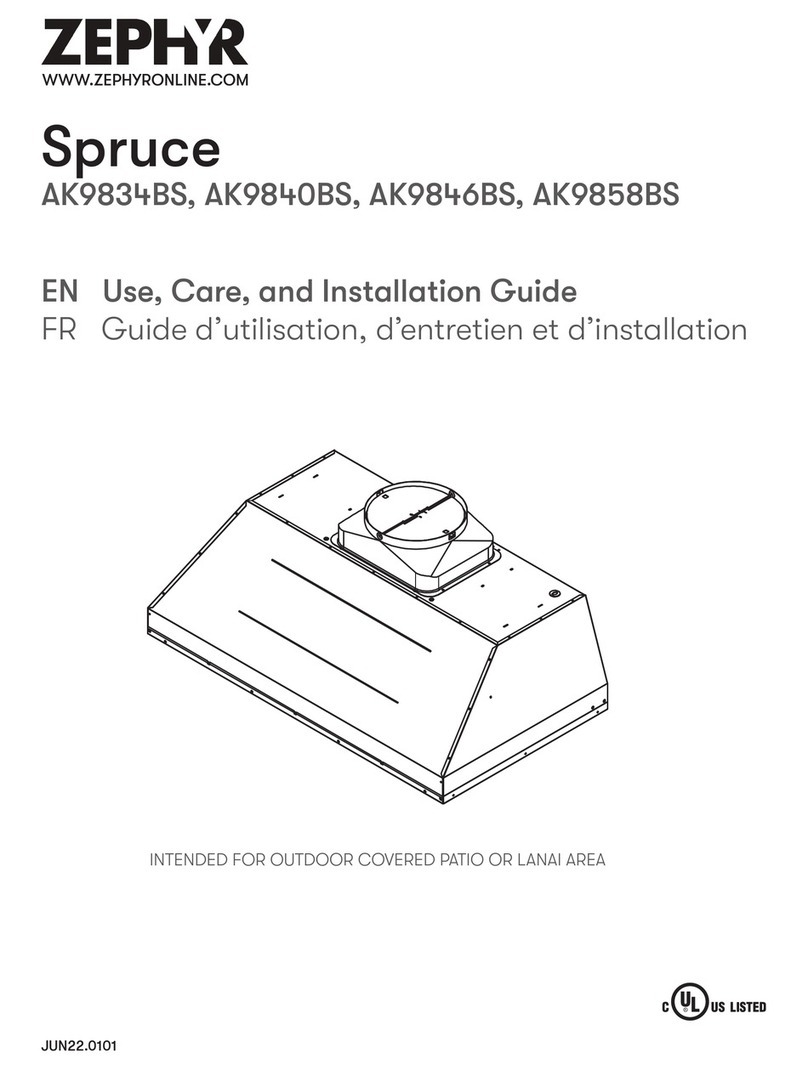
5) Assemble the vent adaptor onto the range hood.
Mount the vent adaptor and draft damper to the range hood body using the 10mm length
screws. Use certified duct tape or other certified duct sealant to seal the vent adaptor and the
range hood by taping over the mounting screws, alongside the flange of the vent adaptor, or
sealing in between the 2 parts. (If already using a vent damper on your ducting, wall cap or
roof cap, remove the draft damper from this vent adaptor. Do not use 2 draft dampers on the
same line of ducting.)
6) Check your mounting references and then cut your vent and power cord holes.
Reposition the range hood in its installation location to ensure the newly installed vent
adaptor will clear your markings. After confirming your markings proceed to cut out the holes
to make clearance for the vent duct and power cord.
7) Partially install mounting screws for the keyhole mounting hole locations.
For the most accuracy, center-punch or stake your hole locations before predrilling you holes.
Do not drill the holes too large for the mounting screws to seat. Predrill the mounting holes,
and then partially screw 2 mounting screws in the keyhole locations, at opposite corners of
each other, leaving approximately 1/4-inch of space so you can align the range hood keyhole
mount holes onto those screws and then temporarily hang the range hood onto those screws.
8) Hang the range hood onto the mounting screws and run the power cord.
Additional help during this step is highly recommended. Position the range hood near the
mounting location, and then run the power cord through its relief hole, (DO NOT plug in the
power cord) and then align the 2 mounting screws with the keyhole mounting holes on the
range hood; insert the range hood onto the mounting screws using the keyhole shaped
mounting holes; hold pressure onto the range hood to ensure it does not dismount or fall;
tighten the mounting screws so that the range hood is safe to release. Adjust the position of
the range hood to your preference, and then proceed to screw in the remainder of the
mounting screws to fully secure the range hood using the standard circle-shaped mounting
holes. A total of 4 mounting screws, one in each corner, are the absolute minimum to
mounting this range hood securely. Additional screws placed through the sheet metal is
acceptable; do not drill or screw into any wires, cables, components or any critical fixtures.
It is recommended to function test the range hood at this point, to ensure there are not
screws or hardware that are impeding the function of the blower; however, you must be sure
there is no power supplied or connected when you continue to work on the range hood.
9) Attach the household ducting to the duct adaptor and range hood.
Ensure the range hood is unplugged and the power line is off. Attach your household ducting
to the range hood using the least amount of bends or transitions as possible. If ducting bends
or duct transitions are used, place each bend or transition as far apart as possible. Use
certified duct sealant, tape or adhesive.
10) Confirm your installation, alignment, screws, ductwork, sealant, accessories, and then
preform a function test.
Check your installation, its alignment, screw tension of all screws, duct work and sealant.
Remove any finish protection and then install the baffle filters. If all the above are good, plug
in the range hood and then turn on power to the line, and then proceed to perform another
function test. Use stainless steel cleaner and a soft cloth to clean any dust or finger prints from
range hood. Always wipe with the grain of the brushed stainless steel; never wipe across the
grain of the brushed stainless steel finish.