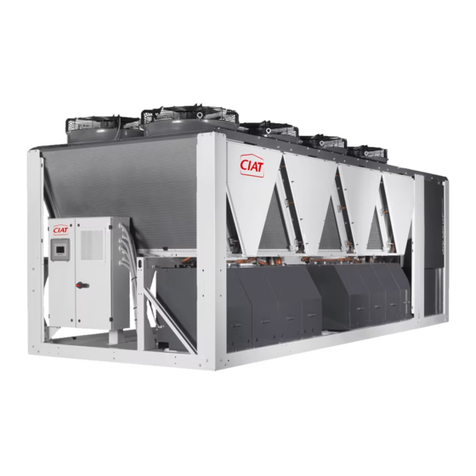
3 - HANDLING AND POSITIONING
3.1 - Handling
Carrier strongly recommends employing a specialised company
to unload the machine.
Do not remove the subbase or the packaging until the unit is in
its nal position.
These units can be safely moved by trained personnel with a
fork lift truck with the correct capacity for the dimensions and
weight of the unit, as long as the forks are positioned in the
location and direction shown on the unit.
The units can also be lifted with slings, using only the designated
lifting points marked on the unit (labels on the chassis and a label
with all unit handling instructions, attached to the unit).
Use slings with the correct capacity, and follow the lifting
instructions on the certied dimensional drawings supplied.
Only attach slings to the clearly marked points on
the unit provided for this purpose.
It is advisable to protect coils against crushing while a unit is
being moved. Use struts or a lifting beam to spread the slings
above the unit. Do not tilt the unit more than 15°.
Safety when lifting can only be guaranteed if all these instructions
are followed. Otherwise, there is a risk of equipment damage or
injury to personnel.
3.2 - Positioning
The unit must be installed in a place that is not accessible to the
public, or is protected against access by unauthorised persons.
The machine is designed to be installed outdoors.
More more details on the various installation scenarios, refer to
the installation guide for A2L refrigerants.
For extra-high units, the unit environment must permit easy
access for maintenance operations.
For the centre of gravity coordinates, the position of the unit
mounting holes, and the weight distribution points, refer to the
certied dimensional drawings. Ensure the free space shown in
the dimensional drawings is respected to facilitate maintenance
and connection.
The typical applications of these units are cooling and heating,
which do not require earthquake resistance. Earthquake
resistance has not been veried.
Before positioning the device, check that:
The chosen location can support the weight of the unit, or that
the appropriate reinforcement measures have been taken.
The unit is installed level on an even surface (maximum
tolerance is 5 mm along both axes).
If the support structure is sensitive to vibration and/or noise
transmission it is advisable to insert anti-vibration mounts
(elastomer mounts or metal springs) between the unit and the
structure. Selection of these devices is based on the system
characteristics and the comfort level required and should be
made by technical specialists.
There is adequate space above and around the unit for air to
circulate and for access to the components (see dimensional
drawings).
The number of support points is adequate and that they are
in the right places.
The unit must be installed on a plinth designed to collect then
drain the water produced by the reversible units during the
defrost cycles.
The location is not subject to ooding.
Avoid installing the unit where snow is likely to accumulate
(in areas subject to long periods of sub-zero temperatures,
the unit should be raised).
The wind may aect the operation and performances of
machines; baes may be necessary to protect the unit from
strong prevailing winds. These must not restrict the unit's air
ow.
Before lifting the unit, check that all enclosure
and set down the unit with great care. Tilting and
jarring can damage the unit and impair unit
operation.
Never apply pressure or leverage to any of the unit's
panels or uprights; only the base of the unit frame
is designed to withstand such stresses. No force or
effort must be applied to pressurised parts,
especially via pipes connected to the water type
module if the unit is equipped with this). The
pump does not support the weight of the pipes.
All welding operations (connection to the hydraulic network) must
be performed by qualied welders. The Victaulic®connection or
the counter-ange must be removed before welding as a matter
of course.
POWER ILD
In some cases, uprights are added for transporting and handling
the unit. The uprights must be removed if necessary for access
or connection.
Follow the disassembly procedure indicated in the
disassembly instructions.
Undo the bolt (3).
Remove the upright (2).
Remove the plate (1).
BD
C
Keep the uprights following start-up and ret them when moving
the unit.
AQUACIATPOWER™ LD/ILD EN-6