2 / 5 DOC ID - 557 • REV 04
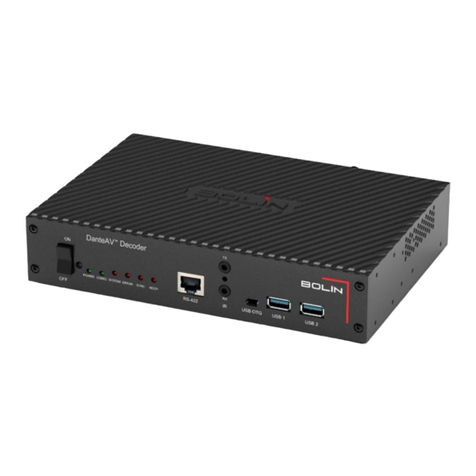
Figure 2: Encoder back
(1) RS-485 – RS-485 serial interface. Connect to a pan/tilt unit,
speed dome, etc.
(2) ALARM IN/OUT – Relay alarm input/output.
Note: The alarm output terminal provides no JP2 pin.
(3) LAN – 10/100 Mbps adaptive Ethernet interface (PoE). The right
LED indicator illuminates green when the network cable is
connected. The left LED indicator blinks orange when data is
transmitting or receiving.
(4) GND – Earth ground
(5) DC 12V – 12 VDC power connection.
Mount the encoder
Caution: This encoder is not approved for outdoor use. Only
install this product in an indoor environment.
The encoder kit contains four screws for mounting the device to a solid
surface.
To mount the encoder:
1. Place the encoder against a solid surface, and then mark
the location of the mounting holes.
2. Remove the encoder, and then drill the four mounting
holes.
3. Position the encoder, and then attach it to the surface
using the screws provided.
Connect the cables
To make the front connections:
1. Connect the camera to the encoder’s BNC connection
labeled “VIDEO IN”.
2. (Optional) Connect an audio input device, such as a
microphone, to the port labeled “LINE IN”.
3. (Optionally) Connect an audio output device, such as a
loudspeaker, to the port labeled “AUDIO OUT.”
To make the back connections:
1. Connect one end of a shielded network cable to the
encoder port labeled “LAN” and then connect the other
end of the cable to one of your router’s network ports.
2. Insert the 6-pin terminal block into the port labeled
“ALARM” and then optionally connect external input/output
devices – for example, alarm devices.
3. Attach a grounding wire to the encoder using the
grounding screw, and then attach the other end to your
rack or other ground.
Insert the memory card
You can store video directly to a microSD memory card inside
the encoder.
To install a microSD card:
1. Insert a microSD card (not included) into the port labeled
“microSD” on the front of the encoder.
2. Check to be sure the card is in the correct orientation.
Connect power
A 2-pin 3.5 mm terminal block is used for power input.
To connect power:
1. Insert the 2-pin terminal block into the outlet marked
“DC12V”, making sure that it is seated properly. See
Figure 2, item 5.
2. Insert the power cable wire marked “DC12V+” into the
connector hole marked “+.”
3. Inset the power cable wire marked “GND” into the
connector hole marked “-.”
4. Attach the other end of the power adapter to and AC
outlet.
5. Check that the indicator LEDs to verify the correct
conditions.
Resetting to the factory default
This will reset all parameters, including the IP address, to the
factory default settings.
To reset the encoder to the factory default:
1. Ensure the encoder is powered off.
2. Insert a rigid object, such as the end of a paper clip, into
the Reset hole, and then press in and hold the button for
15 seconds. See Figure 1, item 5.
Setting the encoder over the LAN
To view and configure the encoder via LAN (Local Area
Network), you need to connect the encoder in the same subnet
with your PC. Then, install the SADP software to search and
change the IP of encoder.