4
ENGLISH
4) Using and maintaining the power tool
a) Do not overload thepowertool. Usethecorrect power tool for thework you aredoing.
Thecorrect power tool will do thejob better and more safely at therate for which it was designed.
b) Do not use thepower tool if theswitch does not turn it on andoff. Apower tool that cannot be
controlled with theswitch is dangerous and must be repaired.
c) Unplug thepower tool before you make any adjustments, change anaccessory or put thetoolaway.
Thesepreventive safety measures will reduce therisk of thetool being started accidentally.
d) Store idle power tools out of thereach of children and do not allow people unfamiliar with thepower
tool and these instructions to useit. Powertools are dangerous in thehands of inexperiencedusers.
e) Checkfor misalignment or binding of moving parts, for broken parts or anything else that may affect
theoperation of thepowertool. Ifthere is any damage it must be repaired before thetool can be
usedagain. Manyaccidents are caused by poorly maintained powertools.
f) Keep cutting tools sharp andclean. Properlymaintained cutting tools with sharp edges are less likely to
bind and are easier to control.
g) Use thepower tool, accessories,etc., in accordance with these instructions and in themanner
intended for theparticular type of power tool, taking into account theworking conditions and
thetype of work to bedone. Usingthepower tool to do work for which it is not intended may result in
ahazardous situation.
5) Servicing
a) Servicing and repairs must be done by authorised personnel, using only genuine spareparts.
Thisguarantees that thesafety of theelectric power tool is preserved.
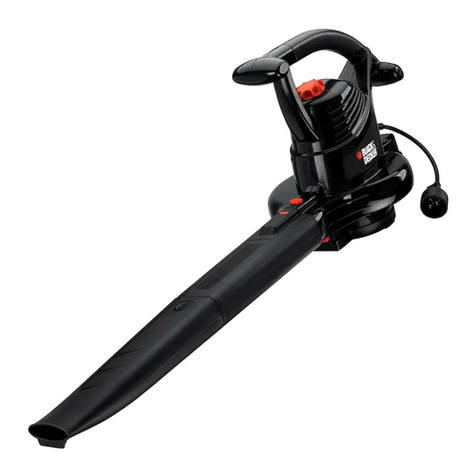
Special safety rules for the leaf blower/vacuum
• Keep children and pets well away when you are using theleaf vacuum.
• Never theuse theleaf vacuum if any part of theguard is missing or damaged.
• Make sure that thepower lead is directed backwards away from themachine when themachine is inuse.
• Themachine may only be used by adults who have read theuserguide.
• Keep your hands and feet away from theair intake or outlet of theleaf vacuum when starting themotor.
• Always unplug thepower lead when leaving theleaf vacuum unattended.
• Always unplug thepower lead from thesocket before servicing and adjusting theleaf vacuum.
• Keep thearea around themotor cooling openingsclean. Removeany grass and leaves.
• Keep theleaf vacuum out of thereach of children.
• Carry theleaf vacuum by its handle, never by thepowerlead.
• Connect theleaf vacuum to thepower supply via aresidual current device (RCD).
• Switch off theleaf vacuum and unplug thepowerlead:
- if themachine starts to vibrate violently. Checkif anything is damaged orloose.
- before cleaning thefan and blowing/vacuum tube, cleaning/emptying or servicing.
- whenever you take abreak or leave theleaf vacuum out of yoursight.
- if theextension lead is damaged. Donot touch thelead, only theplug.
• Use only genuine spareparts.
• Do not drag theextension lead through water or dampgrass. Checkfrequently that theextension lead is
sound and undamaged.
• Only use theleaf vacuum in daylight.
• When using theleaf vacuum, walk normally, keeping your balance. Donotrun.
• Check regularly that all screws and nuts aretight.
• Theuser is liable for injury to people and damage to property.
• For safety, electrical tools should be connected to thepower supply via aresidual current device (RCD).
Leaf blowing
• Theair blast may throw up objects which may cause injury.
• Do not direct theair blast from theleaf blower towards people or animals.
• Do not use theleaf blower to blow away hard objects.
• Do not use theleaf blower close to people or animals.
• Take special care when using theleaf blower in stairs or other locations with sharp corners andedges.
• Use safety glasses or avisor. Wearear protectors, full-cover clothing andshoes.