Company of Animals HALTI Setup guide
Headcollar
HALT1®
TRAINING
GUIDE
Guide d'éducation
Trainings-antleitung
Instrucciones
Trainingsgids
2
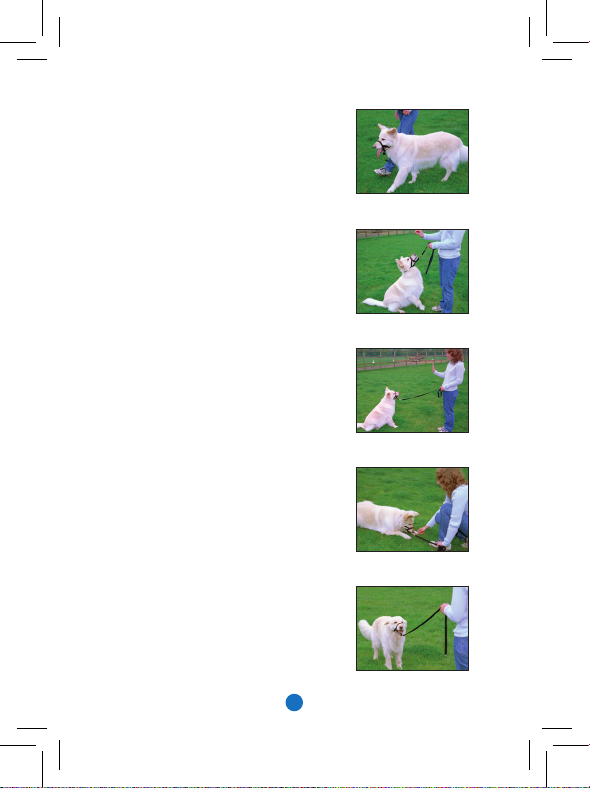
Walking To Heel.............6
„Bei Fuss“ gehen..........10
Marche au pied ...........14
Caminando “junto”.......18
Aan de voet lopen ........23
Sit ...............................7
„Sitz“............................11
Assis ...........................15
Para que se siente........19
Zit .............................23
Stay ...............................7
„Bleib“..........................11
Reste............................15
Para que se quede........19
Sta .............................23
Down .............................7
„Platz“..........................11
Couché.........................15
Para que se eche..........19
Neer .............................23
Come .............................7
„Komm“.......................11
Viens............................15
Para que venga ............19
Kom .............................23
3
Foreword............................................................................4
Fitting the Halti...................................................................4
Safety first..........................................................................5
Troubleshooting.................................................................6
General principles of dog training......................................6
Vorwort..............................................................................8
Anlegen des Halti ...............................................................8
Sicherheit geht vor.............................................................9
Problemlösungen.............................................................10
Allgemeine Grundsätze im Hundetraining ........................10
Introduction .....................................................................12
Ajuster le Halti..................................................................12
Sécurité avant tout...........................................................13
Conseils ...........................................................................14
Principes généraux d’éducation canine............................14
Introducción.....................................................................16
Instrucciones para el uso del Halti...................................16
Seguridad.........................................................................17
Resolución de problemas.................................................18
Guías generales sobre el entrenamiento de perros ..........18
Voorwaarts.......................................................................19
Halti passend makenlti.....................................................19
Veiligheid eerst ................................................................20
Problemen verhelpen.......................................................21
Eerste principe van hondentraining..................................21
GB
D
F
E
NL
Foreword
The Halti has been acclaimed worldwide as the most effective
design of headcollar which naturally follows the contours of
a dog’s face. It is positioned well down the dog’s nose giving
maximum steerage and control for basic training and all other
activities with your dog: from the quiet walk to leading an unruly
or potentially dangerous dog past animals or people.
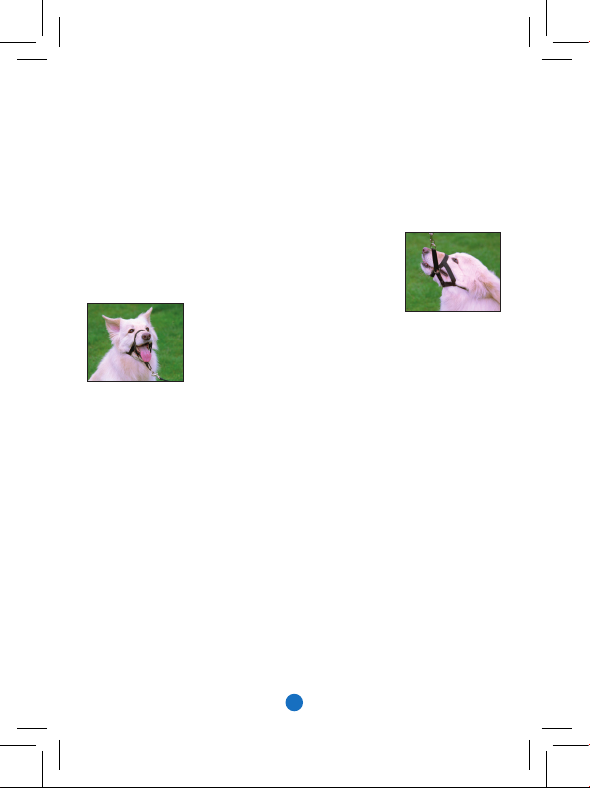
The particular advantage of Halti over other
designs of headcollar is that it has a unique
on-off muzzle closing effect: when the dog
attempts to lunge forward or attack, his jaws are
closed by the slip ring under his
chin. When he is relaxed and
friendly, he can re-open his mouth. At all times
that the dog is behaving well he can pant easily,
loll his tongue and act just like a dog.
Fitting the Halti
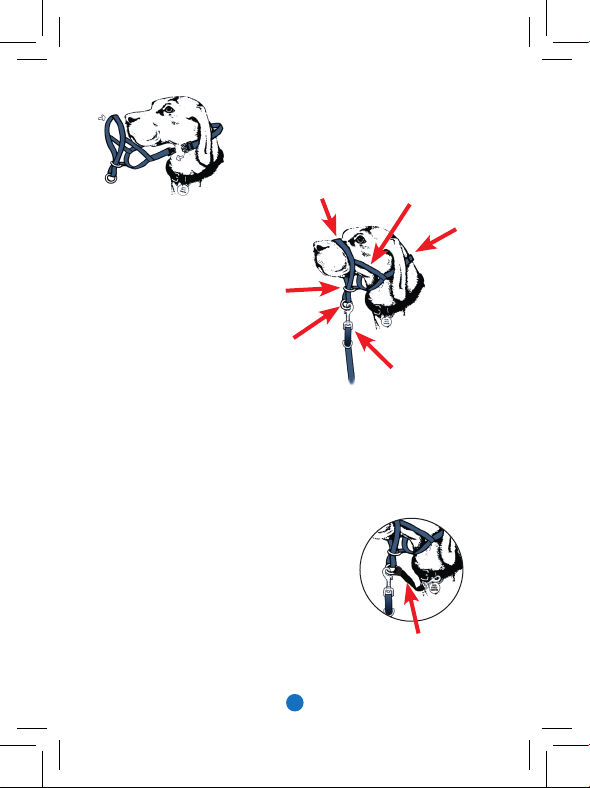
Hold your Halti by the noseband. Halti assumes the shape of
your dog’s head, with the two rings under his chin.
The collar section is adjustable using the slide. When the buckle
is securely closed it should accurately fit your dogs neck. A two-
finger slackness is the best guide.
Having fitted the Halti, see where the noseband naturally sits.
It should be down the nose and away from the eyes. When you
release pressure on the chin strap, make sure your dog can fully
open his mouth without restriction.
4
5
Safety First
Until your dog gets used to wearing the Halti, there is a small
risk that he might pull the collar section over his head. Do ensure
that the collar section is tight enough. No more than 2-3 fingers
should fit under the collar.
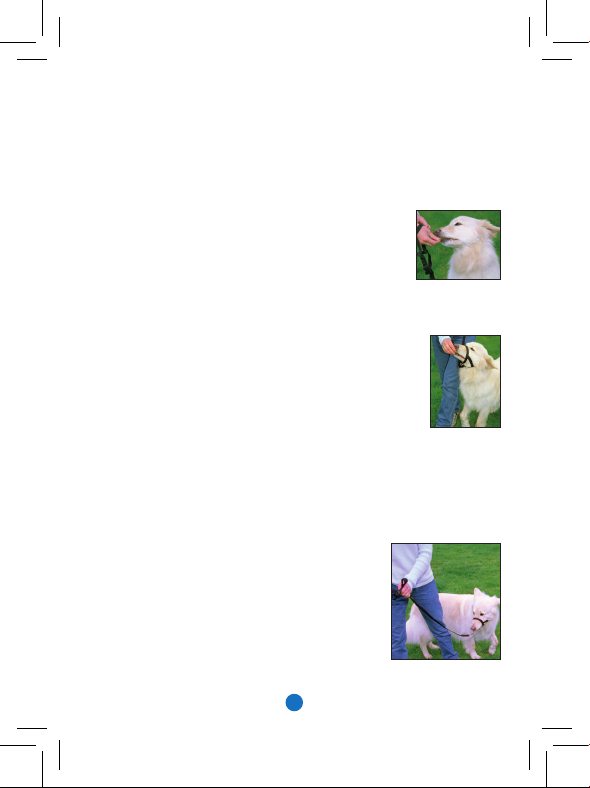
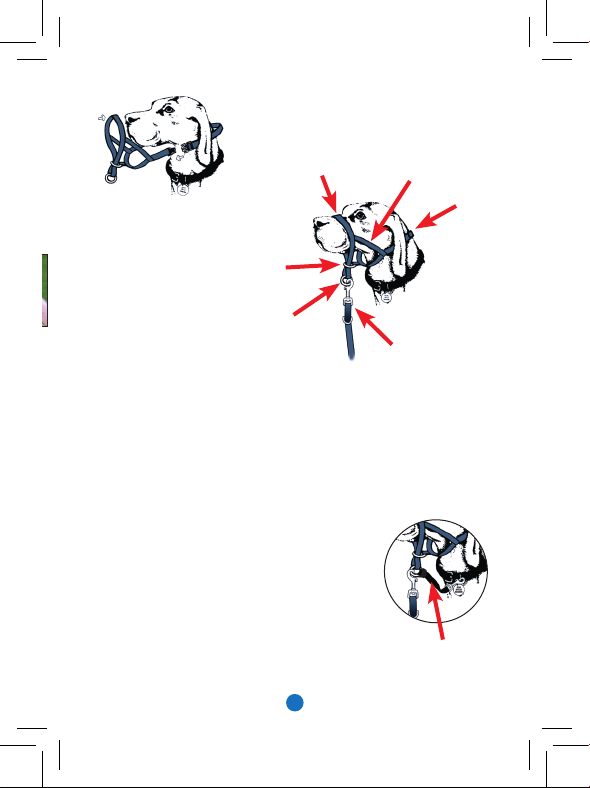
A recommended precaution is to link the
lead to the Halti and to a conventional
collar, ideally using a safety strap.
Alternatively, take a double-ended training
lead and attach one clip to the Halti lead
ring and the other to your dog’s regular
collar.
noseband
slip ring
lead ring
cheek piece
collar
usual lead
safety strap
Troubleshooting
At first, your dog may object to wearing the Halti. Here are some
hints on how to make the process more fun for your dog.
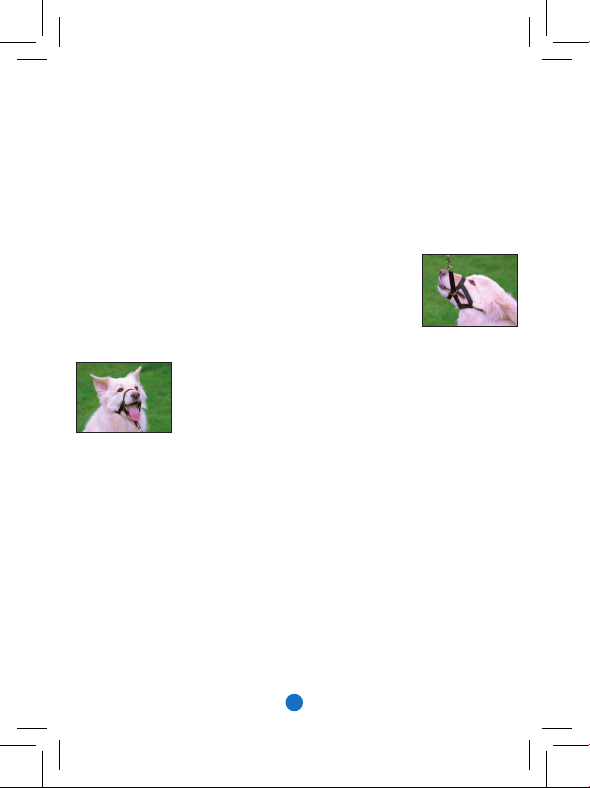
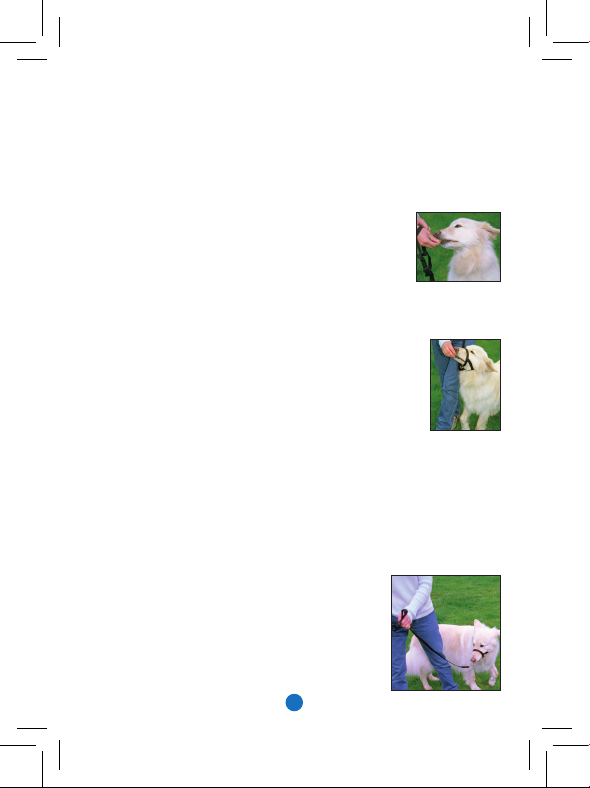
•Show him the Halti and allow him to sniff it and see that it is
nothing to be scared of.
•To fit the Halti, give the dog some titbits with
your hand through the body of the Halti.
•Slide the Halti over your hand onto his nose.
•Allow your dog to wear the Halti for a few
minutes distracting, him with treats or play.
•Attach the lead. If the dog attempts to drop his
head to paw at the Halti, hold a titbit to keep his
head in the air.
General principles of dog training
Walking To Heel
Attach a long lead to the Halti, if your dog begins to walk ahead
of you, transfer a gentle tug and this initiates a
heel response.
As your dog slows down, overtake him and
when your knees are passed his head; praise
him with “heel”. If your dog is pulling, step
to one side and turn him sideways, even
in a complete circle so he stays at the heel
position.
6

7
Sit
Hold a titbit in your right hand, then with the left hand gently lift
his head as you give the sit command. Repeat, always rewarding
your dog with titbits or praise.
Stay
Using a long lead, have your dog sit and then step back with
your right hand held flat towards your dog and say “Stay”. Then
step forward to reward him and repeat the exercise, gradually
increasing the distance between you and the dog.
Down
First, ask your dog to sit; then use a titbit or toy in front of
his forelegs to persuade him to adopt the down posture. If
necessary add a slight downward pressure on the Halti.
Come
Come training should be taught when you first acquire a puppy.
Have your puppy on a long lead and step backwards encouraging
him to follow with his name and the word come. Alternatively,
say come and gently pull your dog toward you to receive a titbit
reward. Repeat the exercise, gradually increasing the distance
between you and the dog.
If you have problems with your dog’s
behaviour,
seek help from your veterinary surgeon,
a local qualified trainer or behaviourist.
Vorwort
Der Halti wird weltweit als das effektivste Kopfhalfterdesign
anerkannt. Es folgt den Konturen des Hundegesichts auf
natürliche Weise und sitzt genügend weit von der Nase des
Hundes entfernt, um beste Führkontrolle zu gewährleisten - ideal
für das Grundtraining und alle anderen Aktivitäten mit Ihrem
Hund, vom gemütlichen Spaziergang bis hin zum Ausführen
eines widerspenstigen or möglicherweise gefährlichen Hundes in
der Gegenwart anderer Tiere oder Menschen.
Der besondere Vorteil des Halti gegenüber anderen
Kopfhalftern ist der einzigartige automatische
Maulschliesseffekt: Wenn Ihr Hund versucht,
vorwärts zu stürmen oder jemanden anzugreifen,
werden seine Kiefer durch den Schlupfring unter
dem Kinn geschlossen. Verhält er sich entspannt
und freundlich, kann er das Maul wieder öffnen.
Sobald sich der Hund gut benimmt, kann er frei
hecheln, seine Zunge heraushängen und sich eben
ganz wie ein Hund benehmen.
Anlegen des Halti
Halten Sie Ihr Halti am Nasengurt. Halti nimmt die Form eines
Hundekopfes an, wobei die beiden Ringe unterm Kinn hängen.
Der Nackengurt kann mit Hilfe der Schiebespange angepaßt
werden. Wenn die Schnalle fest verschlossen ist, sollte er genau
dem Hals Ihren Hundes angepasst sein. Zwei Finger Abstand ist
eine gute Richtlinie.
Wenn Sie das Halti angelegt haben, sehen Sie, wo der Nasen-
gurt zu sitzen kommt. Das sollte im unteren Nasenbereich und
mit genug Abstand von den Augen sein. Wenn Sie den Druck auf
den Nasengurt verringern, stellen Sie sicher, dass Ihr Hund sein
Maul ohne Beeinträchtigung voll öffnen kann.
8
9
Sicherheit geht vor
Bis sich Ihr Hund an sein Halti gewöhnt hat, besteht die Gefahr,
dass er sich den Nackengurt über den Kopf zieht. Stellen Sie
sicher, daß der Nackengurt eng genug ist. Sie sollten nicht mehr
als 2-3 Finger unter den Gurt schieben können.
Eine empfehlenswerte Vorbeugemassnahme
ist es, die Hundeleine sowohl im Halti wie
auch am normalen Halsband Ihres Hundes
einzuschnallen - am besten mit Hilfe eines
Sicherheitsriemens. Andernfalls können Sie
auch eine lange Trainingsleine mit Haken an
beiden Enden benutzen, indem Sie ein Ende
am Führring des Halti und das andere Ende
am normalen Hundehalsband befestigen.
Nasengurt
Schlupfring
Führring
Wangengurt
Nackengurt
Normale
Hundeleine
Sicherheitsriemen
Problemlösungen
Anfangs wird Ihr Hund möglicherweise den Halti ablehnen.
Hier sind einige Tips, wie Sie den Gewöhnungsvorgang mehr
spielerisch gestalten können:
• Zeigen Sie dem Hund den Halti und lassen Sie ihn schnüffeln
und sehen, daß er davor keine Angst haben muss.
• Um den Halti anzulegen, geben Sie ihm einen
Leckerbissen, mit Ihrer Hand durch den
Hauptteil des Halti gesteckt.
• Lassen Sie den Halti dann über Ihre Hand auf
die Hundenase gleiten.
• Lassen Sie Ihren Hund den Halti einige Minuten ohne Leine
tragen, während Sie ihn mit Leckerbissen und
Spielen ablenken.
• Befestigen Sie die Leine am Führring. Wenn der
Hund den Kopf senkt, um mit der Pfote am Halti
zu wetzen, halten Sie einen Leckerbissen in die
Höhe.
Allgemeine Grundsätze im
Hundetraining
„Bei Fuss“ gehen
Legen Sie eine lange Leine an. Wenn Ihr Hund anfängt, voraus zu
laufen, ziehen Sie leicht an der Leine, um die „Bei Fuss“-Reaktion
einzuleiten. Überholen Sie ihren Hund, sobald
er langsamer wird, und wenn Ihr Knie in
Kopfhöhe ist, loben Sie ihn mit „bei Fuss“.
Wenn Ihr Hund zieht, drehen Sie sich zur Seite
und führen Sie ihn seitwärts oder sogar in
einem kompletten Kreis, damit er in der „bei
Fuss“-Position bleibt.
10
Table of contents
Languages:
Other Company of Animals Pet Care Product manuals