right angle. If the target seems to have disappeared or split into two targets, then most likely the object
is of a hard metal structure and coin or ring. Soft metals, such as coins, rings and jewelry, will equal
responses, regardless of the angle of approach.
It is difficult to distinguish between tin foil, pull tabs, bottle caps and coins. The above mentioned
simple test most generally applies to an elongated-shaped object such as a nail, bobby pin, knife blade,
etc.. Any bottle cap, however, if not too deep, will cause a slight null-out or drop in signal just prior to
increased signal in the area of the forward top of the loop. A little practice with this procedure could
possibly save digging. For the purpose of practice, it is recommended that a few of these various
scraps be gathered together and buried approximately one inch in the ground, but apart from each other,
and the operator scan these objects and try to familiarize himself with the variations of tone and signal
response.
F. PROBING
l. SMALL OBJECTS
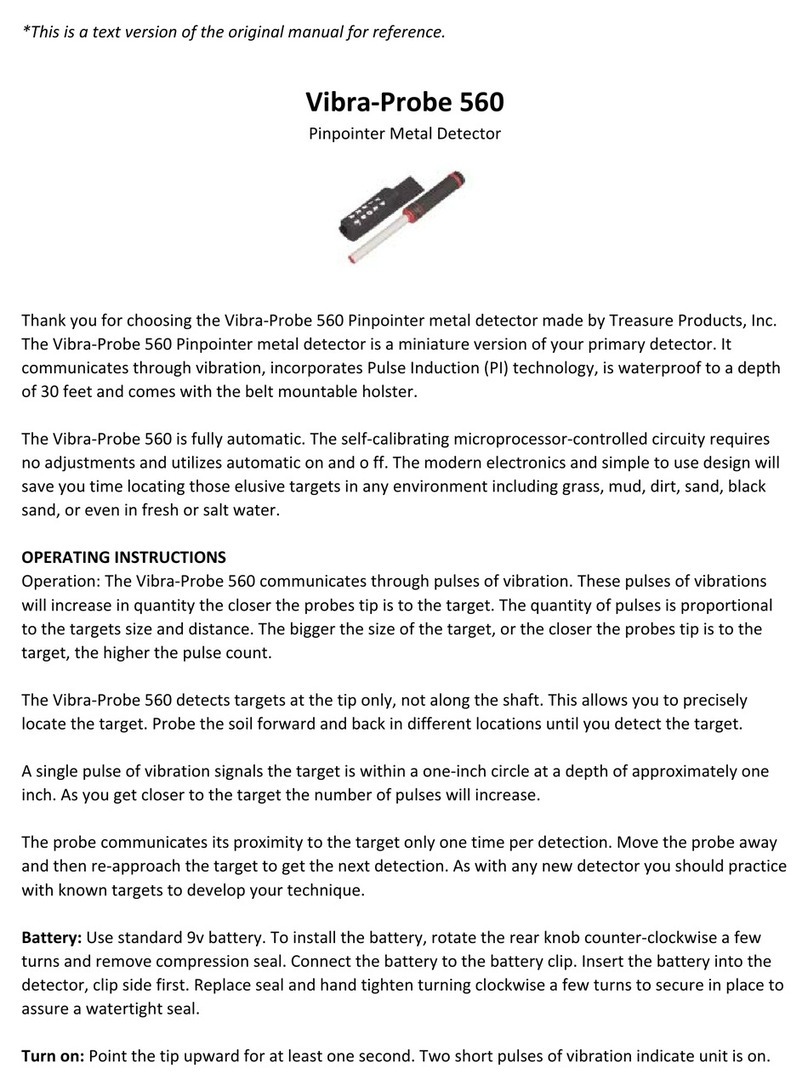
Your probe tool can be a blunted ice pick, long shanked screwdriver, leather awl, or any other long-
bladed object that can be pushed into ground easily. Probing is very important because if you do not
probe to recover the target properly, a very ugly scar on a coin or hole in the ground will be the result.
This does not promote good relations for for treasure hunting with city officials. After having centered
your target with your free hand, just point to the center of the loop. Slide the to the side and lay the
instrument down. Your finger should be pointing the exact spot where the target is (later you will be
able to fix you on this spot). Now, probe straight down gently until your probe comes in contact with
the target. Once you have made contact, remove the probe. Come back under the target with your probe
blade at a 45 degree angle and very carefully pry upward to break the sod and loosen the object. A little
more loosening and your probe blade should pop the object to the surface (do not cut plugs). Replace
the dirt and sod in its original position, then step on it lightly with your foot. The point here is to
recover the coin or object and leave the site as it actually was before you started probing. You will
never see where a good coinhunter has been working. Even though his pockets are bulging.
2. LARGE OBJECTS
In non-public areas or out in the hills, a small garden trowel or spade can be used. The same rule of
filling holes and removing trash applies.
3. WORKING IN WATER
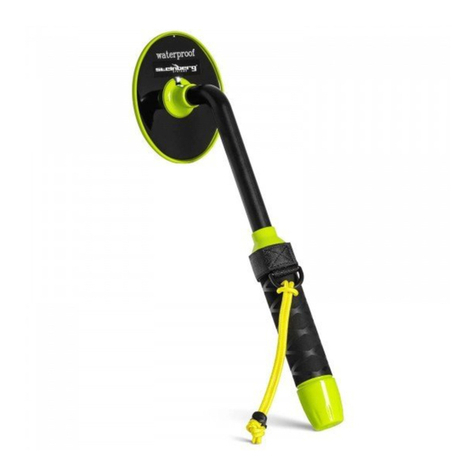
All of COMPASS loops are waterproofed at the time of manufacture and will operate in fresh and salt
water alike. When working in shallow streams, rivers or surfs, the operator must remember that the
relation of the loop to the bottom is the same as the loop to ground, when working on land. In other
words, the closer the loop is to the bottom when tuning, the more depth that can be obtained. Care must
be taken not to submerge the loop rod too deep in the water, for the electronic housing and cable plug
system is not waterproofed. Most underwater detection work is in less than 18" of water. Tuning the
instrument in water is identical to tuning on land; but due to the difference in temperature, the loop
must be placed in the water with the instrument turned OFF and allowed to remain for approximately
two minutes for the loop temperature to equalize with the water temperature. After this short duration,
the instrument can be turned on and tuned in the normal procedure.