4
GENERAL INSTALLATION AND OPERATION
All gas distribution piping systems must meet the appropriate industrial standards for the intended service and
must be thoroughly cleaned before using. For the United States, some applicable safety rules and precautions
are listed below:
1. American National Standards Institute standard Z49.1, Safety in Welding and Cutting, American
Welding Society, 2501 NW Seventh Street, Miami, Florida 33125
2. N.F.P.A. Standard 51, Oxygen-Fuel Gas systems for Welding and Cutting, N.F.P.A., 470 Atlantic Av-
enue, Boston, Massachusetts 02210
3. N.F.P.A. Standard 51B, Cutting and Welding Processes (same address as #2).
4. CONCOA publication ADE 872, Safety Precautions in Welding and Cutting.
5. Local Ordinances
6. O.S.H.A. Standard 29 CFR
7. C.G.A. Pamphlet C-4, American National Standard Method of Marking Portable Compressed Gas
Containers to Identify the Material Contained.
8. C.G.A. Pamphlet G-4, Oxygen – Information on the properties, manufacture, transportation, storage,
handling, and use of oxygen.
9. C.G.A. Pamphlet G-4.1, Equipment Cleaned for oxygen service.
10. C.G.A. Pamphlet G-4.4, Industrial Practices for Gaseous Oxygen Transmission and Distribution Pip-
ing Systems.
11. C.G.A. Pamphlet G-5, Hydrogen – Information on the properties, manufacture, transportation, stor-
age, handling, and use of hydrogen.
12. C.G.A. Pamphlet G-6, Carbon Dioxide – Information on the properties, manufacture, transportation,
storage, handling, and use of carbon dioxide.
13. C.G.A. Pamphlet G-6.1, Standard for Low Pressure Carbon Dioxide Systems at Consumer Sites.
14. C.G.A. Pamphlet P-1, Safe Handling of Compressed Gases in Containers.
15. C.G.A. Safety Bulletin SB-2, Oxygen Deficient Atmospheres.
*C.G.A. pamphlets can be obtained from the Compressed Gas Association, 1235 Jefferson Davis Highway,
Arlington, VA 22202-3239, (703) 979-0900. Publications: (703) 979-4341. Fax: (703) 979-0134.
Keep all cylinders and manifolds away from any source of high temperature over 120°F (50°C) or possible fire
hazards. High-pressure gas contained in a closed cylinder becomes increasingly dangerous when exposed to
high temperature because pressure increases and the strength of the cylinder decreases. Manifolds installed in
open locations should be protected from weather conditions. During winter, protect the manifold from ice and
snow. In summer, shade the manifold and cylinders from continuous exposure to direct sunlight. Always leave
access to the manifold for cylinder replacement.
INSTALLING INLET AND OUTLET CONNECTIONS:
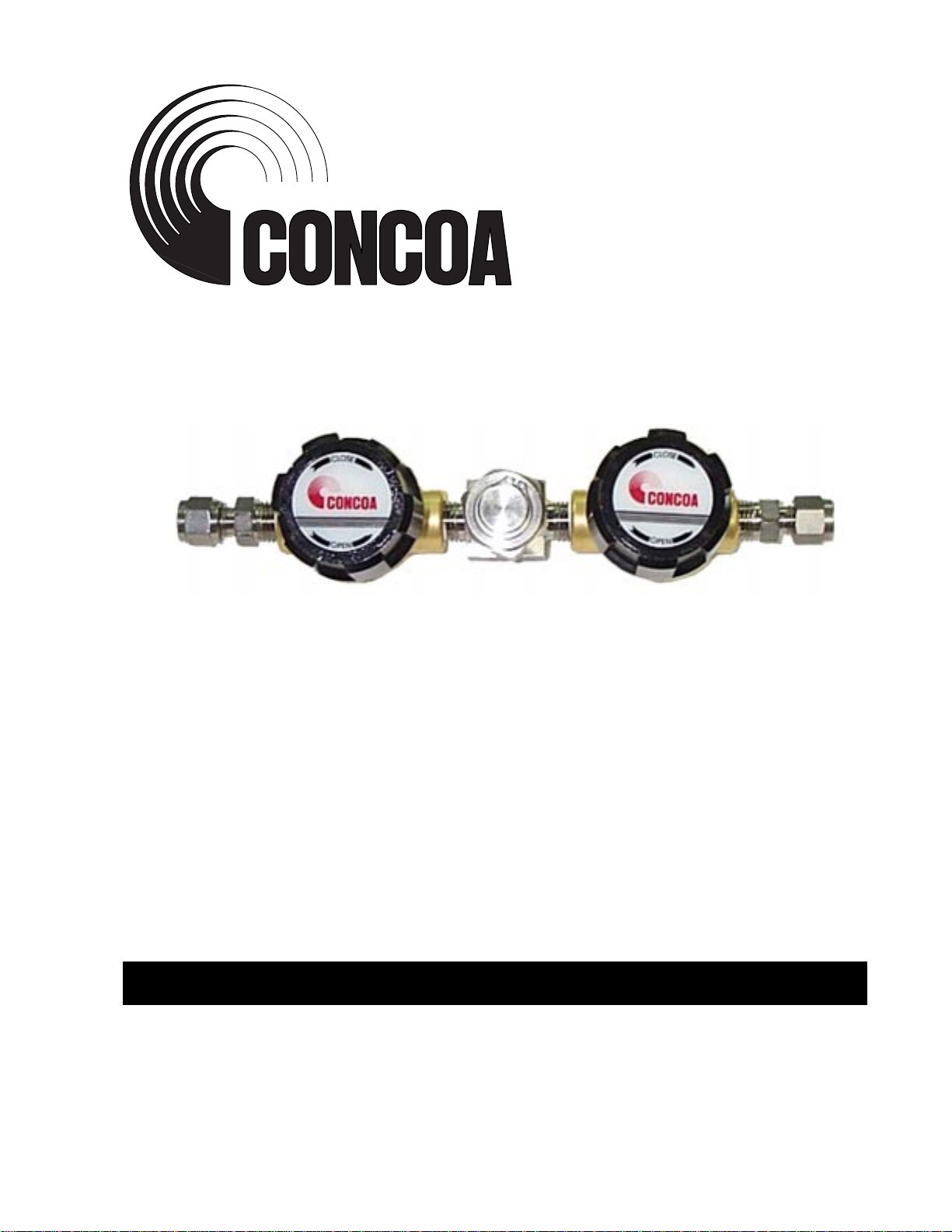
The filter assembly connects upstream of user equipment by ¼ Swagelock tube fittings in and out. The flow
arrow located on the filter body indicates the correct direction of the flow of gas. Assemble tube fittings in
accordance with Swagelock instructuions found on page 7 of this instruction manual.
CONCOA uses Teflon tape on all of its regulator NPT connections. Follow these rules when using Teflon tape.
Inspect the NPT threads and if necessary, clean the fitting to remove any dirt or thread sealant that remains on
the threads. Start the Teflon tape on the second thread as shown in Figure 1; make sure the tape does not overlap
the end of the fitting. As the tape is wrapped in the direction of the thread spiral, pull tightly on the end of tape
LOCATION