Page 6
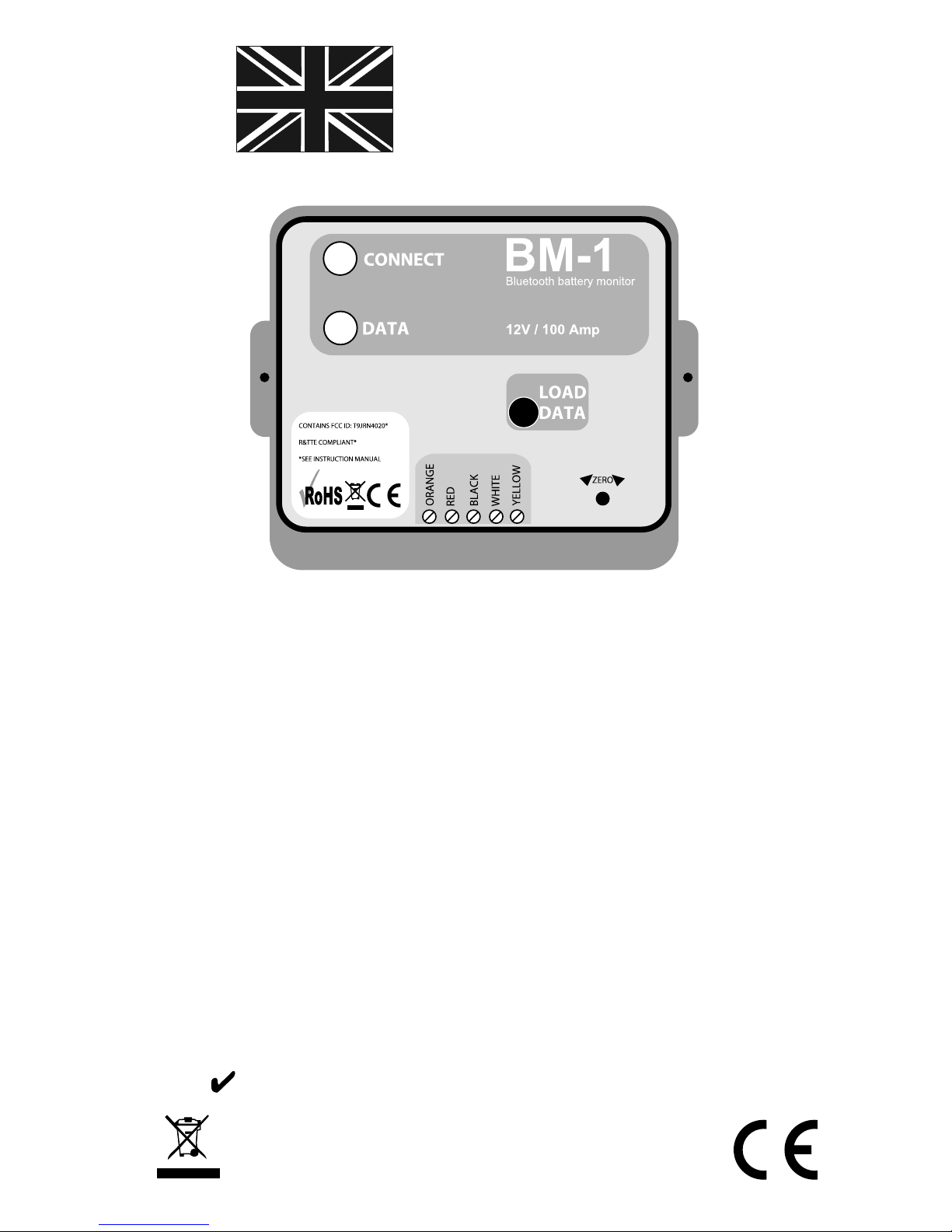
The zero current has been set in the factory and should not require
subsequent adjustment. However if a small residual current is
detected which cannot be attributed to a clock, sensor or standby
LED etc. the zero set can be adjusted. Turn sightly clockwise for a
small residual discharge current or anti-clockwise for a residual
charge current. The control has a limited range of just a few hundred
mA.
BATTERY MANAGEMENT BASICS
After Voltage and Current, the most useful measurement available
from a battery condition monitor is the sate of charge of the battery.
However, estimation of the state of charge of lead-acid batteries is
never exact. The problem of making accurate estimates results from
the characteristics of the cells, the electrolyte, and the history of
currents drawn from (discharge) and supplied to (charge) the battery.
The basis for the best capacity estimates is that the starting condition
is known. The only well-established "known" state of a battery is when
it is fully charged after a long period of trickle or float charging,
usually on a shore or regulated alternator-driven charging system.
Discharging a fully charged new battery at a current 1/20 of the
manufacturer's stated capacity will discharge it fully in 20 hours. This
current is known as the "20-hour rate".
So, for example, if a battery has a stated capacity of 100 Ahr, then the
20- hour rate for that battery is 5 Amps (because 100/20 = 5).
Likewise, a 40 Ahr battery would have a 20-hour rate of 2 Amps
(because 40/20 = 2). If higher currents than the 20-hour rate are
drawn from the battery, the available capacity is reduced. For
example, if it is steadily discharged at 10 times the 20-hour rate (50
Amps from a 100 Ahr battery), the available capacity falls to about half
of the stated capacity. The battery will be flat after about 1 hour
instead of the expected 2 hours. (However, if the battery
is left to recover with the heavy load removed, most of its remaining
capacity will return after perhaps 20 hours' resting or at a discharge
rate close to the 20-hour rate.) The BM1 makes due allowance for
these effects when estimating the battery's state of charge and the
expected time to discharge the battery fully.