- 2 -
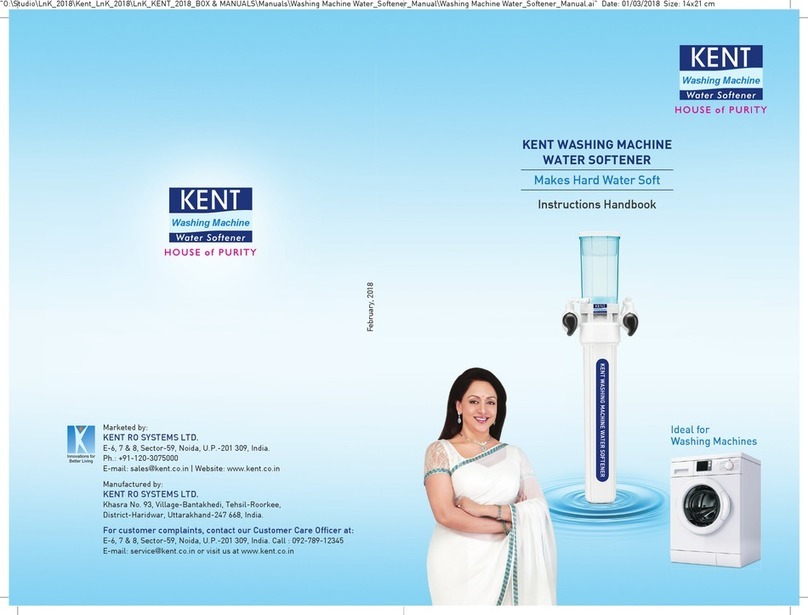
Thank you for purchasing this Softener. We are sure that it will provide you with
trouble free service for many years to come.
Please use the following p
ages to assist you
in the installation and set up of your new Softener.
Planning Your Installation
.
Please
observe the regulations concerning the installation of your water softener. For
guidance check out the water regulations advisory service web site (
www.wras.co.uk) Check
that
you only have one rising main, that you have allowed space for access to the unit for
possible future maintenance and salt replenishment. Check the water pressure; locate the
rising main (stop cock) a drain facility and a power s
upply.
Unless you are replacing an existing water softener, this installation will require you to carry
out plumbing work and may require an electrical outlet to be fitted near the softener. You
should only attempt this if you have the necessary ski
l
ls.
P
ositioning the Softener
.
Where possible the softener should be placed close to the rising main. Take care to allow hard
water take off points for a drinking water facility and /or an outside tap. The distance between
the drain and the Softener should be as
short as possible
. Ensure that both the drain and
overflow will not freeze or reach a temperature above
40°C
. If putting the Softener within a
cupboard ensure that the base is adequately supported. If the Softener is being installed within
your loft etc i
t is recommended to house the Softener within a tank capable of storing at least
100 Litres
with an overflow fitted. The overflow on the tank should be below the Softener
overflow and be a minimum of ¾” in size.
A single Check Valve
.
A
suitable ch
eck val
ve should be fitted. This will usually
be in the installation kit that can be
ordered separately.
Check List
.
Before you start the installation make sure that you
have all the necessary fittings. The purchase of one
of our standard installation kits will
normally ensure
that you have everything that you need for a typical
installation
Water Pressure Test
.
It is important that a pressure test is carried out.
High
and
low
water pressure can result in either damage to
or failure of the Softener. Although the
Softener is
tested to a pressure of 8 bar
(120psi)
, we recommend
the fitting
of a pressure limiter should your pressure
exceed 5 bar (70 psi)
.
The minimum working
pressure is 1.4 bar (20 psi)
Before starting
the
installation of the valves ensure that the
s
top
cock is in the closed
position.