Cornell Plexi 45 User manual

© 1995-2007 CORNELL Musical Equipment Design & Development 1
Plexi 45/50
Owner’s Manual
DC Developments
Musical Equipment Design & Development
Unit 13 Rosshill Industrial Park, Southend-on-sea, Essex SS2 5PZ England
Tel/Fax +44 (0)1702 610964
www.dc-developments.com

© 1995-2007 CORNELL Musical Equipment Design & Development 2
CONTENTS
Introduction 3
The Cornell Plexi Sound 3
Construction and Design 4
The Pre-amplifier
The Output Stage
Controls 5
Specifications 6
Valve Replacement 7
Please read all instructions before operating the amp!
WARNING
To prevent damage, fire or shock hazard, do not expose this unit to rain or
moisture.
No user serviceable parts inside. Refer servicing to qualified personnel only.
This unit must be earthed. Use the correct mains cord.
If you require any further information regarding the Plexi 45/50 amplifier, or any
other CORNELL products, please do not hesitate in contacting us
(details on front page).

© 1995-2007 CORNELL Musical Equipment Design & Development 3
Introduction
Thank you for choosing a Cornell Plexi 45/50 amplifier.
Your amplifier employs valve technology, and is hand built to the highest standards. Only
top quality components are used in our amplifiers, so that you can enjoy years of trouble-
free use.
Please take time to read this manual, to ensure that you get the best from your Plexi
45/50 amplifier.
Most guitarists of today will know some amplifier history, and the name ‘Plexi’ must be
one of the best known. Plexi is a nickname for an amplifier produced between 1963 and
1969, and consisted of a range of three amplifiers of 20, 50 and 100 Watts. These
amplifiers remain a legend, which is reflected in their secondhand value.
The Cornell Plexi amplifiers are not one-hundred-percent copies of the old 1960s models
- they are more like one-hundred-and-ten-percent copies !
Research has shown us that not all amplifiers made at this time were the same. Minor
changes - not just in a visual sense, but also in the basic circuit design - appear between
batches made at the factory. We have taken the basic design to its finest point, tailoring
the components and adjusting the circuit to produce the ultimate Plexi sound.
The Cornell Plexi amplifier is not just a good-looking reproduction antique to be admired;
it reproduces that classic sound and can be gigged and gigged, and gigged.
Cornell Plexi Sound
The Cornell Plexi amplifier has a great tone that is instantly recognised, and often
emulated. Some boffins will tell you that its tone is due to its simplicity of design, and this
is the result of having a minimum number of components in the signal path.
Amplifiers of today offer a wide range of tones and sounds, resulting in a mass of controls
that can confuse even the most enthusiastic fiddler. The result of this complexity is that
most modern amplifiers sound the same, with a noticeable loss of natural tone - tone that
can only be reproduced by simple design and point-to-point wiring.

© 1995-2007 CORNELL Musical Equipment Design & Development 4
Construction and Design
Virtually all modern amplifiers are built using printed circuit boards, which helps to speed up
production and keep down costs. There is, however, one major drawback with printed
circuits - conductor tracks that connect components together often run very close to one
another, creating a small capacitance. The result of this in a guitar amplifier is a substantial
loss in both high frequency response and harmonic richness.
Cornell amplifiers are designed to avoid this by having point-to-point wiring throughout.
Components are mounted onto a specially designed component board which is then
sealed, using a conformal coating to prevent noise and the reduction of component life
caused by moisture penetration.
The hand wiring, carried out by our highly-trained staff, takes time but ensures that each of
our amplifiers performs to the highest standards of reliability and sound.
The stainless steel chassis holds our specially-designed transformers, and chassis-
mounted (rather than circuit-board mounted) valves (tubes).
Such attention to detail ensures a very close reproduction of the full harmonic spectrum of
your guitar’s pickups, resulting in a pure, natural sound that will turn heads at any venue
and/or that records superbly.
The Pre-amplifier
The Plexi 45/50 is designed to be simple in use, and yet produce the quality of sounds that
the musician of today expects from a professional amplifier.
There are two independent channels, each having its own volume control which controls
the overall loudness of the amplifier. The tone controls are designed to work over the
entire frequency range of your guitar, allowing increased amounts of low and high
frequency adjustment.
Channel two has a brighter tone of that of channel one.
The Output Stage
The Plexi 45/50 is a Class ‘AB’ output design and is achieved by means of a negative
voltage applied to the grid of the output valves,
Cathode bias resistors are also employed to stabilise current flow throughout the lifetime of
the valve. The voltage across each resistor will vary with the valve characteristics. When
these voltages are equal, then each valve is drawing the same amount of current and the
valve set is ‘matched’, resulting in maximum output and long life.

© 1995-2007 CORNELL Musical Equipment Design & Development 5
Controls
1. Input - Hi & Lo
High impedance input connections for instruments
Input Hi provides 6db more gain than the Lo input.
2. Treble Volume
Adjusts the gain of Channel 2.
3. Normal Volume
Adjusts the gain of Channel 1.
4. Bass
Adjusts the amount of low frequency boost.
5. Treble
Adjusts the amount of high frequency.
6. Middle
Adjusts the amount of mid frequency boost.
7. Presence
Adjusts the high frequency feedback from the output stage.
8. Mains Indicator
When illuminated, this indicates that the valve heaters are on, and that there is
power to the amplifier.
9. Standby Switch
When operated, this cuts the HT voltage to the amplifier. Use standby mode for
breaks in usage (eg, between performance sets)
10. 45/50 Switch
This changes the rectifier from valve (45) to semiconductor (50). The valve
rectifier gives a bluesy ‘sag’ in output, while the semiconductor rectifier has a
faster response and less sag, improving transient attack.
11. High/Low Switch
Reduces the output to 15 Watts.
12. 8-16 Switch
Output speaker impedance.
If you have a Cornell 2 x 12 speaker cabinet, set this switch to 16 Ohms.
Should you use two 16 Ohm cabinets, switch to 8 ohms.
13. Mains Fuse
The fuse holder contains the mains fuse to the amplifier. The mains fuse
protects the amplifier from electrical faults.
Replace a failed fuse only with the same type and rating.
Do not operate the mains switch without a 30 second delay between
operations. There is an internal thermistor to reduce mains surges. This
protects the amp and helps to ensure a long life for the components. The
thermistor works by introducing a resistance in the circuit when the power is
switched on. Within a few seconds the thermistor heats up and its resistance
reduces, allowing the full current to flow into the mains transformer. After
switching off the amp, it takes a few seconds for the thermistor to cool down
and to return to its initial, protective resistance value.

© 1995-2007 CORNELL Musical Equipment Design & Development 6
Specifications
POWER .............................................. 115 Volts AC, 60Hz, 120 Watts (US model)
230 Volts AC, 50Hz, 120 Watts (GB model)
FUSE .................................................. T2 Amp for the 115 Volt US Model
T1Amp for the 230Volt GB Model
HT 500 mA
INPUT IMPEDANCE ......................... Input Hi 2.2 MegOhm
Input Lo 94 kOhm
CONTROLS ....................................... Normal Channel Volume, Treble Channel Volume,
Bass, Middle,Treble. Presence,
OUTPUT ............................................ 45/50 Watts rms, Class ‘AB’
CABINET ........................................... Plywood (Head)
Pine and Plywood speaker cabinet
DIMENSIONS (Head) ........................ Height: 9in (230mm)
Width: 26in (660mm)
Depth: 9 in (230mm)
WEIGHT (Head) ................................ 37.5 lbs (17Kgs)
OPTIONS (on request) …………...... Colours, Speaker Cabinet.

© 1995-2007 CORNELL Musical Equipment Design & Development 7
Valve Replacement
Valve life varies depending upon playing style and application. Power valves have a
much shorter life than pre-amp valves, which can last for years.
To maintain the optimum performance of your amplifier, the valves should only be
replaced with the same valve types, as specified in the illustration below.
When changing valves, ALWAYS unplug the amplifier, and remember that the
VALVES ARE HOT ! Wait for the valves to cool, or replace valves when the amplifier
has not been used for several hours.
Your Plexi 45/50 amplifier has 6 valves: three pre-amp valves (12AX7/ECC83), two
power valves (EL34), and a rectifier valve (GZ34).
Valve Line-up
Mains
Transformer Output
Transformer
EL34 EL34 ECC83 ECC83
Front panel
GZ 34
ECC83
This manual suits for next models
1
Table of contents
Other Cornell Amplifier manuals
Cornell
Cornell Plexi 7 User manual
Cornell
Cornell LegACy 30 Setup guide

Cornell
Cornell Plexi Seven User manual
Cornell
Cornell Plexi 18 User manual

Cornell
Cornell Vintage Brown 10 User manual
Cornell
Cornell Custom 80 User manual

Cornell
Cornell Rambler 15 User manual
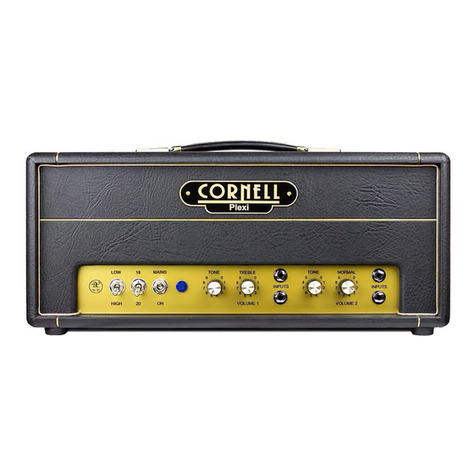
Cornell
Cornell Plexi 18/20 User manual

Cornell
Cornell Romany User manual